

Shopping Cart
Remove All Your shopping cart is currently empty
TargetMol Star Molecule—Adenosine (Cat. No. T0853, CAS 58-61-7), Balancing Cell Survival Through Autophagy and Apoptotic Signaling
Background
Adenosine (T0853) is a pivotal endogenous nucleoside composed of adenine linked to ribose, functioning as a critical regulator within multiple cellular pathways including apoptosis, autophagy, and nucleoside metabolism. Its mechanism of action primarily involves binding to specific adenosine receptors, which are G protein-coupled receptors distributed widely across tissues, thereby modulating intracellular signaling cascades that influence cell survival, energy homeostasis, and inflammatory responses. In the context of apoptosis and autophagy, Adenosine acts as a signaling molecule that can either promote or inhibit these processes depending on cellular context and receptor subtype engagement. For instance, activation of A1 and A3 adenosine receptors has been shown to induce autophagic flux, facilitating the degradation of damaged organelles and proteins, which is essential for maintaining cellular homeostasis under stress conditions. Conversely, Adenosine’s interaction with A2A and A2B receptors often results in anti-apoptotic effects by elevating intracellular cyclic AMP levels, thereby modulating downstream effectors such as protein kinase A and influencing gene expression related to cell survival pathways.
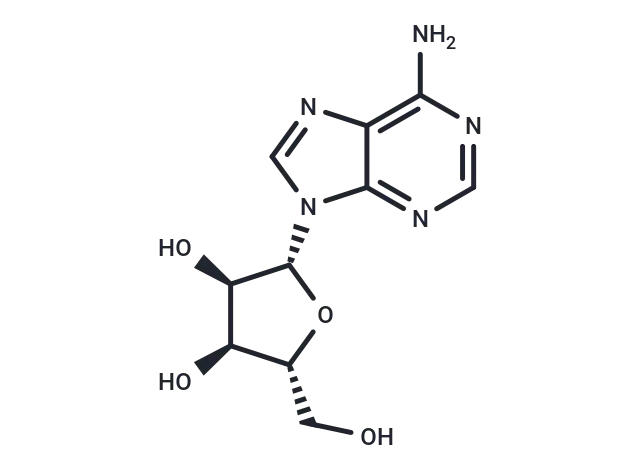
Molecular Structure of Adenosine
Biologically, Adenosine’s vasodilatory properties arise from its ability to relax vascular smooth muscle via receptor-mediated signaling, which also underpins its antiarrhythmic and analgesic effects. These physiological roles are intricately linked to its capacity to regulate nucleoside metabolism and energy balance, as Adenosine is a key metabolite in ATP turnover and purinergic signaling. In research contexts, Adenosine is extensively utilized as a tool to dissect purinergic signaling pathways, investigate mechanisms of programmed cell death, and explore autophagy regulation under various physiological and pathological conditions. Its role as a nucleoside antimetabolite analog also makes it valuable for studying nucleotide metabolism and the cellular response to metabolic stress.
The dynamic modulation of apoptosis and autophagy pathways by Adenosine involves a complex interplay between receptor activation, second messenger systems, and downstream effectors that collectively determine cell fate decisions. This multifaceted regulation underscores Adenosine’s importance as a signaling hub that integrates metabolic cues with cellular stress responses. Consequently, Adenosine (T0853) serves as a versatile biochemical probe in experimental models aimed at elucidating the molecular underpinnings of cell death and survival, as well as in the development of novel strategies to manipulate these pathways for research purposes.
Reference
[1] 1. Fredholm BB, IJzerman AP, Jacobson KA, Klotz KN, Linden J. International Union of Pharmacology. XXV. Nomenclature and classification of adenosine receptors. Pharmacol Rev. 2001;53(4):527-552.
[2] 2. Chen JF, Eltzschig HK, Fredholm BB. Adenosine receptors as drug targets—what are the challenges? Nat Rev Drug Discov. 2013;12(4):265-286.
An essential round-up of science news, opinion and analysis, delivered to your inbox every weekday.
 Feedback
 Hello! How can I help you today?
Copyright © 2015-2026 TargetMol Chemicals Inc. All Rights Reserved.