













Shopping Cart
Remove All Your shopping cart is currently empty

We would love to know what you think, so we have included a feedback tab on every page.

















Fragment-based drug design (FBDD) is theoretically grounded in selecting advantageous fragments for combination or extension to generate novel drug molecules with high activity. Compared to HTS, thousands of fragments can be combined into millions of drug structures, making them easier to collect and manage. Additionally, fragments feature lower molecular weight, higher solubility, and easier structural optimization, resulting in greater drug-like potential.
For complex targets such as protein-protein interactions (PPIs), binding pockets are often flat and difficult for compounds to bind; while HTS is largely ineffective here, FBDD can identify small fragments with weak binding affinity and optimize them into potent drug candidates. This approach has led to several small-molecule drugs, with 30+ in clinical trials and multiple approved drugs: Vemurafenib, Venetoclax, Erdafitinib, Pexidartinib, Ivosidenib, Enasidenib, Baricitinib, Fedratinib, Sotorasib, and Adagrasib. Given its success, FBDD is increasingly favored by drug discovery experts.

480,000 fragments provide rich chemical diversity across various scaffolds and functional groups, expanding chemical space coverage and the likelihood of discovering novel bioactive compounds.

Most of the 480,000 fragments are ready for immediate shipment, shortening research cycles. Flexible specifications and packaging options meet diverse scales and budgets.
Fragment screening typically offers higher hit rates as fragments bind more easily to targets, reducing the number of compounds needed and saving time and cost.

The simple structures of fragments facilitate SAR analysis. They serve as modular templates for designing complex, multifunctional compounds, enhancing flexibility and success in drug design.
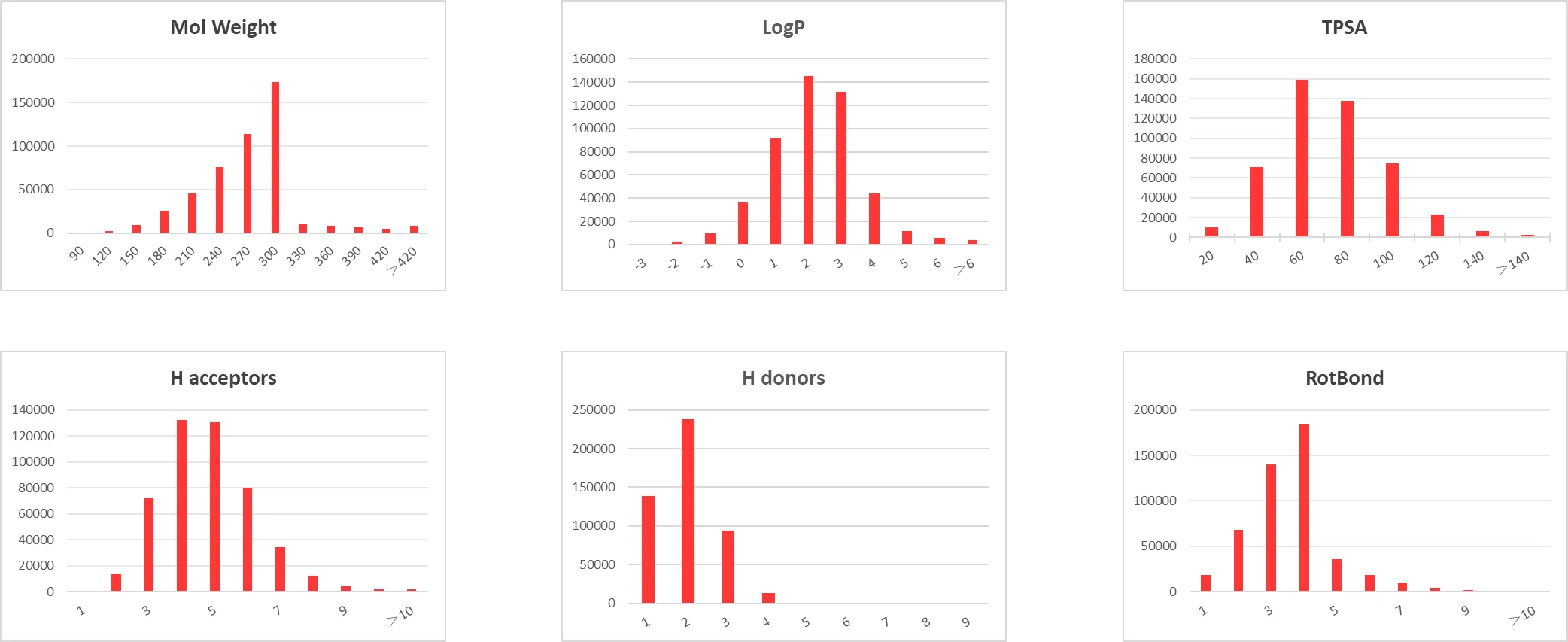
A high-quality fragment library is a prerequisite for the success of FBDD. Generally, a fragment library must consider the Rule of Three (Ro3)—mw<300,HBA<3,HBD<3,Rotablebond<3,cLogP<3—alongside 3D structural diversity and solubility. Furthermore, researchers may specifically require fragments containing certain groups, such as fluorinated or brominated fragments. The Fragment Compound Database contains information on 480,000 fragments, covering structural categories such as linkers, spirocycles, and covalent fragments. Featuring excellent structural diversity and novelty, most of these entries are available as physical products to further empower fragment-based drug discovery.
Through the AnyMol online portal, you can perform comprehensive searches across all compound databases to rapidly locate the products you need. Key details, including inventory status, pricing, and lead times, are clearly listed on the website. In addition to chemical structure searches, the platform supports bulk inventory queries, facilitating the seamless assembly of customized small-to-medium-sized compound libraries tailored to your specific requirements.
AnyMol Feedback
 Hello! How can I help you today?
Copyright © 2015-2026 TargetMol Chemicals Inc. All Rights Reserved.