
Shopping Cart
Remove All
  • TargetMol
    Your shopping cart is currently empty
TargetMol | Molecular Docking

Molecular Binding & Interaction Assay

SPR, BLI & biophysical assays integrated.Binding dynamics decoded.

Inquiry
Advantages of Molecular Binding & Interaction Assay
TargetMol | Copyrighted software
Rich practical experience
Multiple technologies provide different verification methods
TargetMol | Comprehensive Analysis
One-stop service
One-stop preparation for protein and small molecule sample testing
TargetMol | Visualized Binding Modes
Gold standard
Molecular interaction analysis gold standard Biacore to carry out high-throughput drug screening experiments
TargetMol | Experienced Team
Expert-led Team
An experienced interaction analysis team, computer simulation docking-assisted validation

Molecular Binding & Interaction Assay

Provided by TargetMol

For a candidate drug, target binding is a prerequisite for its biological function.
Biacore assays, developed based on SPR (Surface Plasmon Resonance) technology, enable highly sensitive, real-time monitoring of binding and interactions between two molecules, and are compatible with high-throughput screening. As an advanced biosensor-based analytical technique, SPR is applied throughout every stage of drug discovery and development, including target identification, compound screening, proteomics, immunogenicity assessment, biologic drug development and manufacturing, as well as broader life science research.


TargetMol offers a wide range of in vitro services for evaluating binding interactions between small-molecule drugs and target proteins, including:

SPR (Surface Plasmon Resonance)/MST (Microscale Thermophoresis)/BLI (Bio-Layer Interferometry)/ITC (Isothermal Titration Calorimetry)/DSF (Differential Scanning Fluorimetry)
TargetMol | HIT CANNDIDATES Faster and Lighter Drug Discovery
Surface Plasmon Resonance (SPR)
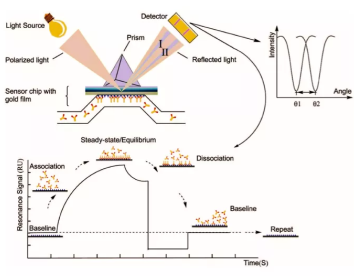
SPR is an optical phenomenon that can be induced by photons or electrons. When light passes from an optically dense medium into a less dense medium and undergoes total internal reflection, an evanescent wave is generated that penetrates into the less dense medium. The incident angle that induces surface plasmon resonance is referred to as the SPR angle.

The SPR phenomenon is closely related to the refractive index at the metal surface. When an analyte binds to the surface of the sensor chip, it causes a change in the local refractive index, leading to a shift in the SPR angle. SPR biosensors detect these changes in the SPR angle to enable real-time monitoring of molecular interactions.

In an SPR experiment, one biomolecule is first immobilized on the sensor chip surface, while its interacting partner is dissolved in solution and flowed across the surface. The detector continuously tracks the entire process of association and dissociation between the solution-phase molecules and the immobilized molecules on the chip surface.
Microscale Thermophoresis (MST)
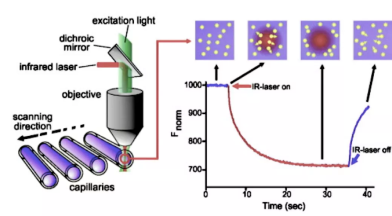
MST is a technique used to analyze biomolecular interactions. It is based on the thermophoretic movement of biomolecules. Nanotemper MST instruments use an infrared laser to locally heat the sample, inducing directed molecular movement, which is then analyzed by monitoring changes in fluorescence distribution within the temperature gradient.
MST can detect binding-induced changes in biomolecular properties such as size, charge, and hydration shell. By recording fluorescence changes within the infrared laser–heated region before laser activation, during heating, and after cooling, the MST instrument enables interaction analysis within a short measurement time.
Biolayer Interferometry (BLI)
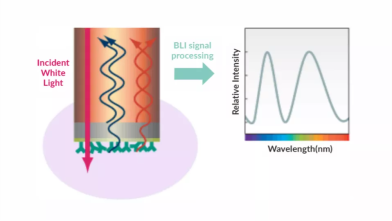
BLI is a technique that detects interactions occurring on the sensor surface by measuring shifts in interference spectra. When a beam of visible light emitted from a spectrometer reaches the optical layers at the tip of the sensor, reflections from two interfaces generate two reflected spectra that interfere to form an interference pattern.

Any changes in film thickness or density resulting from molecular association or dissociation on the sensor surface cause a measurable shift in the interference spectrum. This shift is recorded in real time to generate binding kinetics profiles.

In a BLI experiment, one molecule is immobilized on the surface of a dip-and-read biosensor, while its binding partner is monitored in solution. Molecular binding leads to an interference wavelength shift, and real-time monitoring of this shift provides the binding curves. BLI is a label-free, real-time, quantitative technique with accurate, objective, and reliable results.