


























Shopping Cart
Remove All Your shopping cart is currently empty
TargetMol Star Molecule—Rosiglitazone (Cat. No. , CAS 122320-73-4), A PPARγ Agonist Connecting Metabolic Regulation, TRP Channel Signaling, and Ferroptosis
Background
Rosiglitazone (T0334) is a multifaceted biochemical compound primarily recognized as a potent agonist of peroxisome proliferator-activated receptor gamma (PPARγ), a nuclear receptor that plays a critical role in regulating glucose and lipid metabolism. Beyond its canonical role in modulating PPARγ, Rosiglitazone also exhibits activity as an activator of transient receptor potential canonical 5 (TRPC5) channels and an inhibitor of transient receptor potential melastatin 3 (TRPM3) channels, positioning it as a unique modulator within the TRP channel family. These interactions place Rosiglitazone at the intersection of several key cellular pathways, including autophagy, apoptosis, and ferroptosis, which are essential for maintaining cellular homeostasis and responding to metabolic stress.
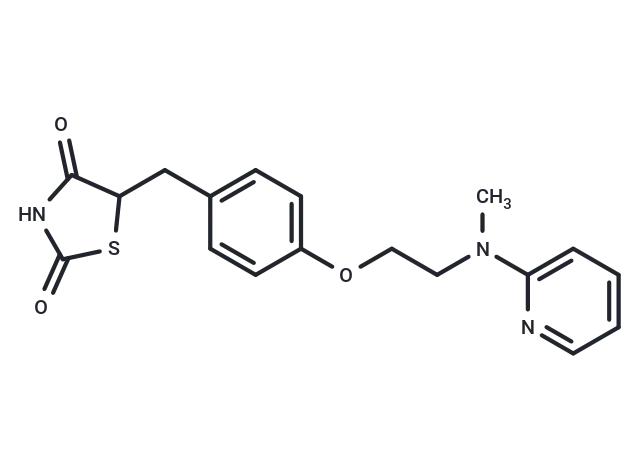
Molecular Structure of Rosiglitazone
The activation of PPARγ by Rosiglitazone initiates transcriptional programs that enhance insulin sensitivity and regulate lipid storage, which has made it a valuable tool in research exploring metabolic disorders and insulin resistance. Concurrently, its modulation of TRPC5 and TRPM3 channels influences calcium influx and downstream signaling cascades, thereby impacting cellular processes such as autophagy and programmed cell death. Specifically, TRPC5 activation by Rosiglitazone can promote autophagic flux, a process critical for the degradation and recycling of cellular components, while TRPM3 inhibition may attenuate calcium-dependent apoptotic pathways. Furthermore, Rosiglitazone’s involvement in ferroptosis, a form of regulated cell death characterized by iron-dependent lipid peroxidation, underscores its potential utility in studies investigating oxidative stress and cell fate decisions.
In research contexts, Rosiglitazone is extensively employed to dissect the molecular mechanisms underlying PPARγ-mediated metabolic regulation and to elucidate the complex roles of TRP channels in cellular physiology. Its dual action on PPARγ and TRP channels allows for the exploration of crosstalk between nuclear receptor signaling and ion channel-mediated pathways, providing insights into how metabolic and ion flux signals integrate to influence cell survival and function. Additionally, Rosiglitazone’s capacity to modulate autophagy and ferroptosis pathways makes it a valuable agent for investigating the interplay between metabolic regulation and cell death mechanisms, which has implications for understanding diseases characterized by metabolic dysregulation and oxidative damage.
Overall, Rosiglitazone (T0334) serves as a versatile biochemical probe in experimental settings, enabling researchers to interrogate the interconnected signaling networks of PPARγ activation, TRP channel modulation, and regulated cell death pathways. Its unique pharmacological profile facilitates the study of metabolic and ion channel biology, as well as the cellular responses to metabolic and oxidative stress, thereby advancing our understanding of complex biological systems and disease models [1,2].
Literature review
2.1 Morin inhibits the transformation of fibroblasts towards myofibroblasts through regulating “PPAR-γ-glutaminolysis-DEPTOR” pathway in pulmonary fibrosis
Rosiglitazone(T0334) demonstrated inhibitory activity against human RAR-related orphan receptor gamma t (ROR-gt) in this study. Specifically, in a cell-based luciferase reporter assay using HEK293T cells expressing GAL4-ROR-gt, Rosiglitazone exhibited more than 30% inhibition of ROR-gt transcriptional activity at a concentration of 10 µM. This experimental result was observed among a group of 18 deepDTnet-predicted drugs tested for their capacity to inhibit ROR-gt. Rosiglitazone was highlighted as one of six drugs achieving this threshold of inhibitory activity, indicating its potential as an antagonist of ROR-gt in the experimental setup.[3]
2.2 The activation of PPARγ enhances Treg responses through up-regulating CD36/CPT1-mediated fatty acid oxidation and subsequent N-glycan branching of TβRII/IL-2Rα
Rosiglitazone(T0334), a synthetic PPARγ agonist, enhanced the generation and function of regulatory T (Treg) cells in this study. At concentrations below 100 μM, Rosiglitazone did not compromise lymphocyte viability, indicating a safe dose range. When lymphocytes were incubated with Rosiglitazone at 10 and 30 μM, there was an increase in the percentage of CD4+Foxp3+ T cells, accompanied by a distinct increase in the protein level of the Treg-specific transcription factor Foxp3. The mRNA expression of Foxp3 was similarly boosted by Rosiglitazone, indicating that this drug acts at the transcriptional level. Furthermore, Rosiglitazone increased the mRNA levels of Treg function-related factors such as IL-10, CTLA4, and TIGIT and enhanced suppressive activity of Treg cells. The effects on cell proliferation and apoptosis during Treg differentiation were minimal, showing that Rosiglitazone’s action was primarily on differentiation and function rather than cell survival or proliferation. Additionally, Rosiglitazone upregulated the expression of the PPARγ target gene LPL with comparable intensity to other tested PPARγ agonists. These findings collectively demonstrate that Rosiglitazone enhances both the generation and functional capabilities of Treg cells in this experimental setting.[4]
Reference
[1] 1. Lehmann JM, Moore LB, Smith-Oliver TA, et al. An antidiabetic thiazolidinedione is a high affinity ligand for peroxisome proliferator-activated receptor gamma (PPARγ). J Biol Chem. 1995;270(22):12953-12956.
[2] 2. Riccio A, Medhurst AD, Mattei C, et al. TRPC5 is a regulator of hippocampal neurite length and growth cone morphology. Nat Neurosci. 2002;5(8):722-730.
[3] Miao Y, Geng Y, Yang L, Zheng Y, Dai Y, Wei Z. Morin inhibits the transformation of fibroblasts towards myofibroblasts through regulating “PPAR-γ-glutaminolysis-DEPTOR” pathway in pulmonary fibrosis. The Journal of Nutritional Biochemistry. 2022;101():108923.
[4] Miao Y, Zhang C, Yang L, Zeng X, Hu Y, Xue X, et al.. The activation of PPARγ enhances Treg responses through up-regulating CD36/CPT1-mediated fatty acid oxidation and subsequent N-glycan branching of TβRII/IL-2Rα. Cell Communication and Signaling. 2022;20(1):.
An essential round-up of science news, opinion and analysis, delivered to your inbox every weekday.
 Feedback
 Hello! How can I help you today?
Copyright © 2015-2026 TargetMol Chemicals Inc. All Rights Reserved.