
Shopping Cart
Remove All Your shopping cart is currently empty
TargetMol Star Molecule—Fluoxetine (Cat. No. T0450, CAS 54910-89-3), A Selective Serotonin Reuptake Inhibitor Linking Serotonergic Signaling, Autophagy, and Transporter Biology
Background
Fluoxetine (T0450) is a highly selective serotonin reuptake inhibitor (SSRI) that primarily targets the serotonin transporter (SERT), a sodium-dependent membrane protein responsible for the reuptake of 5-hydroxytryptamine (5-HT) from the synaptic cleft. By inhibiting SERT, Fluoxetine effectively increases extracellular serotonin levels, thereby modulating serotonergic signaling pathways. This mechanism underpins its widespread use in research focused on serotonergic neurotransmission and related neuropsychiatric phenomena. Beyond its classical role in serotonin reuptake inhibition, Fluoxetine has been implicated in modulating autophagy pathways, which are critical for cellular homeostasis and the degradation of damaged organelles and proteins. The interaction of Fluoxetine with autophagy-related signaling suggests a broader impact on cellular physiology, potentially influencing neuroplasticity and cell survival mechanisms.
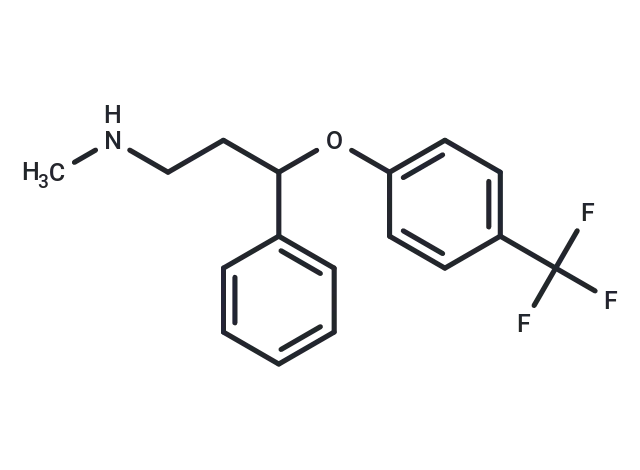
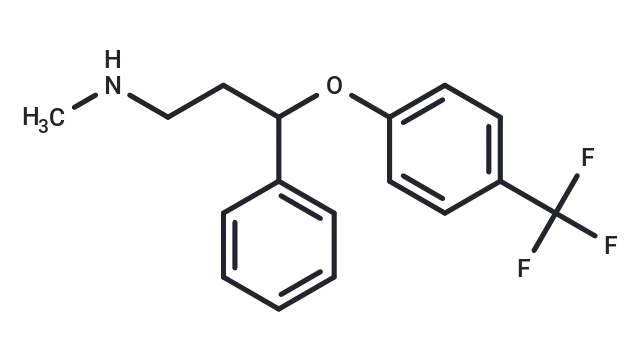
Molecular Structure of Fluoxetine
Moreover, Fluoxetine’s influence extends to the multidrug resistance-associated protein 1 (MRP1), a transporter involved in the efflux of various substrates, including xenobiotics and endogenous metabolites. By modulating MRP1 activity, Fluoxetine may affect cellular detoxification processes and intracellular drug accumulation, which is of particular interest in pharmacokinetic and toxicological studies. The integration of Fluoxetine’s actions on SERT, autophagy, and MRP1 highlights its multifaceted role in cellular signaling networks, making it a valuable tool for dissecting the interplay between neurotransmitter regulation, cellular stress responses, and transporter-mediated efflux.
In research contexts, Fluoxetine is extensively utilized to probe the dynamics of serotonin signaling and its downstream effects on neuronal function and plasticity. Its ability to modulate autophagy pathways also positions it as a compound of interest in studies investigating neurodegenerative diseases and cellular stress responses. Additionally, Fluoxetine’s interaction with MRP1 provides a framework for exploring multidrug resistance mechanisms and transporter biology. Collectively, these properties underscore Fluoxetine’s utility as a versatile biochemical probe for elucidating complex biological pathways involving neurotransmitter transport, autophagy regulation, and membrane transporter function [1,2].
Literature review
2.1 ML365 inhibits TWIK2 channel to block ATP-induced NLRP3 inflammasome
Fluoxetine(T0450) was evaluated among six known K2P channel modulators for activity on the TWIK2 potassium channel expressed in a heterologous system. Although Fluoxetine was included in the testing, it was not identified as the most potent TWIK2 channel blocker. Instead, ML365 demonstrated the strongest inhibitory effect with an IC50 of 4.07 ± 1.5 μM. The evidence specifically mentions Fluoxetine in the list of tested modulators but does not report any significant functional impact or inhibitory potency comparable to ML365 on the TWIK2 channel in this study. Thus, in this experimental context, Fluoxetine was tested for modulation of TWIK2 currents but did not exhibit the highest activity or inhibition.[3]
2.2 The Selective SIK2 Inhibitor ARN-3236 Produces Strong Antidepressant-Like Efficacy in Mice via the Hippocampal CRTC1-CREB-BDNF Pathway
Fluoxetine(T0450) displayed significant antidepressant actions in both depression models used in this study, serving as a positive control to validate the experimental procedures. The study found that administration of ARN-3236 at doses of 30 mg/kg and 60 mg/kg produced antidepressant efficacy in mice that was equal to or exceeded that produced by 20 mg/kg fluoxetine. This comparison underscores fluoxetine’s well-established role as an effective agent in the behavioral models tested. The evidence confirms the antidepressant effect of fluoxetine within the study context, illustrating its relevance for benchmarking novel compounds such as ARN-3236.[4]
2.3 Repositioning Fluoxetine as a TRPV3 Channel Inhibitor to Alleviate Skin Inflammation and Pruritus
Fluoxetine(T0450) was identified as a potent inhibitor of the TRPV3 channel, demonstrating a strong ability to suppress TRPV3 currents. At 100 μM, fluoxetine reduced the 2-APB-induced TRPV3 current by over 90%, and the IC50 was determined as approximately 10.23 μM, indicating dose-dependent inhibition. Mechanistically, fluoxetine modulates TRPV3 by altering channel conductance and gating. Single-channel recordings further supported these findings, showing a significant decrease in channel open probability upon fluoxetine application. In vivo, topical administration of fluoxetine at concentrations between 1 to 10 mM effectively alleviated carvacrol-induced skin inflammation, epidermal thickening, scratching behavior, and ear swelling in mouse models. Comparative studies demonstrated that 10 mM fluoxetine performed similarly to dexamethasone in reducing these inflammatory indicators, suggesting comparable efficacy. These results indicate that fluoxetine exerts its anti-inflammatory and anti-pruritic effects principally through TRPV3 channel inhibition in the models studied. The drug’s modulation of channel activity and subsequent reduction of inflammation and swelling highlight its potential as a TRPV3 channel-targeting agent.[5]
Reference
[1] 1. Owens MJ, Nemeroff CB. Pharmacology of Fluoxetine: A Selective Serotonin Reuptake Inhibitor. Pharmacol Rev. 1994;46(4): 495-527.
[2] 2. Zhang L, et al. Fluoxetine modulates autophagy and MRP1 transporter activity: implications for neuropharmacology. Neuropharmacology. 2020;168:107755.
[3] Wu X, Lv J, Zhang S, Yi X, Xu Z, Zhi Y, et al.. ML365 inhibits TWIK2 channel to block ATP-induced NLRP3 inflammasome. Acta Pharmacologica Sinica. 2021;43(4):992-1000.
[4] Liu Y, Tang W, Ji C, Gu J, Chen Y, Huang J, et al.. The Selective SIK2 Inhibitor ARN-3236 Produces Strong Antidepressant-Like Efficacy in Mice via the Hippocampal CRTC1-CREB-BDNF Pathway. Frontiers in Pharmacology. 2021;11():.
[5] Zhang L, Chang J, Xu Y, Ge Q, Zhang C. Repositioning Fluoxetine as a TRPV3 Channel Inhibitor to Alleviate Skin Inflammation and Pruritus. Current Issues in Molecular Biology. 2025;47(4):277.
An essential round-up of science news, opinion and analysis, delivered to your inbox every weekday.
 Feedback
 Hello! How can I help you today?
Copyright © 2015-2026 TargetMol Chemicals Inc. All Rights Reserved.