




























Shopping Cart
Remove All Your shopping cart is currently empty
TargetMol Star Molecule—LY294002 (Cat. No. T2008, CAS 154447-36-6), A Broad-Spectrum PI3K Inhibitor for PI3K/AKT Pathway Research
Background
LY294002 (T2008) is a well-characterized broad-spectrum inhibitor primarily targeting class I phosphoinositide 3-kinases (PI3Ks), including PI3Kα, PI3Kβ, and PI3Kδ isoforms, with IC50 values of approximately 0.5, 0.97, and 0.57 μM, respectively. Beyond its canonical inhibition of PI3K, LY294002 also inhibits DNA-dependent protein kinase (DNA-PK) at an IC50 of 1.4 μM and casein kinase 2 (CK2) at a notably lower IC50 of 98 nM. The PI3K pathway is a critical regulator of cellular processes such as growth, survival, metabolism, and autophagy, with PI3K catalyzing the phosphorylation of phosphatidylinositol lipids to generate PIP3, which activates downstream effectors like AKT. By inhibiting PI3K activity, LY294002 disrupts this signaling cascade, leading to reduced AKT phosphorylation and downstream signaling, which in turn can trigger programmed cell death (apoptosis) and autophagy. The compound’s ability to inhibit DNA-PK, a key enzyme involved in DNA repair via non-homologous end joining, further sensitizes cells to DNA damage and influences cell fate decisions. Additionally, inhibition of CK2, a serine/threonine kinase implicated in cell cycle regulation and survival, adds another layer of modulation by LY294002, potentially enhancing its pro-apoptotic and autophagic effects.
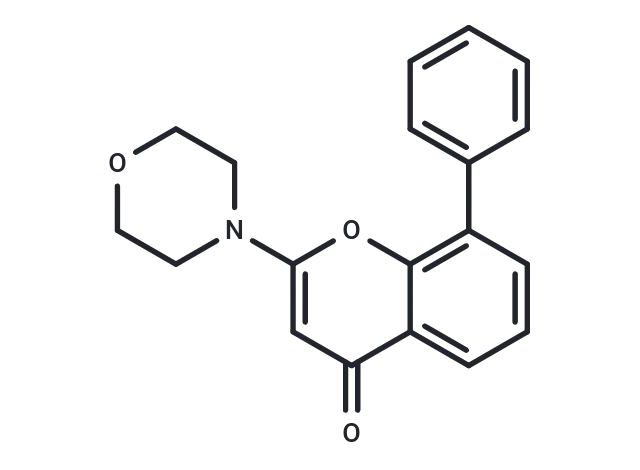
Molecular Structure of LY294002
In research contexts, LY294002 is extensively utilized as a pharmacological tool to dissect the PI3K/AKT signaling axis and its role in various cellular functions, including proliferation, metabolism, and survival. Its broad inhibitory profile allows researchers to study the interplay between PI3K signaling and DNA repair mechanisms, as well as the regulation of autophagy and apoptosis. The compound’s capacity to induce apoptosis and autophagy makes it valuable for investigating mechanisms of cell death and survival under stress conditions or in disease models such as cancer. However, due to its off-target effects on DNA-PK and CK2, caution is warranted when interpreting results, and complementary approaches are often employed to confirm PI3K-specific effects. Overall, LY294002 (T2008) remains a critical reagent for elucidating the complex signaling networks involving PI3K, DNA-PK, and CK2, providing insights into cellular homeostasis and pathophysiology [1,2].
Literature review
2.1 Isoflurane reduces pain and inhibits apoptosis of myocardial cells through the phosphoinositide 3-kinase/protein kinase signaling pathway in mice during cardiac surgery
LY294002(T2008) was used as a PI3K inhibitor in this study to investigate its effects on myocardial cells treated with isoflurane. The administration of LY294002 reduced the anti-apoptotic effects induced by isoflurane in myocardial cells, demonstrating its inhibitory role in this context. Furthermore, LY294002 completely abolished the isoflurane-stimulated promotion of myocardial cell survival. These findings indicate that LY294002 suppresses the protective effects of isoflurane on myocardial cells via the PI3K/AKT signaling pathway, effectively inhibiting both the reduction of apoptosis and enhancement of cell survival triggered by isoflurane. Thus, LY294002 acts as an inhibitor of isoflurane-induced myocardial cell protection in this study.[3]
2.2 Lunasin functionally enhances LDL uptake via inhibiting PCSK9 and enhancing LDLR expression in vitro and in vivo
In this study, LY294002(T2008), identified as an effective PI3K/Akt pathway inhibitor, was used to evaluate the involvement of the PI3K/Akt pathway in the action of lunasin on LDLR expression in HepG2 cells. Pre-culturing HepG2 cells with LY294002 prior to lunasin treatment inhibited the phosphorylation of Akt that lunasin normally induced, indicating successful pathway inhibition. This inhibition by LY294002 resulted in an attenuation of lunasin-induced increases in both LDLR mRNA and protein levels. Additionally, LY294002 reduced the lunasin-mediated enhancement of SREBP-2 mRNA and protein expression. These results demonstrate that LY294002 counteracted lunasin's upregulation of LDLR expression by blocking the PI3K/Akt-dependent activation of SREBP-2, thereby exerting an inhibitory effect on the pathway through which lunasin promotes LDLR expression.[4]
2.3 MAP4 phosphorylation induced by ARID1A loss sensitizes colorectal cancer cells to EMP
In this study, LY294002(T2008), a PI3K inhibitor, was shown to decrease the phosphorylation level of MAP4 in HCT116 ARID1A isogenic colorectal cancer cells. The reduction of MAP4 phosphorylation caused by LY294002 indicates that PI3K activity regulates MAP4 phosphorylation status. Additionally, when LY294002 was combined with EMP, effects on microtubule polymerization and the levels of polymeric microtubules were observed in the same cell model. These experimental results suggest that LY294002 suppresses phosphorylated MAP4 expression and influences microtubule dynamics in ARID1A-deficient colorectal cancer cells, potentially disrupting the microtubule network through modulation of the PI3K pathway.[5]
2.4 Gracillin Protects Liver Ischemia-Reperfusion Injury from Oxidative Stress-Induced Apoptosis
LY294002(T2008) was applied in this study to verify the involvement of the Akt/GSK3β signaling pathway in the hepatoprotective effects of gracillin. Treatment with LY294002 reversed the inhibitory effects of gracillin on oxidative stress markers, including reductions in malondialdehyde levels and increases in antioxidant enzyme activities. Moreover, LY294002 reversed the inhibition of apoptosis induced by gracillin, as evidenced by increased TUNEL-positive cells and elevated caspase activities. In AML12 cells exposed to H2O2, LY294002 aggravated hepatocellular injury by decreasing cell viability and increasing LDH release. Additionally, LY294002 lowered the activities of glutathione peroxidase and superoxide dismutase, and blocked gracillin's anti-apoptotic effects. Collectively, these results demonstrate that LY294002 counteracts the protective effects of gracillin by inhibiting Akt signaling, thereby reversing gracillin-induced suppression of oxidative stress and apoptosis.[6]
2.5 Targeting MDK alleviates bone loss via dual regulation of osteogenic differentiation and inflammatory cytokine expression
In this study, LY294002(T2008), a PI3K inhibitor, was used to investigate its impact on osteoblast differentiation suppressed by recombinant MDK protein. The study demonstrated that LY294002 treatment partially reversed the MDK-induced suppression of key osteogenic proteins including ALP, RUNX2, and OSX in MC3T3-E1 cells after 7 days of osteogenic induction. Western blotting analysis revealed that LY294002 inhibited the activation of the PI3K/AKT signaling pathway caused by MDK, thereby partially counteracting the inhibitory effect of MDK on osteoblast differentiation. These findings highlight that LY294002 restored osteogenic marker expression by modulating the PI3K/AKT pathway, suggesting that the pathway’s blockade by LY294002 alleviates the suppression imposed by recombinant MDK protein on bone-forming cell differentiation.[7]
Reference
[1] 1. Vlahos CJ, Matter WF, Hui KY, Brown RF. A specific inhibitor of phosphatidylinositol 3-kinase, 2-(4-morpholinyl)-8-phenyl-4H-1-benzopyran-4-one (LY294002). J Biol Chem. 1994;269(7):5241-5248.
[2] 2. Knight ZA, Shokat KM. Features of selective kinase inhibitors. Chem Biol. 2005;12(6):621-637.
[3] Pi Z, Lin H, Yang J. Isoflurane reduces pain and inhibits apoptosis of myocardial cells through the phosphoinositide 3-kinase/protein kinase�B signaling pathway in mice during cardiac surgery. Molecular Medicine Reports. 2018;():.
[4] Gu L, Wang Y, Xu Y, Tian Q, Lei G, Zhao C, et al.. Lunasin functionally enhances LDL uptake via inhibiting PCSK9 and enhancing LDLR expression <i>in vitro</i> and <i>in vivo</i>. Oncotarget. 2017;8(46):80826-80840.
[5] Pan L, Wu D, He Y, Wang K, Zeng Y, Xiang C, et al.. MAP4 phosphorylation induced by ARID1A loss sensitizes colorectal cancer cells to EMP. Cell Death & Disease. 2025;17(1):.
[6] Shen Y, Shi R, Wang G, Liu H, Li C, Liu F, et al.. Gracillin Protects Liver Ischemia-Reperfusion Injury from Oxidative Stress-Induced Apoptosis. Drug Design, Development and Therapy. 2025;Volume 19():10075-10090.
[7] Ruze X, Hu Y, Wang X, Lai H, Zhang R, Pan S, et al.. Targeting MDK alleviates bone loss via dual regulation of osteogenic differentiation and inflammatory cytokine expression. Genes & Diseases. 2026;13(3):101931.
An essential round-up of science news, opinion and analysis, delivered to your inbox every weekday.
 Feedback
 Hello! How can I help you today?
Copyright © 2015-2026 TargetMol Chemicals Inc. All Rights Reserved.