























Shopping Cart
Remove All Your shopping cart is currently empty
TargetMol Star Molecule—(+)-JQ-1 (Cat. No. T2110, CAS 1268524-70-4), A Selective BET Bromodomain Inhibitor for BRD4 and Transcriptional Regulation Studies
Background
(+)-JQ-1 (T2110) is a potent and selective inhibitor of the bromodomain and extra-terminal (BET) family proteins, primarily targeting BRD4 isoforms 1 and 2 with IC50 values of 77 nM and 33 nM, respectively. BET proteins function as epigenetic reader domains that recognize acetylated lysine residues on histone tails, thereby regulating transcriptional programs critical for cell proliferation and survival. By competitively binding to the acetyl-lysine recognition pocket of BRD4, (+)-JQ-1 disrupts the recruitment of transcriptional machinery to chromatin, leading to altered gene expression profiles. This mechanism underlies its ability to inhibit cell proliferation and induce autophagy, a cellular catabolic process involved in the degradation and recycling of cytoplasmic components. The modulation of autophagy by (+)-JQ-1 is particularly significant, as it links epigenetic regulation to cellular homeostasis and stress responses.
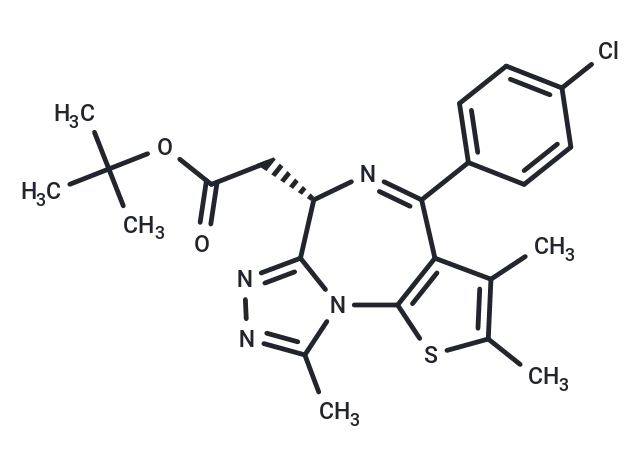
Molecular Structure of (+)-JQ-1
In the context of signaling pathways, (+)-JQ-1’s inhibition of BRD4 affects downstream transcriptional networks that govern cell cycle progression and survival pathways. BRD4 is also a key target in the design of proteolysis-targeting chimeras (PROTACs), where ligands like (+)-JQ-1 serve as molecular handles to recruit E3 ubiquitin ligases for targeted protein degradation. This dual role highlights the compound’s versatility in epigenetic modulation and targeted protein degradation strategies. The reversible and specific binding of (+)-JQ-1 to BRD4 allows for dynamic control of epigenetic states, making it a valuable tool for dissecting BET protein functions in various biological contexts.
In research applications, (+)-JQ-1 is extensively utilized to investigate the role of BET proteins in cancer biology, inflammation, and transcriptional regulation. Its ability to induce autophagy and suppress proliferation provides insights into the interplay between epigenetic regulation and cellular stress pathways. Moreover, (+)-JQ-1 is employed in the development and validation of PROTAC molecules, facilitating the exploration of targeted protein degradation as a novel approach in chemical biology. The compound’s specificity and reversibility make it an indispensable reagent for probing epigenetic reader domains and their contribution to gene expression dynamics. Overall, (+)-JQ-1 serves as a critical molecular probe for advancing our understanding of epigenetic regulation, autophagy, and targeted protein degradation in biomedical research [1,2].
Literature review
2.1 BE screen reveals METTL3 S2 dephosphorylation sensitizes gastric cancer cells to oxaliplatin by interfering METTL3-eIF3H interaction
In this study, (+)-JQ-1(T2110), a BET bromodomain inhibitor targeting BRD4, was evaluated in combination with oxaliplatin (OXA) for its effects on gastric cancer (GC) models. Experimental results showed that the combination of OXA and (+)-JQ-1 significantly inhibited GC cell growth as demonstrated by CCK8 assays. Cells treated with the combination exhibited significantly increased γH2AX levels compared to controls and monotherapies, indicating a substantial elevation in DNA damage. Furthermore, (+)-JQ-1 inhibited the ATR-CHK1 signaling pathway, which is activated by OXA treatment, suggesting an interference in the replication stress response. In vivo, the combination treatment led to a significant inhibition of tumor growth relative to the control or single-agent groups, accompanied by decreased Ki-67 expression in the xenograft gastric cancer tissues. These results collectively indicate that (+)-JQ-1 exerts an inhibitory effect on GC cell proliferation and tumor growth when combined with OXA, enhancing DNA damage and blocking a key replication stress signaling pathway.[3]
2.2 Epithelial-Mesenchymal Transition Activates YAP to Drive Malignant Progression and Immune Evasion
In this study, (+)-JQ-1(T2110) functioned as a small-molecule inhibitor of the bromodomain protein BRD4, which is a co-activator necessary for the transcriptional activity of YAP. The drug demonstrated the capacity to overcome resistance induced by TGFβ in A549 cancer cells to apoptosis-promoting compounds ABT-737 and camptothecin. Specifically, TGFβ treatment rendered the cells resistant to these agents; however, co-treatment with (+)-JQ-1 restored the sensitivity of cancer cells to these apoptosis-inducing and chemotherapeutic compounds. This indicates that (+)-JQ-1 acts to reverse TGFβ-driven chemoresistance and apoptosis resistance mediated by YAP through inhibition of BRD4. These findings underscore the role of (+)-JQ-1 as an agent that sensitizes cancer cells undergoing EMT-associated resistance to apoptosis and chemotherapeutics without directly reversing the EMT morphological state. The figures associated with these results include Fig.4 E.[4]
2.3 Lycorine hydrochloride inhibits cholangiocarcinoma through cholesterol biosynthesis and PTPN11 nuclear translocation
In this study, (+)-JQ-1(T2110) was among the chemotherapeutic agents evaluated for their effects on RBE cells. The half-maximal inhibitory concentration (IC50) of (+)-JQ-1 was determined to be 25 µM. When combined with Lycorine Hydrochloride (LY), (+)-JQ-1 contributed to a significant reduction in cell viability compared to treatment with either agent alone. This finding indicates that (+)-JQ-1, in combination with LY, synergistically decreases the viability of RBE cells. The combination therapies involving (+)-JQ-1 and LY were administered at concentrations below their respective IC50 values, yet still produced enhanced anti-proliferative effects. The data demonstrate the synergistic potential of (+)-JQ-1 when used with LY in this specific experimental context.[5]
Reference
[1] 1. Filippakopoulos P, Qi J, Picaud S, et al. Selective inhibition of BET bromodomains. Nature. 2010;468(7327):1067-1073.
[2] 2. Winter GE, Buckley DL, Paulk J, et al. Phthalimide conjugation as a strategy for in vivo target protein degradation. Science. 2015;348(6241):1376-1381.
[3] Xu X, Tao W, Liu Y, Guo T, Zhang Y, Wei D, et al.. BE screen reveals METTL3 S2 dephosphorylation sensitizes gastric cancer cells to oxaliplatin by interfering METTL3-eIF3H interaction. Science Advances. 2025;11(50):.
[4] Huang X, Zhang M, Pearce A, Gibbons M, Jin D, Li L, et al.. Epithelial-Mesenchymal Transition Activates YAP to Drive Malignant Progression and Immune Evasion. Cancers. 2025;17(17):2767.
[5] Zhao F, Peng S, Zou L, Zhong M, Huang Y, Wang P, et al.. Lycorine hydrochloride inhibits cholangiocarcinoma through cholesterol biosynthesis and PTPN11 nuclear translocation. Cell Communication and Signaling. 2025;23(1):.
An essential round-up of science news, opinion and analysis, delivered to your inbox every weekday.
 Feedback
 Hello! How can I help you today?
Copyright © 2015-2026 TargetMol Chemicals Inc. All Rights Reserved.