






























Shopping Cart
Remove All Your shopping cart is currently empty
TargetMol—Star Molecules—Azelaprag (Cat. No. T14390, CAS. 2049980-18-7), Open a New Avenue for APJ Receptor Drug Development
1. Product Introduction
Azelaprag, (Cat. No. T14390, CAS. 2049980-18-7), also known as AMG 986,is a candidate active molecule as an apelin receptor agonist (EC50 = 0.32 nM). Azelaprag can be used for the treatment of neurological and cardiovascular diseases.
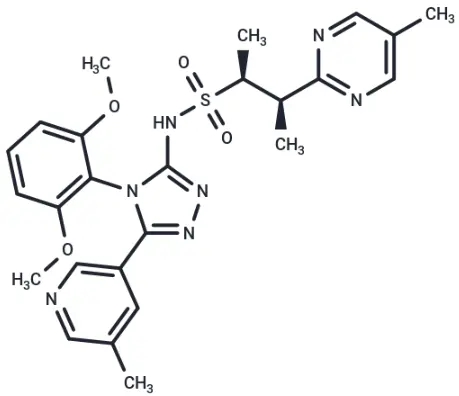
Molecular structure of Azelaprag
2. Background Introduction
The Apelin receptor, also known as APJ, is a class A G protein–coupled receptor (GPCR) whose endogenous peptide ligands are Apelin and Elabela. These peptides mediate a variety of essential physiological functions, including cardiovascular regulation, blood pressure stabilization, fluid homeostasis, and metabolic control. The APJ receptor was first deorphanized in 1998, and since then it has become a prominent drug development target due to its potential therapeutic value in cardiovascular and metabolic diseases. [1] Although the endogenous peptide ligands exhibit high affinity for activating the APJ receptor, they are typically prone to rapid enzymatic degradation in vivo and have short plasma half-lives, limiting their feasibility for direct therapeutic application. Consequently, researchers have been striving to design and develop small-molecule APJ agonists with improved pharmacokinetic properties to achieve more stable and controllable receptor activation, thereby expanding therapeutic strategies for heart failure, hypertension, metabolic disorders, and related conditions. [2]
Azelaprag is an important small-molecule candidate APJ receptor agonist that departs from the traditional peptide-mimetic approach, providing a novel design paradigm for drug development targeting this GPCR. Compared with endogenous peptides, small-molecule agonists can offer improved pharmacokinetic properties, greater stability, and oral bioavailability, enabling more convenient clinical applications. Studies have shown that small-molecule agonists such as AMG 986 can mimic the receptor-activating effects of endogenous peptide segments in vitro and exhibit APJ-like cardiovascular regulatory effects in animal models. This demonstrates the feasibility of the “from peptide signaling to small-molecule activation” strategy and advances the drug development pathway for the receptor. Azelaprag displays high affinity for the APJ receptor and effectively activates receptor signaling, making it a promising candidate for further pharmacological and mechanistic studies. [3]
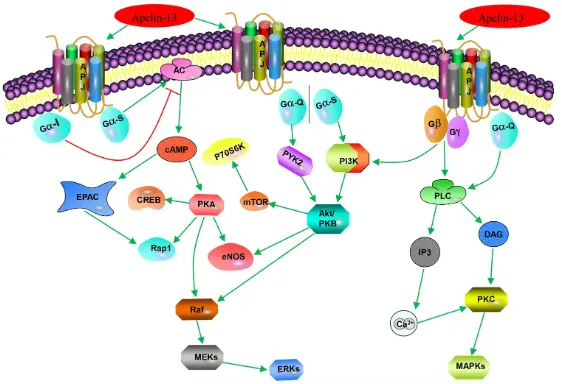
Apelin-Related Signaling Pathways [3]
3. Application References
Cardiovascular response to small-molecule APJ activation

Research Overview:
This study employed a medicinal chemistry–based drug discovery approach to identify AM-8123 and AMG 986 (a precursor compound of Azelaprag). Initial in vitro receptor functional assays demonstrated that AMG 986 effectively activates the APJ receptor, exhibiting typical G protein–dependent signaling pathway activation (such as inhibition of cAMP and promotion of GTPγS binding), confirming it as a potent full agonist. Subsequently, in rat models with impaired metabolic function, the study validated the clear target-specific mechanism of AMG 986 as a small-molecule APJ agonist and, through comprehensive animal disease model data, demonstrated its integrated pharmacological effects on cardiac remodeling, myocardial function, and hemodynamic regulation. [4]
In this study, AMG 986 was administered to ZSF1 obese rat models to evaluate the effects of APJ activation on cardiac function. AMG 986 was infused at a rate of 1 mg/kg/min for 10 minutes, followed by a 5-minute co-infusion with dobutamine (12 μg/kg/min) to assess cardiac reserve function. AMG 986 reduced the MAP/cardiac output ratio, indicating a decrease in cardiac afterload.
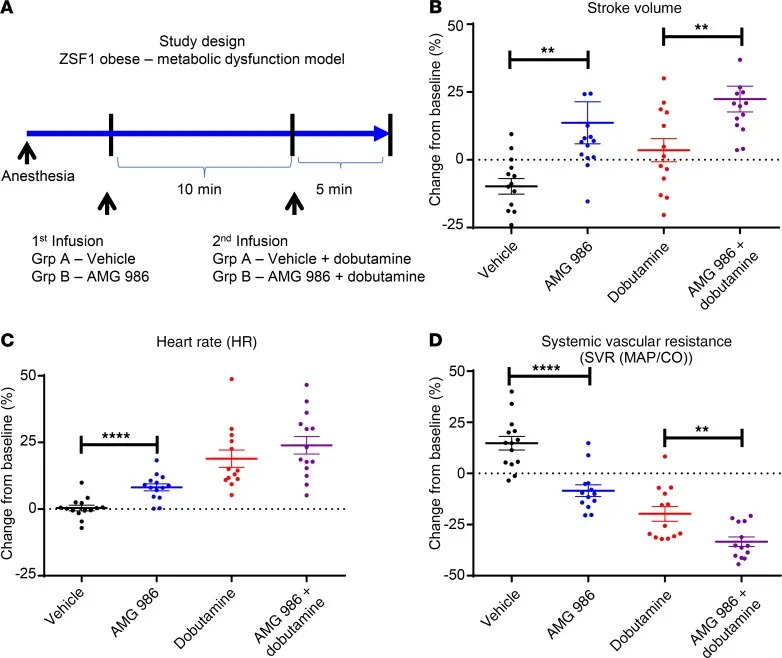
Acute infusion of AMG 986 enhances cardiac reserve in metabolically impaired rats under dobutamine stress [4]
4. References
[1] Kinjo T, Higashi H, Uno K, et al. Apelin/Apelin Receptor System: Molecular Characteristics, Physiological Roles, and Prospects as a Target for Disease Prevention and Pharmacotherapy. Curr Mol Pharmacol. 2021;14(2):210-219. doi: 10.2174/1874467213666200602133032. PMID: 32484774.
[2] Fischer C. A patent review of apelin receptor (APJR) modulators (2014-2019). Expert Opin Ther Pat. 2020 Apr;30(4):251-261. doi: 10.1080/13543776.2020.1731473. Epub 2020 Feb 20. PMID: 32066307.
[3] Hu G, Wang Z, Zhang R, et al. The Role of Apelin/Apelin Receptor in Energy Metabolism and Water Homeostasis: A Comprehensive Narrative Review. Front Physiol. 2021 Feb 10;12:632886. doi: 10.3389/fphys.2021.632886. PMID: 33679444; PMCID: PMC7928310.
[4] Ason B, Chen Y, Guo Q, et al. Cardiovascular response to small-molecule APJ activation. JCI Insight. 2020 Apr 23;5(8):e132898. doi: 10.1172/jci.insight.132898. PMID: 32208384; PMCID: PMC7205427.
An essential round-up of science news, opinion and analysis, delivered to your inbox every weekday.
 Feedback
 Hello! How can I help you today?
Copyright © 2015-2026 TargetMol Chemicals Inc. All Rights Reserved.



![[TargetMol Star Molecule] - Meropenem: Targeting Bacterial Cell Wall Synthesis to Combat Multidrug Resistance](https://cdn.targetmol.com/group9/newyun/20260525/s/daloama4neet9vcastg3rvjes.png)
![[TargetMol Star Molecule] - Acarbose: A Key Enzyme Inhibitor Modulating Blood Glucose and Metabolic Pathways](https://cdn.targetmol.com/group9/newyun/20260525/c/17dqa1mmpq3ysri7zb6kubu5f.png)