































Shopping Cart
Remove All Your shopping cart is currently empty
TargetMol — Star Molecule — Disulfiram (Cat. No. T0054, CAS 97-77-8), a Dual Regulator of ALDH Inhibition and Pyroptosis Pathway
Background
Disulfiram (T0054) functions primarily as a potent inhibitor of acetaldehyde dehydrogenase (ALDH), specifically targeting human ALDH1 and ALDH2 isoforms with IC50 values of 0.15 μM and 1.45 μM, respectively. By covalently modifying the active site cysteine residues of these enzymes, Disulfiram effectively blocks the oxidation of acetaldehyde to acetate, a critical step in alcohol metabolism. Beyond its classical role in modulating dehydrogenase activity, Disulfiram has been shown to interfere with gasdermin D (GSDMD) pore formation, a key event in pyroptosis, an inflammatory form of programmed cell death. This dual functionality places Disulfiram at the intersection of metabolic and inflammatory signaling pathways, including cuproptosis, interleukin-mediated responses, apoptosis, and pyroptosis.
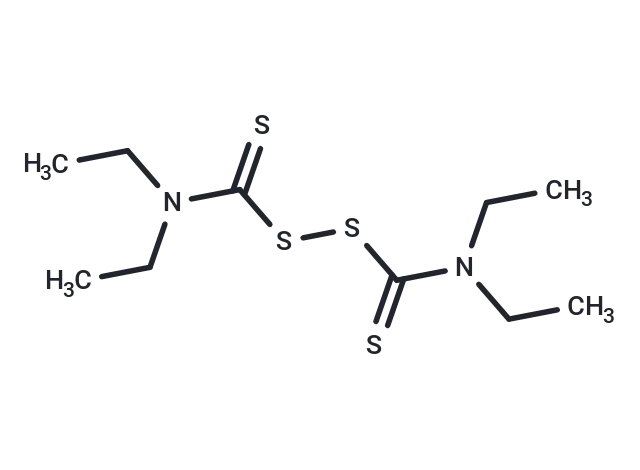
Molecular Formula of Disulfiram
The inhibition of ALDH by Disulfiram leads to the accumulation of acetaldehyde, which sensitizes cells to alcohol exposure and can modulate cellular redox states and metabolic fluxes. In the context of pyroptosis, Disulfiram’s ability to inhibit GSDMD pore formation prevents the release of pro-inflammatory cytokines such as interleukins, thereby modulating the inflammatory cascade. This suggests that Disulfiram can dynamically regulate interleukin signaling pathways by attenuating pyroptotic cell death and subsequent cytokine release. Furthermore, Disulfiram’s interaction with dehydrogenases implicates it in broader metabolic pathways, including those involved in cuproptosis, a recently characterized copper-dependent cell death mechanism, highlighting its potential as a tool to dissect complex cell death modalities.
In research settings, Disulfiram is widely utilized to investigate the biochemical and cellular consequences of ALDH inhibition, particularly in studies exploring alcohol metabolism, oxidative stress, and metabolic regulation. Its role in blocking GSDMD pore formation has also made it a valuable compound for probing the molecular mechanisms underlying pyroptosis and inflammatory signaling. Additionally, Disulfiram’s specificity for ALDH isoforms and its impact on interleukin pathways provide a unique opportunity to study the crosstalk between metabolic enzymes and immune responses. Given these properties, Disulfiram serves as a versatile biochemical probe for elucidating the interplay between dehydrogenase activity, inflammatory cell death, and cytokine signaling, offering insights into the regulation of cell fate and immune modulation in various experimental models.
Literature review
2.1 High-throughput screen of drug repurposing library identifies inhibitors of Sarcocystis neurona growth
Disulfiram(T0054) was evaluated in this study for its inhibitory activity against *Sarcocystis neurona* merozoite growth using a high-throughput screening method that employed GFP- and firefly luciferase-expressing parasites. It was identified as one of eighteen confirmed compounds exhibiting greater than 80% inhibition of parasite proliferation in both the primary and secondary screening phases. Further testing assessed disulfiram’s half-maximal effective concentration (EC_50) by treating parasite-infected bovine turbinate cells with varying compound concentrations, followed by measurement of parasite luciferase activity. These experiments demonstrated that disulfiram exerted a dose-dependent inhibitory effect on parasite growth. The assays were robust, as indicated by Z′ scores above 0.6, validating the assay’s capacity for accurate measurement of inhibition. This study thus confirmed disulfiram as an effective inhibitor within the chemical library against *S. neurona* parasite replication in vitro.[3]
2.2 Xuanqing Hefa formula relieves sepsis-triggered acute lung injury by targeting the NLRP3/Caspase-1 pyroptosis mechanism
Disulfiram(T0054), as a component within the multi-constituent formula Xuanqing Hefa formula (XQHF), demonstrated the ability to suppress inflammatory cascades and attenuate pyroptosis, contributing to the alleviation of lung injury in sepsis-induced acute lung injury models. Experimental results showed that Disulfiram(T0054)-containing XQHF significantly preserved lung tissue architecture by reducing inflammatory responses and oxidative stress, which improved survival rates in septic mice. At the molecular level, Disulfiram(T0054) inhibited key pyroptosis-related protein expression and reduced apoptosis in macrophage pyroptosis models induced by LPS plus Nigericin. Additionally, Disulfiram(T0054) decreased the expression of pro-inflammatory cytokines IL-1β and IL-18. These findings suggest that Disulfiram(T0054) exerts inhibitory effects on the NLRP3/Caspase-1-dependent pyroptosis signaling pathway, playing a part in modulating sepsis-related lung injury through suppression of inflammatory and pyroptotic processes.[4]
2.3 Disulfiram activates autophagy via proteasome inhibition and c-Fos/beclin-1 upregulation, synergizing with chloroquine
Disulfiram(T0054) exerts multiple mechanistic effects in colorectal cancer cell models. It inhibits the ubiquitin-proteasome pathway by targeting the p97-NPL4-UFD1 axis, resulting in significant proteasome inhibition as evidenced by increased ubiquitination levels. This inhibition induces compensatory autophagy, which Disulfiram also promotes through transcriptional upregulation of autophagy-related gene BECN1 via increased expression of the FOS gene. The AP-1 transcription factor component c-Fos binds directly to the BECN1 promoter, enhancing Beclin-1 expression and thereby elevating autophagy levels in a dose- and time-dependent manner. The anti-tumor effect of Disulfiram depends on copper ions, with copper gluconate significantly augmenting its capacity to kill tumor cells. Combining Disulfiram with autophagy inhibitors like chloroquine results in complete blockade of cellular protein degradation, causing abnormal protein accumulation and subsequent cell death. This synergistic combination markedly enhances the anti-tumor efficacy compared to Disulfiram alone. Moreover, experimental overexpression of NPL4 attenuates Disulfiram-induced autophagy, confirming the dependence of autophagy activation on proteasome inhibition via the NPL4 axis. These findings collectively demonstrate that Disulfiram activates autophagy through dual pathways—proteasome inhibition and c-Fos/Beclin-1 transcriptional upregulation—and synergizes with autophagy inhibitors to enhance tumor cell killing.[5]
Reference
[1] Liu X, Zhang Z, Ruan J, et al. Inflammasome-activated gasdermin D causes pyroptosis by forming membrane pores. Nature. 2016;535(7610):153-158.
[2] Skrott Z, Mistrik M, Andersen KK, et al. Alcohol-abuse drug disulfiram targets cancer via p97 segregase adaptor NPL4. Nature. 2017;552(7684):194-199.
[3] Bowden G, Land K, O'Connor R, Fritz H. High-throughput screen of drug repurposing library identifies inhibitors of Sarcocystis neurona growth. International Journal for Parasitology: Drugs and Drug Resistance. 2018;8(1):137-144.
[4] Lei C, Zhao C, Li X, Wang K, Cen T, Liu Q, et al.. Xuanqing Hefa formula relieves sepsis-triggered acute lung injury by targeting the NLRP3/Caspase-1 pyroptosis mechanism. Frontiers in Immunology. 2026;16():.
[5] Wang K, Wang Z, Peng W, Li G, Xiao H, Zhong Z, et al.. Disulfiram activates autophagy via proteasome inhibition and c-Fos/beclin-1 upregulation, synergizing with chloroquine. Cell Death Discovery. 2025;12(1):.
An essential round-up of science news, opinion and analysis, delivered to your inbox every weekday.
 Feedback
 Hello! How can I help you today?
Copyright © 2015-2026 TargetMol Chemicals Inc. All Rights Reserved.



![[TargetMol Star Molecule] - Meropenem: Targeting Bacterial Cell Wall Synthesis to Combat Multidrug Resistance](https://cdn.targetmol.com/group9/newyun/20260525/s/daloama4neet9vcastg3rvjes.png)
![[TargetMol Star Molecule] - Acarbose: A Key Enzyme Inhibitor Modulating Blood Glucose and Metabolic Pathways](https://cdn.targetmol.com/group9/newyun/20260525/c/17dqa1mmpq3ysri7zb6kubu5f.png)