































Shopping Cart
Remove All Your shopping cart is currently empty
TargetMol Star Molecule—Sorafenib (Cat. No. T0093L, CAS 284461-73-0), a Multikinase Inhibitor Blocking Raf and VEGF/PDGF Receptor Signaling
Background
Sorafenib (T0093L) is a potent multikinase inhibitor that targets a spectrum of kinases including Raf-1, B-Raf (both wild-type and the oncogenic V599E mutant), VEGFR2, VEGFR3, VEGFR4, PDGFRβ, FLT3, and c-Kit, with inhibitory concentrations (IC50) ranging from low nanomolar values (6–90 nM). This broad kinase inhibition profile enables Sorafenib to modulate multiple signaling pathways critical for cellular proliferation, survival, and angiogenesis. Central to its mechanism of action is the inhibition of the Raf kinase family, which plays a pivotal role in the MAPK/ERK signaling cascade, a pathway frequently dysregulated in cancer and other proliferative disorders. By blocking Raf-1 and B-Raf activity, Sorafenib disrupts downstream ERK activation, thereby influencing cellular processes such as apoptosis and autophagy.
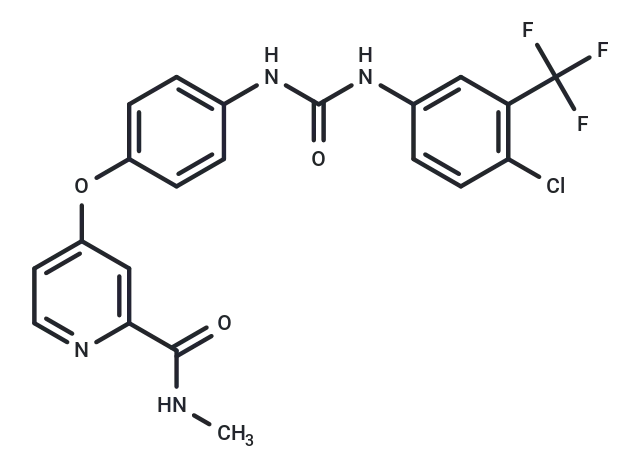
Molecular Formula of Sorafenib
In addition to its effects on Raf kinases, Sorafenib inhibits receptor tyrosine kinases involved in angiogenesis and hematopoiesis, including VEGFR2/3/4 and PDGFRβ, which are essential for vascular endothelial cell function and pericyte recruitment. This inhibition leads to modulation of the VEGFR and PDGFR signaling pathways, impacting vascular remodeling and cellular microenvironment dynamics. Furthermore, Sorafenib targets FLT3 and c-Kit, receptors implicated in hematopoietic stem cell maintenance and proliferation, thereby influencing cell fate decisions.
Sorafenib’s biological activity extends beyond kinase inhibition to the induction of regulated cell death pathways. It has been shown to promote apoptosis and autophagy, two critical mechanisms for maintaining cellular homeostasis and responding to stress. Notably, Sorafenib also acts as an agonist of ferroptosis, a form of iron-dependent, lipid peroxidation-driven cell death distinct from apoptosis and necrosis. This multifaceted modulation of cell death pathways underscores Sorafenib’s utility in dissecting complex cellular responses to kinase inhibition and oxidative stress.
In research contexts, Sorafenib is widely employed as a tool compound to investigate the interplay between kinase signaling, angiogenesis, and cell death mechanisms. Its ability to simultaneously inhibit multiple kinases and induce diverse forms of cell death makes it invaluable for studying tumor biology, vascular biology, and mechanisms of drug resistance. Moreover, Sorafenib’s modulation of autophagy and ferroptosis pathways provides a platform for exploring novel therapeutic targets and resistance mechanisms in cancer and other diseases characterized by aberrant kinase activity and dysregulated cell death.
Overall, Sorafenib (T0093L) serves as a critical molecular probe for elucidating the complex signaling networks involving Raf kinases, VEGFRs, PDGFRβ, FLT3, and c-Kit, and their downstream effects on apoptosis, autophagy, and ferroptosis. Its broad kinase inhibition profile and ability to induce multiple cell death modalities make it a versatile compound for advancing our understanding of cellular signaling and death pathways in biomedical research [1,2].
Literature review
2.1 Antitumor Effects of Trimethylellagic Acid Isolated From Sanguisorba officinalis L. on Colorectal Cancer via Angiogenesis Inhibition and Apoptosis Induction
In this study, Sorafenib(T0093L) was characterized as a small molecule inhibitor targeting key kinases including Raf, VEGFR, and PDGFR, which are involved in cancer cell proliferation and angiogenesis. Experimental data incorporated Sorafenib as a 10 μM treatment condition alongside various concentrations of TMEA to evaluate its effects on human umbilical vein endothelial cells (HUVECs). Sorafenib demonstrated an inhibitory effect on migration and tube formation activities of HUVECs, processes that are critical steps in angiogenesis. These comparative experiments with Sorafenib allowed assessment of TMEA’s effects relative to a known kinase inhibitor that is active against VEGFR and associated pathways. Thus, Sorafenib exerted inhibitory effects on endothelial cell behaviors linked to angiogenesis in the study context.[3]
2.2 Tumor-derived exosomal miR-1247-3p induces cancer-associated fibroblast activation to foster lung metastasis of liver cancer
Sorafenib (T0093L) resistance was affected in liver cancer cells when treated with conditioned medium from fibroblasts pre-treated with exosomes derived from high-metastatic cancer cells. This conditioned medium enhanced tumor cell spheroid formation ability, motility, and specifically increased resistance to Sorafenib(T0093L). The study demonstrated that fibroblasts educated by miR-1247-3p promote tumor stemness, epithelial-mesenchymal transition (EMT), chemoresistance, and tumorigenicity. Notably, the increased resistance to Sorafenib(T0093L) could be partially reversed by blocking pro-inflammatory cytokines IL-6 or IL-8 with neutralizing antibodies. These findings suggest that Sorafenib(T0093L) resistance is modulated through the tumor microenvironment influenced by fibroblast-secreted factors activated by tumor-derived exosomal miR-1247-3p.[4]
2.3 STC2+ Malignant Cell State Associated with EMT, Tumor Microenvironment Remodeling, and Poor Prognosis Revealed by Single-Cell and Spatial Transcriptomics in Colorectal Cancer
Sorafenib(T0093L) was characterized as an anti-angiogenic agent in this study and was evaluated for its efficacy in colorectal cancer (CRC) cell lines, specifically HCT116 and LoVo. After initial colony formation and adherence of these cells, media containing sorafenib was applied for a prolonged duration of 7 to 14 days with continuous culture, allowing assessment of colony formation under drug exposure. Furthermore, the study employed drug response profile analyses from multiple comprehensive datasets, including the Genomics of Drug Sensitivity in Cancer (GDSC2), Cancer Therapeutics Response Portal (CTRP), and PRISM Repurposing dataset, to evaluate the correlation between STC2 expression—a key prognostic marker—and sorafenib sensitivity. Spearman’s correlation analysis was applied to indicators such as area under the dose-response curve (AUC) and half-maximal inhibitory concentration (IC50) values to elucidate the relationship between STC2 levels and responsiveness to sorafenib. These experiments collectively demonstrate that sorafenib exerted inhibitory effects on CRC cell proliferation under the experimental conditions tested.[5]
Reference
[1] Wilhelm SM, Adnane L, Newell P, Villanueva A, Llovet JM, Lynch M. Preclinical overview of sorafenib, a multikinase inhibitor that targets both Raf and VEGF and PDGF receptor tyrosine kinase signaling. Mol Cancer Ther. 2008;7(10):3129-40.
[2] Louandre C, Ezzoukhry Z, Godin C, Barbare JC, Mazière JC, Chauffert B, Galmiche A. Iron-dependent cell death of hepatocellular carcinoma cells exposed to sorafenib. Int J Cancer. 2013;133(7):1732-42.
[3] Bai C, Sun Y, Pan X, Yang J, Li X, Wu A, et al.. Antitumor Effects of Trimethylellagic Acid Isolated From Sanguisorba officinalis L. on Colorectal Cancer via Angiogenesis Inhibition and Apoptosis Induction. Frontiers in Pharmacology. 2020;10():.
[4] Fang T, Lv H, Lv G, Li T, Wang C, Han Q, et al.. Tumor-derived exosomal miR-1247-3p induces cancer-associated fibroblast activation to foster lung metastasis of liver cancer. Nature Communications. 2018;9(1):.
[5] Gui K, Yang T, Xiong C, Wang Y, He Z, Li W, et al.. STC2+ Malignant Cell State Associated with EMT, Tumor Microenvironment Remodeling, and Poor Prognosis Revealed by Single-Cell and Spatial Transcriptomics in Colorectal Cancer. Oncology Research. 2026;34(1):1-10.
An essential round-up of science news, opinion and analysis, delivered to your inbox every weekday.
 Feedback
 Hello! How can I help you today?
Copyright © 2015-2026 TargetMol Chemicals Inc. All Rights Reserved.



![[TargetMol Star Molecule] - Meropenem: Targeting Bacterial Cell Wall Synthesis to Combat Multidrug Resistance](https://cdn.targetmol.com/group9/newyun/20260525/s/daloama4neet9vcastg3rvjes.png)
![[TargetMol Star Molecule] - Acarbose: A Key Enzyme Inhibitor Modulating Blood Glucose and Metabolic Pathways](https://cdn.targetmol.com/group9/newyun/20260525/c/17dqa1mmpq3ysri7zb6kubu5f.png)