






























Shopping Cart
Remove All Your shopping cart is currently empty
[TargetMol Star Molecule] - Meropenem: Targeting Bacterial Cell Wall Synthesis to Combat Multidrug Resistance
Background
Meropenem (T0224), CAS: 96036-03-2, is a carbapenem-class β-lactam antibiotic characterized by its broad-spectrum antibacterial activity, primarily exerted through inhibition of bacterial cell wall synthesis.

Molecular structure of meropenem
Its mechanism of action involves high-affinity binding to penicillin-binding proteins (PBPs), particularly D-alanyl-D-alanine carboxypeptidase DacB, which are essential enzymes in the cross-linking of peptidoglycan layers within the bacterial cell wall. By irreversibly acylating the active site serine residues of these PBPs, Meropenem disrupts the final transpeptidation step, leading to weakened cell wall integrity and subsequent bacterial cell lysis. This interaction also extends to β-lactamases, enzymes produced by bacteria to hydrolyze β-lactam antibiotics; Meropenem exhibits relative stability against many β-lactamases, thereby maintaining its antibacterial efficacy.
Within the antibiotic and antibacterial signaling pathways, Meropenem dynamically modulates bacterial survival by targeting key enzymatic components involved in cell wall biosynthesis. The compound’s binding to DacB and related PBPs effectively halts peptidoglycan maturation, a critical process for bacterial growth and division. This biochemical interference triggers downstream effects such as activation of bacterial stress responses and autolytic pathways, which are integral to the bacterial cell death cascade. Consequently, Meropenem serves as a valuable tool in research settings to probe bacterial cell wall assembly, resistance mechanisms mediated by β-lactamases, and the functional roles of PBPs in various bacterial species.
In experimental contexts, Meropenem is utilized to investigate bacterial susceptibility profiles, elucidate mechanisms of β-lactam resistance, and assess the efficacy of novel β-lactamase inhibitors. Its broad spectrum and stability against many β-lactamases make it particularly useful for studying multidrug-resistant bacterial strains.
Furthermore, Meropenem’s propensity to cause mild transient elevations in aminotransferases and rare cholestatic liver injury in vivo provides a model for exploring antibiotic-induced hepatotoxicity and the molecular basis of drug-induced liver injury. Thus, beyond its antibacterial activity, Meropenem offers significant utility in dissecting host-pathogen interactions, bacterial enzymology, and antibiotic resistance pathways, contributing to the development of improved antimicrobial strategies and diagnostic tools.
Literature review
2.1 Morin combined with meropenem is a potent inhibitor of NDM-1 against NDM-1-producing E. coli
Meropenem (T0224) was investigated in combination with morin for its antibacterial and anti-inflammatory effects against NDM-1-producing Escherichia coli. The study demonstrated that morin alone did not inhibit bacterial growth, but when combined with meropenem, it significantly suppressed bacterial growth and reduced the minimum inhibitory concentration (MIC) values by 4- to 32-fold.
Additionally, this combination reduced tissue damage in the liver, spleen, and intestine of infected mice, indicating an improvement in histological outcomes. The anti-inflammatory activity of meropenem was also evaluated in infected mice, revealing that morin enhanced this effect when combined with meropenem. Overall, meropenem exerted enhanced antibacterial activity and improved anti-inflammatory and tissue protective effects in the presence of morin in this specific study. [3]
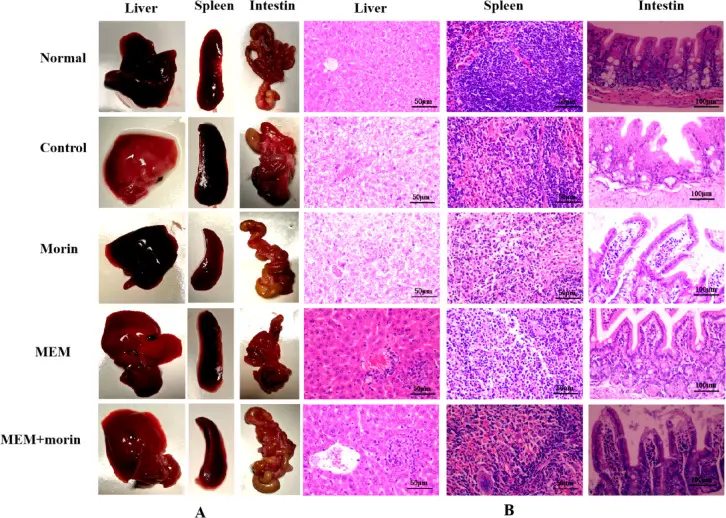
Morin and meropenem can reduce tissue damage
2.2 Betaxolol as a Potent Inhibitor of NDM-1-Positive E. coli That Synergistically Enhances the Anti-Inflammatory Effect in Combination with Meropenem
In this study, the antimicrobial activity of meropenem (T0224) was restored through the highly selective inhibition of NDM-1 by betamethasone (BET). Evidence indicates that BET can specifically inhibit NDM-1, thereby restoring the antimicrobial activity of meropenem against NDM-1-carrying E. coli strains.
In vivo experiments further demonstrated that the combination of BET and meropenem (both at a dose of 10 mg/kg) significantly improved the survival rate of mice infected with NDM-1-carrying E. coli. This suggests that under NDM-1-mediated resistance mechanisms, the antimicrobial activity of meropenem is enhanced by the inhibitory effect of BET. The experimental results reveal that the primary effect of meropenem is the restoration of its antimicrobial activity, which in turn improves the survival status of infected animals. [4]
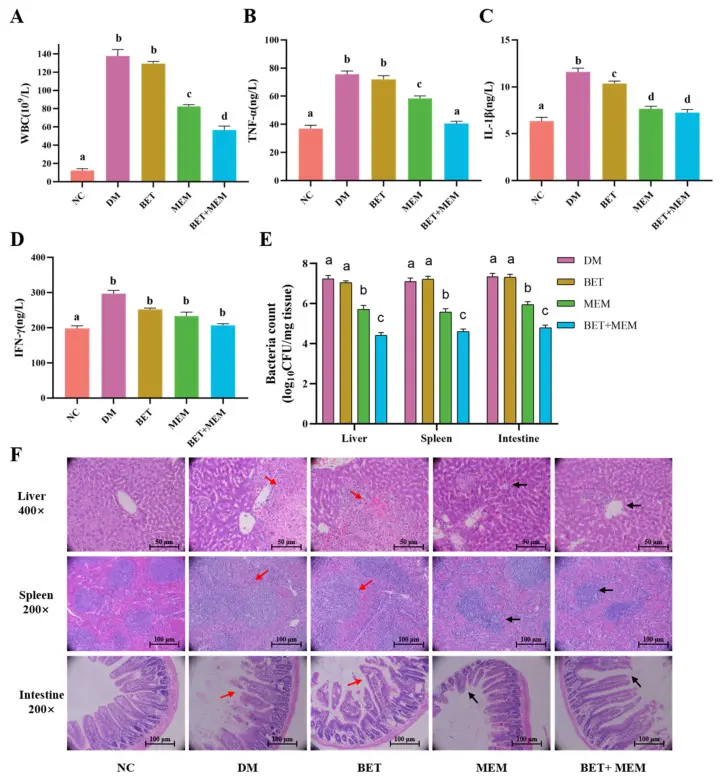
Combination therapy with BET and meropenem effectively
reduces the inflammatory response in infected mice
2.4 The stability of a novel carbapenem antibiotic, meropenem (SM-7338), in a solid state formulation for injection.
Meropenem (T0224) is described as a novel carbapenem antibiotic, with research focusing on the stability of its solid formulation for injection. The experimental results explicitly address the stability of meropenem in this solid formulation, repeatedly emphasizing its stability profile. [5]
Conclusion
Meropenem acts by irreversibly binding to penicillin-binding proteins (PBPs), particularly DacB, inhibiting the final transpeptidation step of peptidoglycan cross-linking, which disrupts bacterial cell wall synthesis and leads to bacterial cell lysis. It also shows stability against β-lactamases, preserving its antibacterial activity.
Literature indicates that while Meropenem alone serves as a broad-spectrum antibiotic and a research tool, its antibacterial efficacy and anti-inflammatory effects are significantly enhanced when combined with inhibitors such as morin or betaxolol against NDM-1-producing resistant bacteria. Additionally, its stable formulation supports drug delivery studies. Future research may focus on optimizing combination therapies to overcome β-lactamase mediated resistance, further elucidating molecular mechanisms of antibiotic-induced liver injury, and developing new β-lactamase inhibitors to extend Meropenem’s clinical utility.
Q&A
Q1: What is the primary mechanism by which Meropenem exerts its antibacterial effect?
A1: Meropenem irreversibly binds to penicillin-binding proteins, especially DacB, inhibiting the final transpeptidation step in peptidoglycan cross-linking, disrupting bacterial cell wall synthesis and causing bacterial cell death.
Q2: How does the combination of Meropenem with morin or betaxolol affect its antibacterial activity against NDM-1-producing E. coli?
A2: Morin and betaxolol act as inhibitors of NDM-1, restoring or enhancing Meropenem’s antibacterial activity by reducing the minimum inhibitory concentration and improving outcomes such as bacterial growth suppression, anti-inflammatory effects, tissue protection, and survival in infected mice.
Q3: What role does Meropenem play in research beyond its antibacterial activity?
A3: Meropenem serves as a tool to study bacterial cell wall assembly, β-lactamase-mediated resistance mechanisms, PBP function, antibiotic-induced liver injury, and supports the evaluation of novel β-lactamase inhibitors due to its broad spectrum and stability.
Reference
[1] Livermore DM. Meropenem: a carbapenem antibiotic with broad-spectrum activity. J Antimicrob Chemother. 1995;35 Suppl A:1-9.
[2] Drawz SM, Bonomo RA. Three decades of β-lactamase inhibitors. Clin Microbiol Rev. 2010;23(1):160-201
[3] Ren Q, Zhang B, Wang M, Wang T, Zhang W, Du L, et al.. Morin combined with meropenem is a potent inhibitor of NDM-1 against NDM-1-producing E. coli. Scientific Reports. 2025;15(1):.
[4] Sun J, Ren S, Yang Y, Li X, Zhang X. Betaxolol as a Potent Inhibitor of NDM-1-Positive E. coli That Synergistically Enhances the Anti-Inflammatory Effect in Combination with Meropenem. International Journal of Molecular Sciences. 2023;24(17):13399.
[5] Takeuchi Y, Takebayashi Y, Sunagawa M, Isobe Y, Hamazume Y, Uemura A, et al.. The stability of a novel carbapenem antibiotic, meropenem (SM-7338), in a solid state formulation for injection.. Chemical & pharmaceutical bulletin. 1993;41(11):1998-2002.
An essential round-up of science news, opinion and analysis, delivered to your inbox every weekday.
 Feedback
 Hello! How can I help you today?
Copyright © 2015-2026 TargetMol Chemicals Inc. All Rights Reserved.
![[TargetMol Star Molecule] - Meropenem: Targeting Bacterial Cell Wall Synthesis to Combat Multidrug Resistance](https://cdn.targetmol.com/group9/newyun/20260525/s/daloama4neet9vcastg3rvjes.png)
![[TargetMol Star Molecule] - Acarbose: A Key Enzyme Inhibitor Modulating Blood Glucose and Metabolic Pathways](https://cdn.targetmol.com/group9/newyun/20260525/c/17dqa1mmpq3ysri7zb6kubu5f.png)
![[TargetMol Star Molecule] - Artesunate: A Multifunctional Modulator of Ferroptosis, Immunity, and Viral Protease Inhibition](https://cdn.targetmol.com/group9/newyun/20260525/v/2pda6kh6imzsy1lskw0ptgitt.png)
![[TargetMol Star Molecule] - Probenecid: A Multifunctional Modulator of Ion Channels and Pathogen Mechanisms](https://cdn.targetmol.com/group9/newyun/20260525/k/cy2l4fpvt8fzekalm45rwxr1.png)