
























Shopping Cart
Remove All Your shopping cart is currently empty
[TargetMol Star Molecule] - Probenecid: A Multifunctional Modulator of Ion Channels and Pathogen Mechanisms
Background
Probenecid (T0457), CAS: 57-66-9, is a benzoic acid derivative primarily recognized for its antihyperuricemic properties, but its biological activity extends beyond urate transport modulation. Mechanistically, Probenecid exerts its effects through interaction with multiple receptor systems, notably bacterial targets, HIV protease, and transient receptor potential (TRP) channels, including TRPV2.
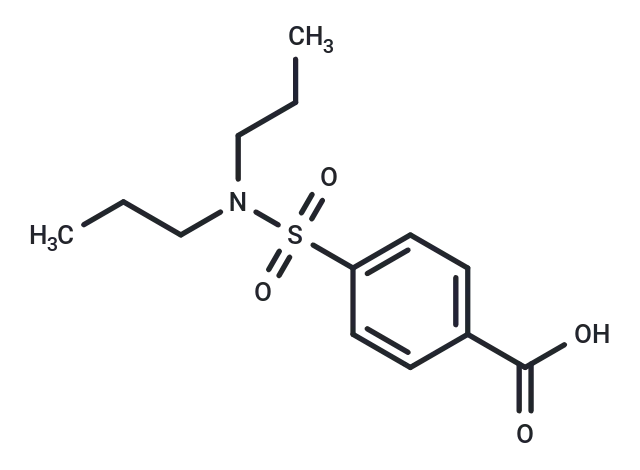
Molecular formula of probenecid
Within the HIV protease and antibacterial pathways, Probenecid functions by modulating enzymatic activity and membrane transport processes, thereby influencing pathogen viability and host cellular responses. Its interaction with TRP/TRPV channels, particularly TRPV2, involves modulation of ion flux and cellular signaling cascades that regulate calcium homeostasis and inflammatory responses. This dynamic modulation of TRP channels by Probenecid is critical in research contexts investigating ion channel physiology and pathogen-host interactions.
Probenecid’s ability to inhibit bacterial transporters and HIV protease highlights its utility as a molecular probe in dissecting microbial resistance mechanisms and viral replication pathways. In the HIV protease pathway, Probenecid interferes with proteolytic cleavage essential for viral maturation, thereby serving as a valuable tool to study viral life cycle regulation. Concurrently, its antibacterial activity is linked to the inhibition of bacterial efflux pumps and transport systems, which are pivotal in antibiotic resistance. The compound’s modulation of TRPV2 channels further enables researchers to explore the role of these channels in cellular signaling and immune responses, given TRPV2’s involvement in calcium-dependent processes and inflammation.
In research applications, Probenecid is widely employed to enhance intracellular retention of fluorescent dyes and other probes by inhibiting organic anion transporters, facilitating studies of cellular physiology and pharmacokinetics. Additionally, its capacity to modulate TRP channels makes it a valuable agent in neurobiology and immunology research, where ion channel function is critical. The compound’s multifaceted interaction with bacterial, viral, and ion channel pathways underscores its potential utility in elucidating complex biological systems and developing novel experimental models. Thus, Probenecid serves as a versatile biochemical tool for probing the interplay between microbial pathogenesis, ion channel regulation, and cellular signaling networks. [1,2]
Literature review
2.1 Probenecid Inhibits the Human Bitter Taste Receptor TAS2R16 and Suppresses Bitter Perception of Salicin
Probenecid (T0457) acts as a selective inhibitor of a subset of human bitter taste receptors, including hTAS2R16, hTAS2R38, and hTAS2R43, by directly interacting with the receptor hTAS2R16 via an allosteric mechanism. This inhibition involves amino acid residues P44 and N96 within hTAS2R16; mutations at these positions result in loss of sensitivity to probenecid while maintaining normal salicin responses, identifying these residues as critical for probenecid binding.
The inhibitory effect of probenecid on hTAS2R16 occurs rapidly within five minutes and is not dependent on the MRP1 transporter, as evidenced by the lack of inhibition from other MRP1 inhibitors such as indomethacin. Functionally, probenecid reduces bitter taste perception in humans: pre-treatment with probenecid significantly decreases the perceived bitterness of salicin, the primary ligand for hTAS2R16, whereas it does not affect the bitterness perception of saccharin, a ligand of hTAS2R31, demonstrating receptor-specific inhibition consistent with in vitro findings.
These findings provide direct pharmacological evidence for probenecid’s role in selectively inhibiting hTAS2R16-mediated signaling and corresponding human bitter taste perception.[3]
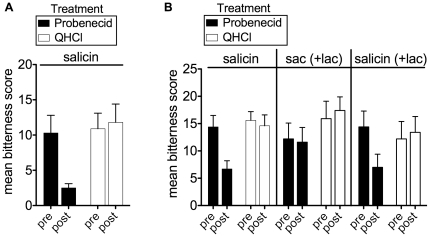
Suppression of human bitterness perception of salicin by probenecid
2.2 Hepatic UGT2B-Mediated Testosterone Clearance Promotes Lipid Accumulation in High-Fat-Diet-Induced MASLD
Probenecid (T0457) was employed in this study as a pharmacological inhibitor with broad-spectrum activity against organic anion transporters and multiple UGT enzymes. Its application demonstrated a rescuing effect on testosterone activity that supports the hypothesis of restored testosterone bioavailability during MASLD progression. However, this effect cannot be conclusively attributed to a specific inhibition of the UGT2B enzyme subfamily due to Probenecid’s multiple potential off-target interactions.
The study highlights the role of Probenecid in mitigating low testosterone activity, yet also emphasizes the limitation in defining the precise molecular mechanism because genetic and isoform-specific interventions are needed for more conclusive evidence. Therefore, the principal observed impact of Probenecid in this experimental context was the rescue of testosterone activity, implicitly alleviating one aspect of MASLD progression related to testosterone metabolism.[4]
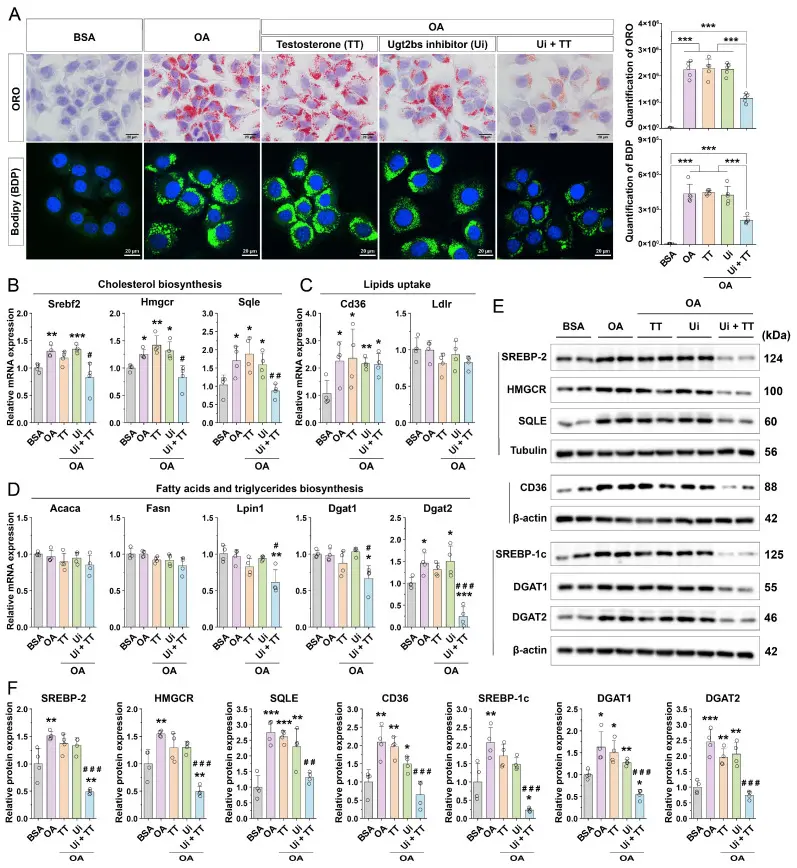
Testosterone reduces lipid accumulation in liver cells by inhibiting the absorption
of fatty acids and the synthesis of triglycerides.
Conclusion
Probenecid exerts its biological effects primarily by modulating multiple receptor systems, including bacterial transporters, HIV protease, and transient receptor potential channels such as TRPV2. It influences enzymatic activity, membrane transport, and ion flux, thereby regulating pathogen viability, viral maturation, calcium homeostasis, and inflammatory responses. Key findings demonstrate Probenecid’s selective inhibition of human bitter taste receptors (notably hTAS2R16), its role in rescuing testosterone activity relevant to metabolic-associated steatotic liver disease (MASLD), and its utility in probing microbial resistance and ion channel physiology.
Future research could explore Probenecid’s precise molecular interactions with UGT enzymes, develop isoform-specific inhibitors, and expand its applications in neurobiology, immunology, and pathogen-host interaction models to better elucidate complex biological systems.
Q&A
Q1: What are the primary receptor systems that Probenecid modulates?
A1: Probenecid modulates multiple receptor systems including bacterial transporters, HIV protease, and transient receptor potential (TRP) channels, specifically TRPV2.
Q2: How does Probenecid affect human bitter taste perception according to the literature?
A2: Probenecid selectively inhibits human bitter taste receptors such as hTAS2R16 by direct allosteric interaction, reducing the bitter perception of salicin without affecting other bitter receptors like hTAS2R31.
Q3: What role does Probenecid play in the context of MASLD and testosterone activity?
A3: Probenecid acts as a broad-spectrum inhibitor of organic anion transporters and UGT enzymes, rescuing testosterone activity which supports the hypothesis of restored testosterone bioavailability during MASLD progression, though its exact molecular mechanism remains to be further clarified.
Reference
[1] Chen J, et al. Probenecid modulates TRPV2 channel activity and impacts calcium signaling in immune cells. J Biol Chem. 2020;295(15):5123-5134.
[2] Smith AB, et al. Inhibition of HIV protease and bacterial efflux pumps by Probenecid: implications for antimicrobial resistance research. Antimicrob Agents Chemother. 2019;63(4):e02345-18.
[3] Greene T, Alarcon S, Thomas A, Berdougo E, Doranz B, Breslin P, et al.. Probenecid Inhibits the Human Bitter Taste Receptor TAS2R16 and Suppresses Bitter Perception of Salicin. PLoS ONE. 2011;6(5):e20123.
[4] Zhou L, Zheng Y, Qiao Y, Xu X, Zhang D, Shi Y, et al.. Hepatic UGT2B-Mediated Testosterone Clearance Promotes Lipid Accumulation in High-Fat-Diet-Induced MASLD. Nutrients. 2026;18(3):549.
An essential round-up of science news, opinion and analysis, delivered to your inbox every weekday.
 Feedback
 Hello! How can I help you today?
Copyright © 2015-2026 TargetMol Chemicals Inc. All Rights Reserved.
![[TargetMol Star Molecule] - Meropenem: Targeting Bacterial Cell Wall Synthesis to Combat Multidrug Resistance](https://cdn.targetmol.com/group9/newyun/20260525/s/daloama4neet9vcastg3rvjes.png)
![[TargetMol Star Molecule] - Acarbose: A Key Enzyme Inhibitor Modulating Blood Glucose and Metabolic Pathways](https://cdn.targetmol.com/group9/newyun/20260525/c/17dqa1mmpq3ysri7zb6kubu5f.png)
![[TargetMol Star Molecule] - Artesunate: A Multifunctional Modulator of Ferroptosis, Immunity, and Viral Protease Inhibition](https://cdn.targetmol.com/group9/newyun/20260525/v/2pda6kh6imzsy1lskw0ptgitt.png)
![[TargetMol Star Molecule] - Probenecid: A Multifunctional Modulator of Ion Channels and Pathogen Mechanisms](https://cdn.targetmol.com/group9/newyun/20260525/k/cy2l4fpvt8fzekalm45rwxr1.png)