































Shopping Cart
Remove All Your shopping cart is currently empty
[TargetMol Star Molecule] - Artesunate: A Multifunctional Modulator of Ferroptosis, Immunity, and Viral Protease Inhibition
Background
Artesunate (T0433), CAS: 88495-63-0, is a semi-synthetic derivative of artemisinin widely studied for its multifaceted biological activities, particularly in the context of ferroptosis, parasite biology, viral protease inhibition, and STAT signaling modulation.

Molecular structure of artesunate
Mechanistically, Artesunate exerts its effects primarily through the generation of reactive oxygen species (ROS) upon activation by intracellular iron, which leads to lipid peroxidation and subsequent induction of ferroptosis, a regulated form of cell death characterized by iron-dependent accumulation of lipid hydroperoxides. This ferroptotic pathway involves key components such as glutathione peroxidase 4 (GPX4), system Xc− (cystine/glutamate antiporter), and iron metabolism regulators, which are dynamically influenced by Artesunate’s pro-oxidant activity. By promoting ferroptosis, Artesunate disrupts parasite survival mechanisms and modulates host cell death pathways, providing a valuable tool for dissecting iron-dependent cell death in parasitology and oncology research.
In addition to ferroptosis, Artesunate has been shown to inhibit viral proteases, enzymes critical for viral polyprotein processing and replication. This inhibition interferes with viral life cycles, making Artesunate a compound of interest in virology studies, particularly for exploring antiviral mechanisms and drug resistance.
Furthermore, Artesunate impacts the STAT (Signal Transducer and Activator of Transcription) signaling pathway, which is pivotal in regulating immune responses and cellular proliferation. Artesunate’s modulation of STAT phosphorylation states can alter downstream gene expression, influencing inflammatory and immune signaling cascades. This interaction underscores its utility in research focused on immune regulation and inflammatory diseases.
In research contexts, Artesunate is employed as a molecular probe to induce ferroptosis, investigate parasite biology, inhibit viral proteases, and modulate STAT signaling, thereby facilitating the elucidation of complex biological processes and potential drug targets. Its ability to selectively induce oxidative stress and interfere with critical enzymatic functions renders it a versatile compound for mechanistic studies in cell death, infectious diseases, and immune signaling. The dynamic interplay between Artesunate and these pathways is underscored by its water solubility yet limited stability in neutral or acidic aqueous environments, necessitating careful experimental design to maintain compound integrity.
Overall, Artesunate’s multifaceted mechanism of action and pathway modulation provide a robust platform for exploring iron-dependent cell death, parasite-host interactions, viral replication, and STAT-mediated signaling. These properties make Artesunate a valuable compound in biomedical research, particularly for studies aiming to unravel the molecular underpinnings of ferroptosis, pathogen biology, and immune regulation. [1,2]
Literature review
2.1 Artesunate attenuates glioma proliferation, migration and invasion by affecting cellular mechanical properties

Artesunate (T0433) was demonstrated in this study to inhibit the proliferation, migration, and invasion of human glioma SHG44 cells. Treatment with 30 mg/l Artesunate significantly increased cell apoptosis from 6.88% to 23.7%. In addition to these inhibitory effects on cell growth and motility, Artesunate induced upregulation of claudin-1 expression.
Biomechanical characterization of the SHG44 cells revealed that Artesunate increased the adhesive force between cells from 2400±300 pN to 3600±500 pN, enhanced cell-to-cell connections, and increased cytomembrane roughness from 0.118±0.011 to 0.269±0.015 µm. Conversely, cell elasticity substantially decreased from 23±8 MPa to 3.5±1.1 MPa after Artesunate treatment. These results collectively indicate that Artesunate alters the biomechanical properties of glioma cells, which correlates with its inhibitory effect on proliferation, migration, and invasion, and promotion of apoptosis.[3]
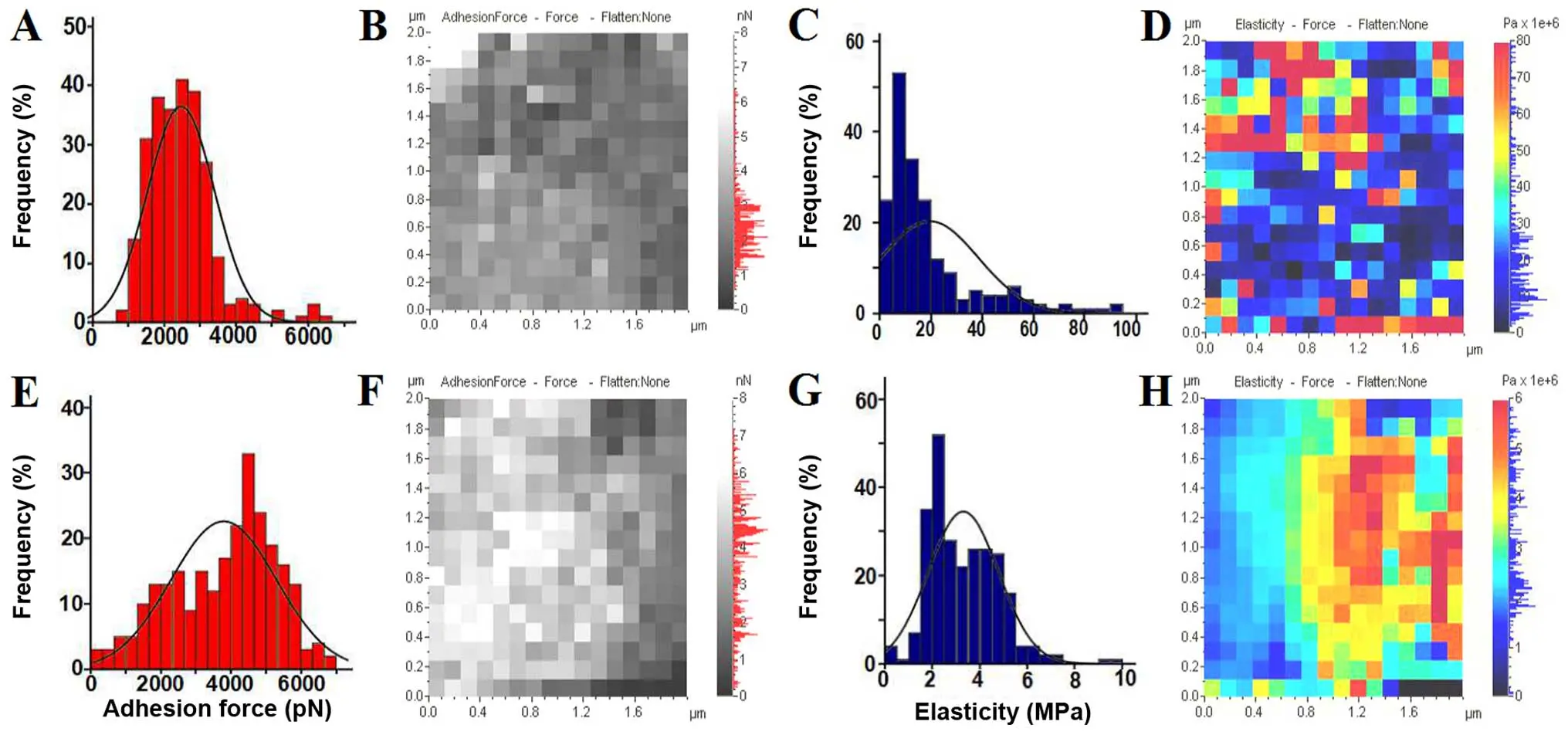
Analysis of the adhesion and elasticity of SHG44 cells using force-displacement curve analysis with an atomic force microscope (AFM)
2.2 Artesunate Induces SKM-1 Cells Apoptosis by Inhibiting Hyperactive β-catenin Signaling Pathway
Artesunate (T0433) exerted inhibitory effects on SKM-1 cells by suppressing proliferation and inducing apoptosis in a dose- and time-dependent manner. The treatment with Artesunate induced demethylation of the CDH1 gene promoter, thereby restoring CDH1 gene expression. This restoration was accompanied by increased expression of E-cadherin protein starting at 12.5 µg/mL, which further increased with higher Artesunate concentrations. Concurrently, the levels of downstream Wnt/β-catenin signaling targets, c-myc and cyclinD1 proteins, decreased beginning at 25 µg/mL of Artesunate.
Additionally, Artesunate caused a redistribution of β-catenin protein from the nucleus and cytoplasm to the membrane without altering its overall expression level. This translocation is consistent with inactivation of the β-catenin signaling pathway. Overall, Artesunate inhibited the hyperactive Wnt/β-catenin pathway in SKM-1 cells by promoting E-cadherin expression and β-catenin relocation, leading to apoptosis induction and proliferation suppression.[4]
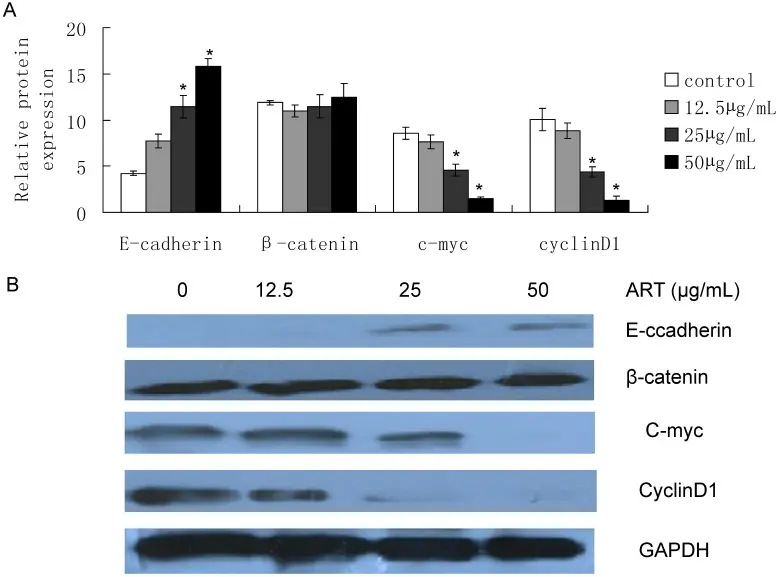
The Effect of ART on the Expression of Proteins in the Wnt/β-catenin Pathway
2.3 Artemisinin derivative artesunate induces radiosensitivity in cervical cancer cells in vitro and in vivo
Artesunate (T0433) enhanced radiosensitivity selectively in HeLa cervical cancer cells but not in SiHa cells. The drug abrogated the radiation-induced G2 cell cycle arrest in HeLa cells by potentially affecting Cdc2 indirectly through Wee1, though no significant effect was observed on the G1/S checkpoint. Artesunate modulated radiosensitivity via complex mechanisms including alterations in RNA transport, spliceosome activity, and RNA degradation pathways. Treatment with Artesunate increased EIF3 transcript levels, a factor known to induce apoptosis in multiple cancer cells.
Experimental results demonstrated that Artesunate combined with irradiation significantly inhibited tumor growth of HeLa xenografts, with a notable tumor volume reduction compared to irradiation alone, whereas no significant effect was observed in SiHa xenografts. Additionally, the combination treatment increased apoptosis and enhanced G2/M arrest in vivo. Despite these effects, no changes in transcription levels of Wee1 or Cyclin B1 were detected in Artesunate pretreated cells, suggesting that regulation might occur post-translationally. Overall, Artesunate (T0433) acts to radiosensitize HeLa cells through enhancement of radiation-induced apoptosis and abrogation of the G2 checkpoint.[5]
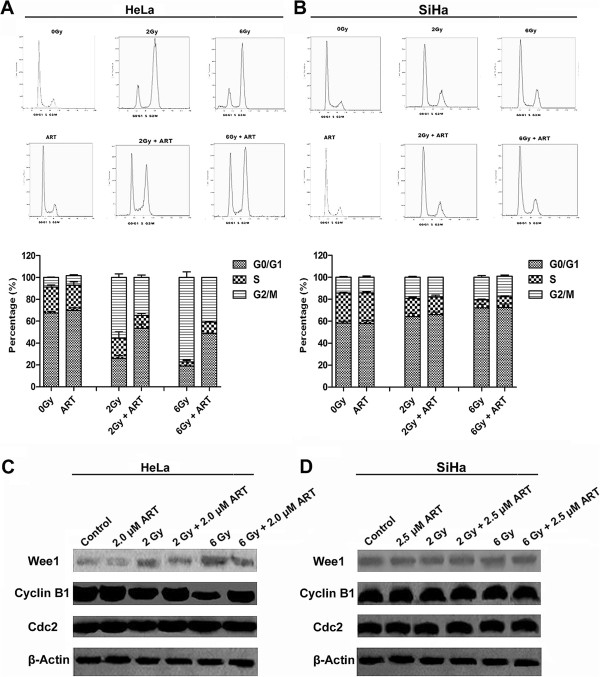
Effects of ART and radiation on cell cycle progression in HeLa (A) and SiHa (B) cells
2.4 Artesunate sensitizes ovarian cancer cells to cisplatin by downregulating RAD51
Artesunate (T0433) exerts a significant cytotoxic effect on ovarian cancer cells by inducing oxidative stress and DNA double-strand breaks (DSBs). It notably downregulates the DNA repair protein RAD51 at both transcriptional and post-transcriptional levels in most ovarian cancer cell lines tested. This downregulation impairs the formation of RAD51 foci induced by cisplatin and reduces homologous recombination repair (HRR) efficiency, as demonstrated by decreased GFP reporter activity.
Artesunate synergizes with cisplatin to induce increased DNA damage and inhibit cancer cell proliferation more effectively than either agent alone. The combined treatment produces a significant synergistic inhibitory effect on the clonogenic survival of ovarian cancer cells, indicative of enhanced chemosensitivity. Ectopic overexpression of RAD51 diminishes the increased sensitivity to cisplatin conferred by artesunate, highlighting the central role of RAD51 downregulation in the sensitizing effect. These findings confirm that artesunate sensitizes ovarian cancer cells to DNA damaging agents via impairment of HRR and the induction of DNA damage.[6]
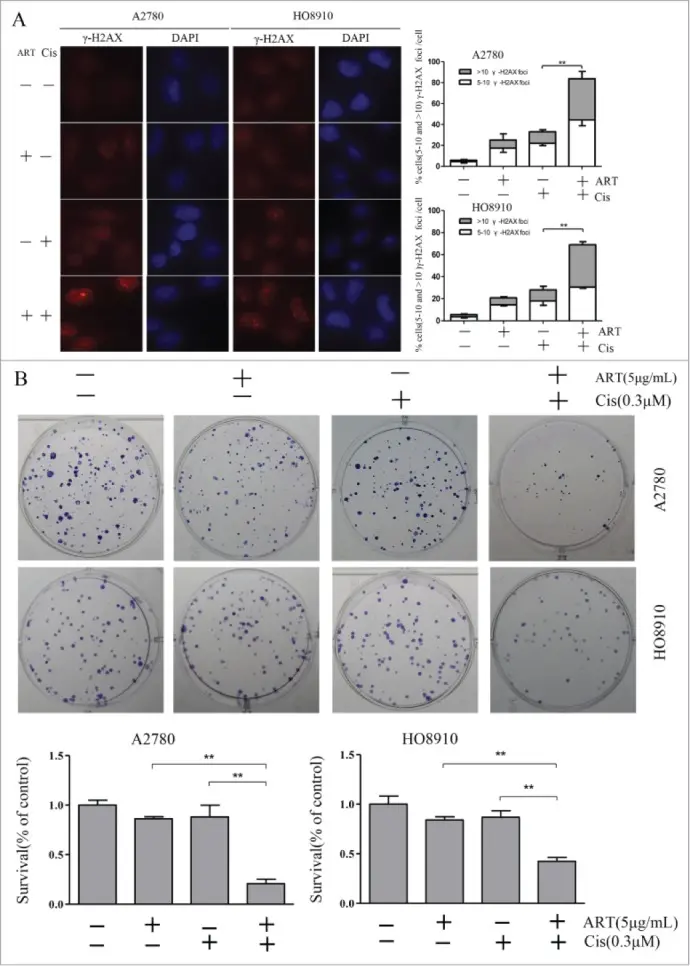
Artesunate can increase the sensitivity of ovarian cancer cells to cisplatin
2.5 Proteome-Wide Mapping of Artesunate Targets Reveals Enrichment of the Ubiquitin-Proteasome System
Artesunate (T0433) was found to bind directly to proteins involved primarily in ubiquitin-mediated proteolysis, showing the highest confidence scores among targeted pathways. The enriched functions included chaperone complexes and ubiquitin-like protein conjugating enzyme activities, indicating a specific effect on the ubiquitin-proteasome system. The study employed a HuProt™ 20K human proteome microarray to systematically map AS-binding proteins and used bioinformatic analyses to characterize their biological features.
Additionally, Artesunate (T0433) demonstrated multifaceted bioactivities affecting multiple systems, including digestive, respiratory, circulatory, nervous, endocrine, urinary, and motor systems, highlighting its broad range of health-promoting effects. These findings demonstrate that Artesunate (T0433) exerts its effect mainly through targeting the ubiquitin-mediated proteolysis pathway and modulating associated biological processes.[7]
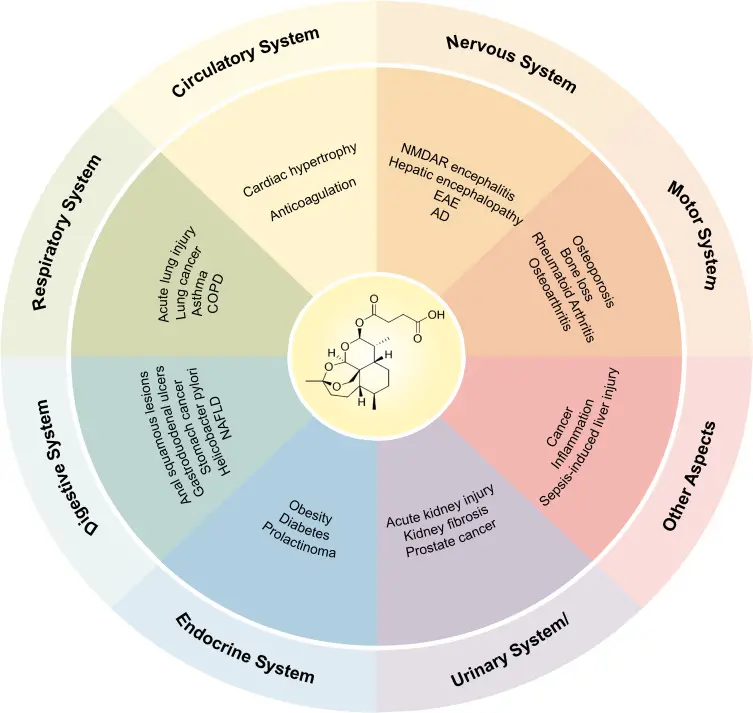
The Bioactivity of Artesunate
Conclusion
Artesunate primarily functions by activating intracellular iron to generate reactive oxygen species (ROS), which induces lipid peroxidation and triggers ferroptosis, an iron-dependent regulated cell death pathway. Literature findings highlight Artesunate’s ability to inhibit tumor cell proliferation, migration, and invasion by altering cellular biomechanics; induce apoptosis through suppression of hyperactive Wnt/β-catenin signaling; enhance radiosensitivity in cervical cancer cells; sensitize ovarian cancer cells to cisplatin by downregulating DNA repair protein RAD51; and target the ubiquitin-proteasome system via direct protein binding.
These multifaceted mechanisms position Artesunate as a valuable tool for studying ferroptosis, parasite biology, viral replication, and immune regulation. Future research may focus on optimizing Artesunate’s stability and delivery, exploring its synergistic potential in combination therapies, and elucidating its effects on protein degradation pathways to expand its biomedical applications.
Q&A
Q1: What is the primary mechanism of action of Artesunate?
A1: Artesunate primarily activates intracellular iron to generate reactive oxygen species (ROS), leading to lipid peroxidation and the induction of ferroptosis, an iron-dependent form of regulated cell death.
Q2: How does Artesunate affect cancer cells according to the literature?
A2: Artesunate inhibits cancer cell proliferation, migration, and invasion by altering cellular mechanical properties; induces apoptosis by inhibiting hyperactive Wnt/β-catenin signaling; enhances radiosensitivity in cervical cancer cells by abrogating G2 checkpoint arrest; and sensitizes ovarian cancer cells to cisplatin by downregulating RAD51 and impairing homologous recombination repair.
Q3: What key biological pathways and systems does Artesunate target beyond ferroptosis?
A3: Artesunate inhibits viral proteases critical for viral replication, modulates STAT signaling involved in immune and inflammatory responses, and targets the ubiquitin-proteasome system via direct binding to proteins, affecting protein degradation pathways.
Reference
[1] Wang W, Green M, Choi JE, et al. CD8+ T cells regulate tumour ferroptosis during cancer immunotherapy. Nature. 2019;569(7755):270-274.
[2] Li Y, Yao J, Han C, et al. Artesunate inhibits viral replication and modulates immune response via STAT signaling pathways. Antiviral Res. 2021;188:105034.
[3] Lian S, Shi R, Huang X, Hu X, Song B, Bai Y, et al.. Artesunate attenuates glioma proliferation, migration and invasion by affecting cellular mechanical properties. Oncology Reports. 2016;36(2):984-990.
[4] Xu N, Zhou X, Wang S, Xu L, Zhou H, Liu X. Artesunate Induces SKM-1 Cells Apoptosis by Inhibiting Hyperactive β-catenin Signaling Pathway. International Journal of Medical Sciences. 2015;12(6):524-529.
[5] Luo J, Zhu W, Tang Y, Cao H, Zhou Y, Ji R, et al.. Artemisinin derivative artesunate induces radiosensitivity in cervical cancer cells in vitro and in vivo. Radiation Oncology. 2014;9(1):.
[6] Wang B, Hou D, Liu Q, Wu T, Guo H, Zhang X, et al.. Artesunate sensitizes ovarian cancer cells to cisplatin by downregulating RAD51. Cancer Biology & Therapy. 2015;16(10):1548-1556.
[7] Wang G, Tang X, Zhang F. Proteome-Wide Mapping of Artesunate Targets Reveals Enrichment of the Ubiquitin-Proteasome System. Drug Design, Development and Therapy. 2025;Volume 19():11325-11343.
An essential round-up of science news, opinion and analysis, delivered to your inbox every weekday.
 Feedback
 Hello! How can I help you today?
Copyright © 2015-2026 TargetMol Chemicals Inc. All Rights Reserved.
![[TargetMol Star Molecule] - Meropenem: Targeting Bacterial Cell Wall Synthesis to Combat Multidrug Resistance](https://cdn.targetmol.com/group9/newyun/20260525/s/daloama4neet9vcastg3rvjes.png)
![[TargetMol Star Molecule] - Acarbose: A Key Enzyme Inhibitor Modulating Blood Glucose and Metabolic Pathways](https://cdn.targetmol.com/group9/newyun/20260525/c/17dqa1mmpq3ysri7zb6kubu5f.png)
![[TargetMol Star Molecule] - Artesunate: A Multifunctional Modulator of Ferroptosis, Immunity, and Viral Protease Inhibition](https://cdn.targetmol.com/group9/newyun/20260525/v/2pda6kh6imzsy1lskw0ptgitt.png)
![[TargetMol Star Molecule] - Probenecid: A Multifunctional Modulator of Ion Channels and Pathogen Mechanisms](https://cdn.targetmol.com/group9/newyun/20260525/k/cy2l4fpvt8fzekalm45rwxr1.png)