































Shopping Cart
Remove All Your shopping cart is currently empty
TargetMol Star Compound—MK-2206 dihydrochloride (Catalog No. T1952, CAS 1032350-13-2), allosterically locks Akt to precisely regulate cell survival and proliferation
MK-2206 dihydrochloride, catalog number T1952, CAS 1032350-13-2, also known as MK-2206 2HCl.
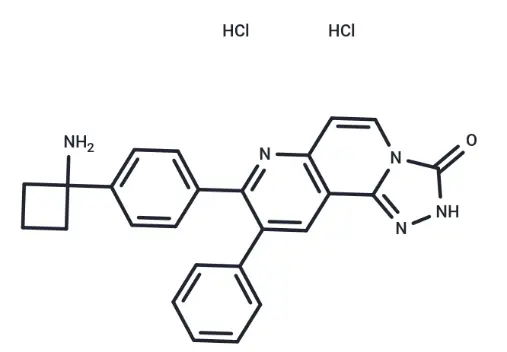
Molecular Structure of MK-2206 Dihydrochloride
1. Background
Allosteric inhibition is a highly specific small-molecule regulatory mechanism in which the inhibitor does not compete with the substrate or ATP for the active site, but instead binds to an allosteric site outside the active site of the target protein. By inducing reversible changes in the protein’s spatial conformation, it indirectly blocks the protein’s catalytic function, protein-protein interactions, or downstream signal transduction, thereby achieving precise inhibition of the target protein.
Compared to traditional competitive inhibition, allosteric inhibition offers higher selectivity and safety: the sequences and structures of allosteric sites vary more significantly among homologous proteins, making off-target effects less likely; simultaneously, allosteric inhibition does not depend on competition with ATP concentrations, resulting in more stable and sustained inhibitory effects within cells.
In the development of kinase-targeted drugs, allosteric inhibitors can prevent kinase phosphorylation and block its binding to upstream activators or downstream substrates, thereby maintaining the kinase in an inactive conformation. Since allosteric inhibition does not occupy the highly conserved ATP-binding pocket, it can effectively overcome resistance issues caused by mutations in the ATP-binding site and reduce cross-inhibition of other kinases, making it the preferred strategy for targeted drug development. DNA methylation is a highly conserved and extensively studied epigenetic mechanism in eukaryotes.
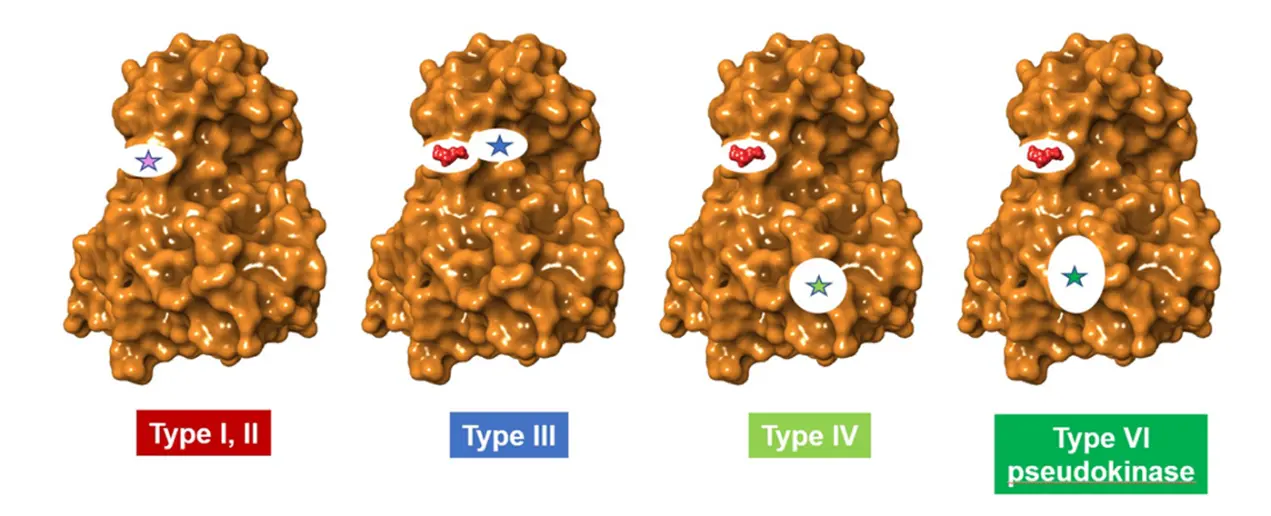
Schematic of allosteric inhibition [1]
MK-2206 dihydrochloride is a highly potent and selective oral Akt allosteric inhibitor. By blocking Akt phosphorylation and downstream oncogenic signaling, it inhibits tumor proliferation, induces apoptosis, reverses drug resistance, and suppresses metastasis. It serves as both a core tool molecule for basic research and an important clinical candidate for targeting the PI3K/Akt pathway, particularly for studying tumor progression and resistance mechanisms driven by abnormal Akt activation.
2. Selected Literature
2.1 Article Title:Autophagy-enhancing strategies to promote intestinal viral resistance and mucosal barrier function in SARS-CoV-2infection

Study Overview: This study demonstrates that MK-2206 dihydrochloride (an Akt allosteric inhibitor) significantly inhibits SARS-CoV-2 invasion of human intestinal epithelial cells by enhancing SNAP29-dependent autophagy, while also protecting intestinal barrier integrity and mitigating virus-induced barrier damage; It was also found that the ATG16L1 rs6861 (TT) genotype exhibits higher endogenous autophagy flux and greater resistance to SARS-CoV-2, suggesting that enhancing autophagy is a potential host-targeted strategy. [2]
This study found that intestinal epithelial cells with the ATG16L1rs6861(TT) genotype exhibit significantly reduced susceptibility to SARS-CoV-2 due to enhanced endogenous autophagy flux. The Akt inhibitor MK-2206 dihydrochloride significantly enhances autophagy flux and inhibits viral invasion of the intestinal epithelium; this effect depends on the SNAP29-mediated autophagy-lysosomal degradation pathway. Additionally, MK-2206 dihydrochloride effectively reverses SARS-CoV-2-induced disruption of the intestinal epithelial barrier structure and maintains cell junction integrity, providing a new strategy for targeting autophagy to prevent and treat COVID-19 intestinal infections and their sequelae.
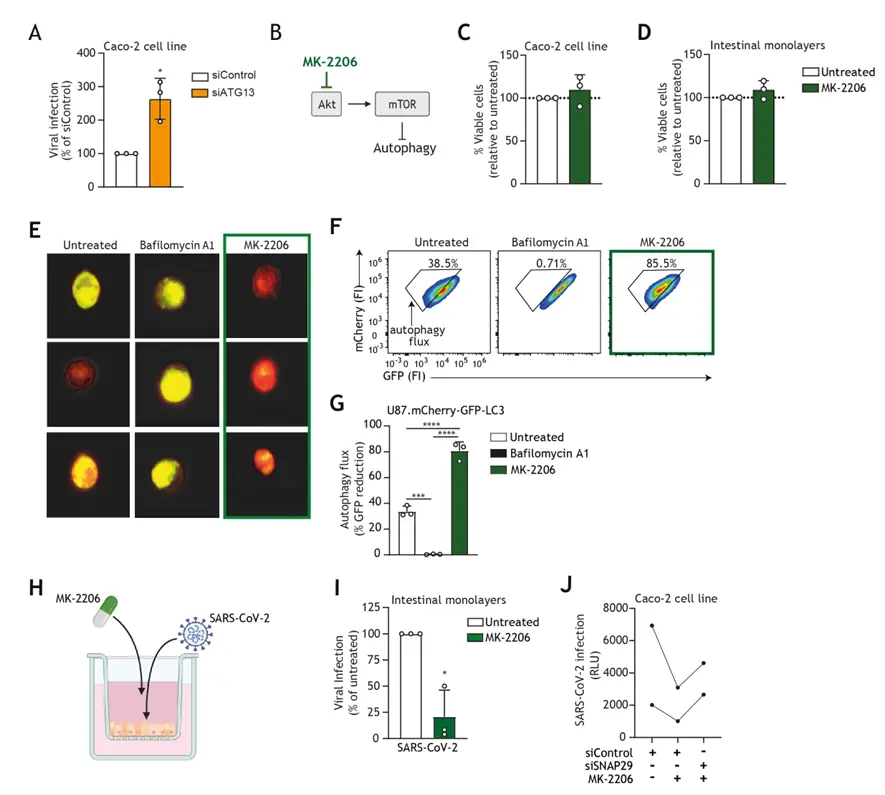
MK-2206 dihydrochloride enhances autophagy and inhibits intestinal SARS-CoV-2 infection
2.2 Article Title:Context-dependent antagonism between Akt inhibitors and topoisomerase poisons

Study Overview: This study found that the combination of Akt inhibitors (A-443654/MK-2206 dihydrochloride) with chemotherapeutic agents exhibits a high degree of context-dependence: synergistic effects are consistently observed when combined with DNA-crosslinking agents such as cisplatin and melphalan; however, when combined with topoisomerase inhibitors (camptothecin, etoposide), they exhibit synergy at low concentrations and antagonism at high concentrations; this antagonism occurs exclusively in PI3KCA wild-type cells, with the mechanism being that excessive Akt inhibition reduces DNA synthesis, thereby mitigating DNA damage induced by topoisomerase inhibitors; in PI3KCA mutant cells, synergy is observed throughout the entire process. [3]
This study confirms that Akt inhibitors (A-443654/MK-2206 dihydrochloride) significantly inhibit Akt substrate phosphorylation and suppress cell proliferation. These inhibitors exhibit consistent synergy (CI < 1) with DNA cross-linking agents but concentration- and context-dependent antagonism with topoisomerase inhibitors, with pronounced antagonism at high concentrations (CI > 1). Mechanistic analysis revealed that high concentrations of the Akt inhibitor reduce DNA damage induced by topoisomerase inhibitors by decreasing DNA synthesis. Furthermore, this antagonism was observed only in PI3KCA wild-type cells, whereas mutant cells exhibited synergy throughout the experiment, suggesting that the PI3KCA background determines
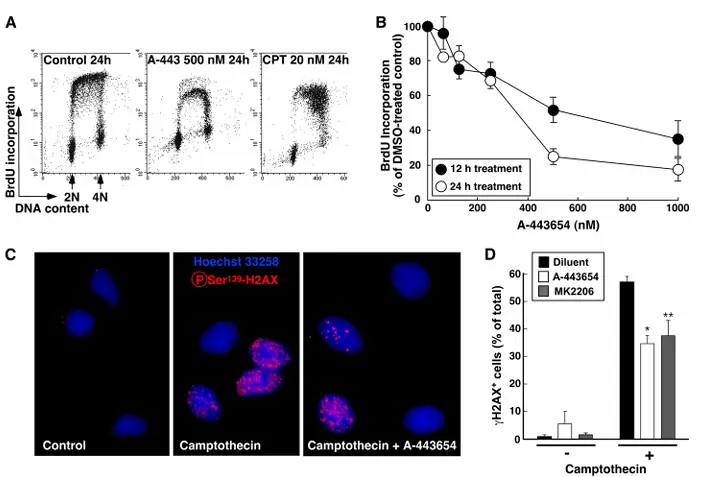
High concentrations of MK-2206 dihydrochloride significantly inhibit DNA synthesis
2.3 Article Title:Thiocoraline mediates drug resistance in MCF-
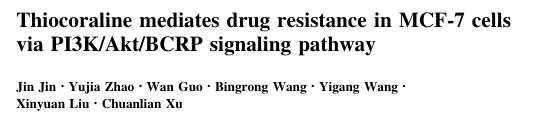
Study Overview: This study found that thiocoraline induces resistance in MCF-7 breast cancer cells by activating the PI3K/Akt/BCRP pathway; in the resistant MCF-7/T strain, p-Akt and BCRP levels were significantly elevated, and this resistance could be reversed by the Akt inhibitor MK-2206 dihydrochloride.
This study investigated the cytotoxic effects of thiocoraline on MCF-7 breast cancer cells and the mechanisms underlying drug resistance. Results showed that thiocoraline exhibited potent cytotoxic activity against MCF-7 cells with an IC₅₀ of 53.8 nM, while demonstrating low toxicity to normal liver cells. A drug-resistant strain, MCF-7/T, was successfully established through stepwise induction; this strain exhibited reduced clonogenic capacity and significantly elevated expression of Akt, p-Akt, and BCRP. Thiocoraline activates Akt phosphorylation in a dose-dependent manner, and overexpression of Akt1 reduces cellular drug sensitivity. The Akt inhibitor MK-2206 dihydrochloride significantly inhibits Akt phosphorylation and restores the sensitivity of resistant cells to thiocoraline. This confirms that thiocoraline mediates resistance through the PI3K/Akt/BCRP pathway, and that
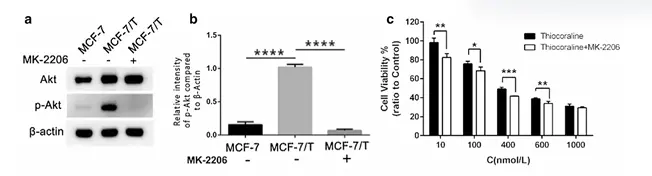
MK-2206 dihydrochloride inhibits Akt phosphorylation and restores drug sensitivity
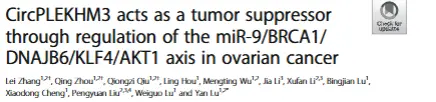
Research Overview: This study focuses on the role of circPLEKHM3 in ovarian cancer, confirming that it is a tumor-suppressive circular RNA. By binding to miR-9, it upregulates BRCA1, DNAJB6, and KLF4, thereby inactivating the AKT1 and Wnt/β-catenin pathways to inhibit tumor progression. Additionally, the study proposes that the AKT inhibitor MK-2206, in combination with paclitaxel, can synergistically kill ovarian cancer cells with low circPLEKHM3 expression.
MK-2206 (Catalog No. T1952) serves as a key tool molecule and potential therapeutic agent in this study: it is used to validate that circPLEKHM3 exerts an anticancer effect via AKT1 and to block the excessive activation of AKT1 caused by the loss of circPLEKHM3; It also confirms that circPLEKHM3 enhances the growth-inhibitory effects of paclitaxel on ovarian cancer cells, with a particularly pronounced synergistic effect in cells with low circPLEKHM3 expression, thereby providing experimental evidence for combination therapy in ovarian cancer.
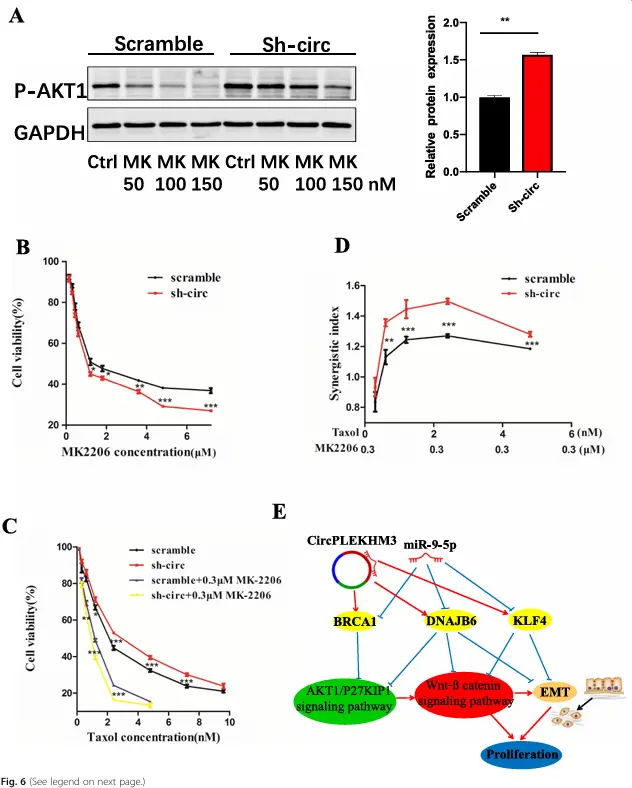
MK-2206 inhibits the AKT pathway and enhances the efficacy of chemotherapy drugs
References
[1]Pan Y,Mader MM.Principles of Kinase Allosteric Inhibition and Pocket Validation.J Med Chem.2022;65(7):5288-5299. doi:10.1021/acs.jmedchem.2c00073
[2]Rader AG,Cloherty APM,Patel KS,et al.Autophagy-enhancing strategies to promote intestinal viral resistance and mucosal barrier function in SARS-CoV-2infection.Autophagy Rep.2025;4(1):2514232.Published 2025 Jun 10. doi:10.1080/27694127.2025.2514232
[3]Gálvez-Peralta M,Flatten KS,Loegering DA,et al.Context-dependent antagonism between Akt inhibitors and topoisomerase poisons.Mol Pharmacol.2014;85(5):723-734.doi:10.1124/mol.113.088674
[4]Jin J,Zhao Y,Guo W,et al.Thiocoraline mediates drug resistance in MCF-7cells via PI3K/Akt/BCRP signaling pathway.Cytotechnology.2019;71(1):401-409.doi:10.1007/s10616-019-00301-w
[5]Zhang L, Zhou Q, Qiu Q, et al. CircPLEKHM3 acts as a tumor suppressor through regulation of the miR-9/BRCA1/DNAJB6/KLF4/AKT1 axis in ovarian cancer. Mol Cancer. 2019;18(1):144. Published 2019 Oct 17. doi:10.1186/s12943-019-1080-5
An essential round-up of science news, opinion and analysis, delivered to your inbox every weekday.
 Feedback
 Hello! How can I help you today?
Copyright © 2015-2026 TargetMol Chemicals Inc. All Rights Reserved.



![[TargetMol Star Molecule] - Meropenem: Targeting Bacterial Cell Wall Synthesis to Combat Multidrug Resistance](https://cdn.targetmol.com/group9/newyun/20260525/s/daloama4neet9vcastg3rvjes.png)
![[TargetMol Star Molecule] - Acarbose: A Key Enzyme Inhibitor Modulating Blood Glucose and Metabolic Pathways](https://cdn.targetmol.com/group9/newyun/20260525/c/17dqa1mmpq3ysri7zb6kubu5f.png)