Shopping Cart
Remove All Your shopping cart is currently empty
TargetMol—Natural Product—2-Deoxy-D-glucose (Cat. No. T6742, CAS. 154-17-6), Glycolysis Path Blocker
1. Product Introduction
2-Deoxy-D-glucose (Cat. No. T6742, CAS. 154-17-6), also known as NSC 15193, D-Arabino-2-deoxyhexose, Ba 2758, 2-DG, 2-deoxyglucose, 2-Deoxy-D-arabino-hexose. 2-Deoxy-D-glucose ( 2-DG ), a glucose analogue, is a glycolytic inhibitor. 2-Deoxy-D-glucose has antiviral activity, and also has the activity of inhibiting cell proliferation and inducing apoptosis.
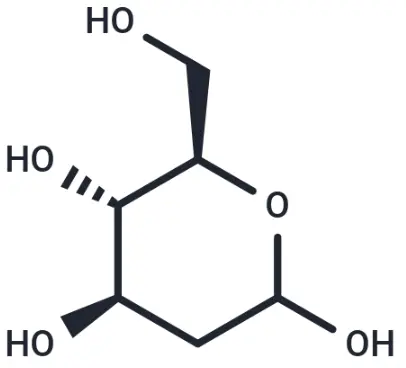
Molecular structure of 2-Deoxy-D-glucose
2. Background Introduction
Metabolic reprogramming of tumor cells is one of the core features of their survival and proliferation. The most typical manifestation is the ' Warburg effect ', that is, even under aerobic conditions, tumor cells still preferentially obtain energy through the glycolysis pathway and accumulate biosynthetic intermediates. This phenomenon of high glucose uptake and lactic acid production is common in a variety of malignant tumors. This metabolic feature depends on the high expression of glucose transporters ( such as GLUTs ) and key glycolytic enzymes ( such as hexokinase, lactate dehydrogenase, etc. ), as well as the regulatory changes caused by abnormal activation of signaling pathways in cancer cells, so that the utilization of glucose in tumor cells is significantly higher than that in normal cells. Inhibition of these key nodes can interfere with the energy supply of cancer cells, thereby inhibiting their growth. Targeting the glucose metabolism pathway is one of the most widely studied strategies in cancer treatment. [1]
2-Deoxy-D-glucose is a structural analogue of glucose, and its metabolic pathway in cells is similar to that of glucose. However, the absence of a key hydroxyl group in the molecular structure makes it impossible to complete the normal glycolysis process. After 2-Deoxy-D-glucose enters cells through glucose transporters, it is phosphorylated by hexokinase ( HK ) to 2-deoxy-D-glucose-6-phosphate ( 2-DG-6-P ), but this phosphorylation product cannot be further metabolized by subsequent glycolytic enzymes ( such as glucose phosphate isomerase ), thereby accumulating in cells. The accumulation of 2-DG-6-P blocks the glycolytic pathway by non-competitively inhibiting the activity of enzymes such as hexokinase, resulting in a decrease in ATP production and energy depletion. In addition, the intervention of 2-Deoxy-D-glucose may also increase oxidative stress, interfere with the N-linked glycosylation process, and induce apoptosis and other cellular stress responses. Due to the high dependence of tumor cells on glucose metabolism, this blocking of energy metabolism will have a significant impact on their survival. Therefore, 2-Deoxy-D-glucose is considered as a potential metabolic intervention drug. Although the efficacy of single use is limited, it may enhance the anti-tumor effect in combination with chemotherapy or radiotherapy. [2]
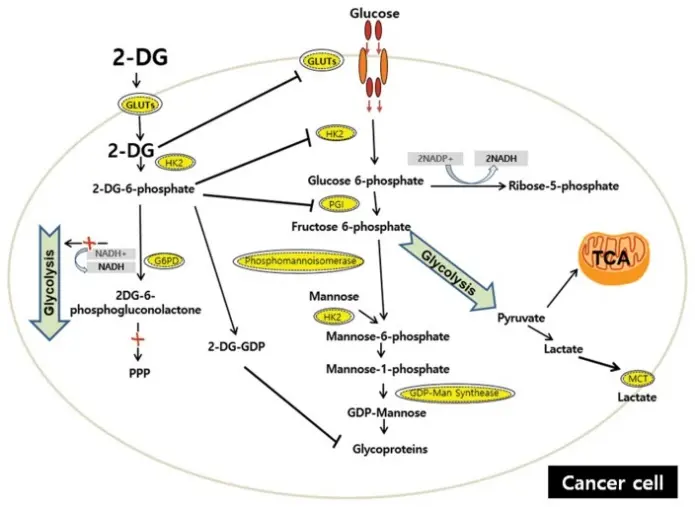
The target of 2-Deoxy-D-glucose [1]
3. Application References
Effect of 2-deoxy-D-glucose on gellan gum biosynthesis by Sphingomonas paucimobilis

Research Overview:
In this study, the effect of glucose analogue 2-Deoxy-D-glucose as a metabolic regulator on the synthesis of gellan gum by Sphingomonas paucimobilis was investigated. The results showed that 2-Deoxy-D-glucose can effectively regulate the physiological state of cells and significantly change the synthesis efficiency and structural characteristics of extracellular polysaccharides by interfering with the glycolytic pathway and the metabolic flow of intracellular glyconucleotide precursors. This discovery not only reveals the regulation mechanism of metabolic inhibitors on microbial polysaccharide biosynthesis, but also provides a theoretical basis for directional optimization of fermentation yield and control of product quality through chemical strategies, and opens up new intervention ideas for improving product yield and characteristic regulation in industrial microbial engineering. [3]
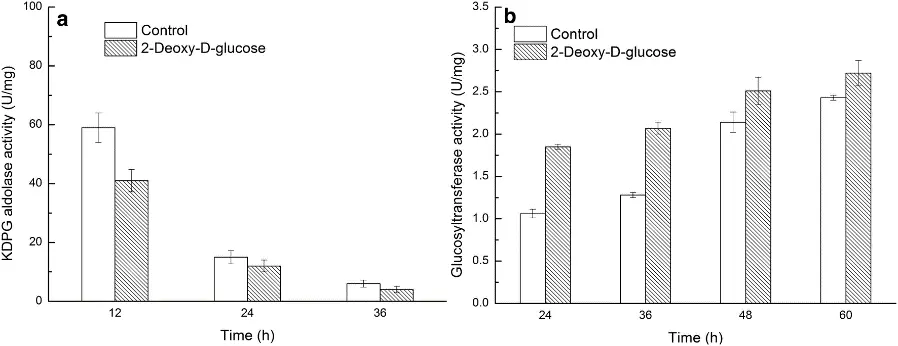
The effect of 2-Deoxy-D-glucose on the activity of KDPG aldolase and glucosyltransferase [3]
Cascade-targeting pH/ROS microneedles promote scarless diabetic wound healing by macrophage metaboimmune reprogramming

Research Overview:
In this study, a microneedle system with cascade targeting function and pH / ROS dual responsiveness was developed, which effectively promoted the scarless healing of diabetic wounds by metaboimmune reprogramming of macrophages. The system can accurately target the inflammatory cells in the wound microenvironment, and induce the transformation of macrophages from pro-inflammatory M1 type to pro-repair M2 type by reducing the level of oxidative stress and regulating the energy metabolism pathway of cells, thus overcoming the clinical problems of long-term non-healing of diabetic wounds and easy scar formation, and providing an innovative biomaterial strategy for the precise treatment of chronic complex wounds. [4]
In this experiment, 2-Deoxy-D-glucose was used as an instrumental reagent for the determination of glucose metabolism in macrophages. When the glycolysis activity of macrophages was evaluated by Seahorse XF cell metabolic analyzer, glucose, oligomycin ( OM ) and 2-Deoxy-D-glucose were injected in turn in the detection of extracellular acidification rate ( ECAR ). Among them, 2-Deoxy-D-glucose was used to inhibit the glycolysis pathway to verify the changes of glycolysis-related parameters ( such as glycolysis capacity and reserve ). As a standardized compound for experimental inhibition of glycolysis, the energy metabolism reprogramming of macrophages under different treatment conditions was analyzed.
4. References
[1] Tran Q, Lee H, Park J, Kim SH, Park J. Targeting Cancer Metabolism - Revisiting the Warburg Effects. Toxicol Res. 2016 Jul;32(3):177-93. doi: 10.5487/TR.2016.32.3.177. Epub 2016 Jul 30. PMID: 27437085; PMCID: PMC4946416.
[2] Zhang D, Li J, Wang F, Hu J, Wang S, Sun Y. 2-Deoxy-D-glucose targeting of glucose metabolism in cancer cells as a potential therapy. Cancer Lett. 2014 Dec 28;355(2):176-83. doi: 10.1016/j.canlet.2014.09.003
[3] Zhu G, Guo N, Yong Y, Xiong Y, Tong Q. Effect of 2-deoxy-D-glucose on gellan gum biosynthesis by Sphingomonas paucimobilis. Bioprocess Biosyst Eng. 2019 May;42(5):897-900. doi: 10.1007/s00449-019-02078-w
[4] Yang G, Yang J, Diao Z, Long J, Shu Z, Liu C, Wan W. Cascade-targeting pH/ROS microneedles promote scarless diabetic wound healing by macrophage metaboimmune reprogramming. Sci Adv. 2025 Oct 31;11(44):eadw3834. doi: 10.1126/sciadv.adw3834

An essential round-up of science news, opinion and analysis, delivered to your inbox every weekday.
 Feedback
 Hello! How can I help you today?
Copyright © 2015-2026 TargetMol Chemicals Inc. All Rights Reserved.