Shopping Cart
Remove All Your shopping cart is currently empty
TargetMol—Signaling Pathway—SB-431542 (Cat. No.T1726, CAS. 301836-41-9), Press the TGF-β signal pause button
1. Product Introduction
SB-431542 (Cat. No. T1726, CAS. 301836-41-9), also known as SB 431542. SB-431542 is a selective inhibitor of ALK5 / TGF-β type I Receptor ( IC50 = 94 nM ). SB-431542 also had inhibitory activity on ALK4 and ALK7, but had no inhibitory effect on other proteins. SB-431542 can be used to induce the differentiation of stem cells.
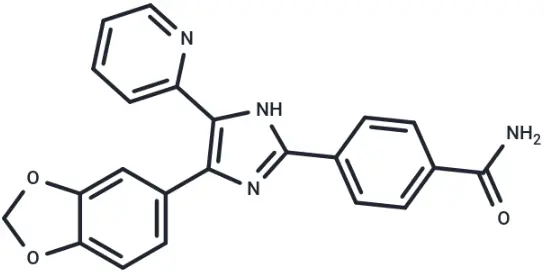
Molecular structure of SB-431542
2. Background Introduction
TGF-β receptor kinase ( especially Activin receptor-like kinase 5, ALK5 ) is a key cell signal transduction molecule, which belongs to the serine / threonine kinase receptor family. They mainly include TGF-β type I receptors ( also known as ALK5 ), type II receptors, etc., and control key biological processes such as cell proliferation, differentiation, migration, extracellular matrix production, and immune regulation by regulating SMAD-dependent and independent pathways. Abnormal TGF-β signaling pathway is closely related to a variety of pathological conditions, such as fibrosis, tumor progression and metastasis, immunosuppressive microenvironment formation, etc. In many tumor cells, TGF-βsignaling can not only inhibit early tumor growth, but also promote invasion and metastasis in tumor progression, so it has become an important target for tumor treatment research. In addition, TGF-β also plays a central role in organ fibrosis diseases ( such as liver fibrosis, pulmonary fibrosis ), and promotes pathological fibrosis by activating fibroblasts and inducing epithelial-mesenchymal transition ( EMT ). [1]
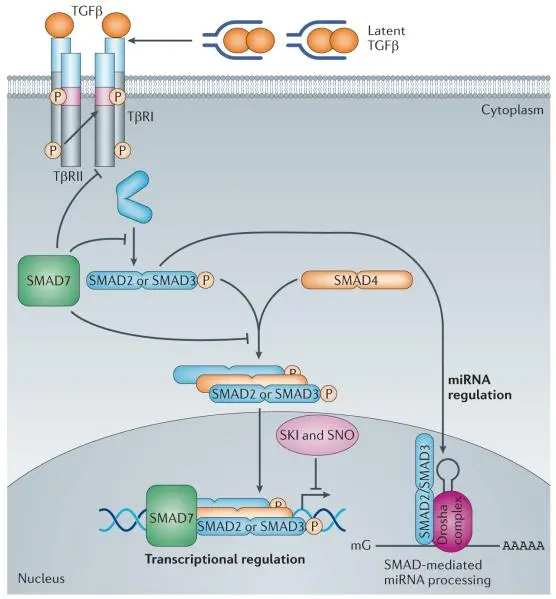
Overview of the classic SMAD-dependent TGFβ signaling pathway [1]
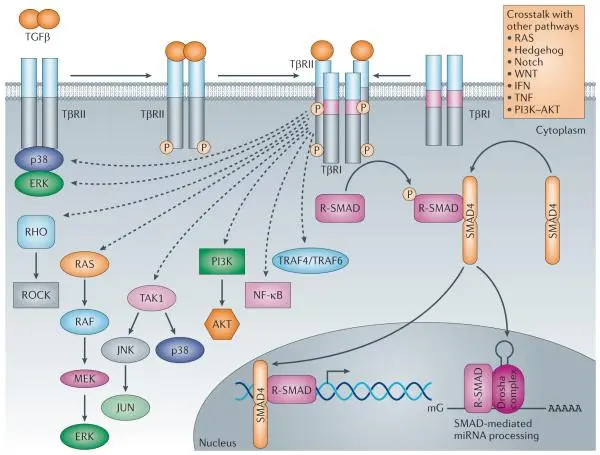
Non-classical TGFβ signaling and crosstalk with other signaling pathways [1]
SB-431542 is a selective small molecule inhibitor that mainly targets TGF-β receptor I kinase ( ALK5 ), and also has inhibitory activity against Activin receptor-like kinases ALK4 and ALK7. By competitively binding to the ATP-binding pocket, SB-431542 blocks the phosphorylation activity of receptor I kinase, thereby inhibiting the phosphorylation and nuclear translocation of downstream SMAD2 / 3 and terminating TGF-β / Smad-dependent signaling. This inhibitory effect not only effectively blocks TGF-β-mediated apoptosis, EMT, and fibrosis, but is also widely used in in vitro experiments to maintain stem cell status or prevent the formation of fibrotic phenotypes. Due to its high selectivity and reversibility, SB-431542 has become an important chemical probe for studying the biological function of TGF-β pathway and developing related therapeutic strategies. [2]
3. Application References
ALK5 Inhibition of Subconjunctival Scarring From Glaucoma Surgery: Effects of SB-431542 Compared to Mitomycin C in Human Tenon's Capsule Fibroblasts
Research Overview:
In this study, human Tenon 's capsule fibroblasts ( HTCFs ) were used as an in vitro model to compare the effects of ALK5 inhibitor SB-431542 and clinical commonly used anti-scar drug Mitomycin C ( MMC ) on inhibiting subconjunctival scar formation after glaucoma filtration surgery. It was found that SB-431542 significantly reduced TGF-β-induced fibroblast proliferation, migration and myofibroblast differentiation by specifically inhibiting the activity of TGF-β receptor I ( ALK5 ) kinase, which was manifested by decreased expression of fibrosis-related markers such as α-SMA, collagen I and fibronectin, and effectively blocked the phosphorylation of SMAD2 / 3. Different from the mechanism by which MMC inhibits cell proliferation through cytotoxicity, SB-431542 selectively inhibits fibrosis phenotype without significantly affecting cell viability, suggesting that it may be used as a more targeted and less side-effect anti-scar strategy. This study provides an important experimental basis for the use of ALK5 inhibitors to regulate TGF-β / SMAD signaling to prevent postoperative scar formation. [3]
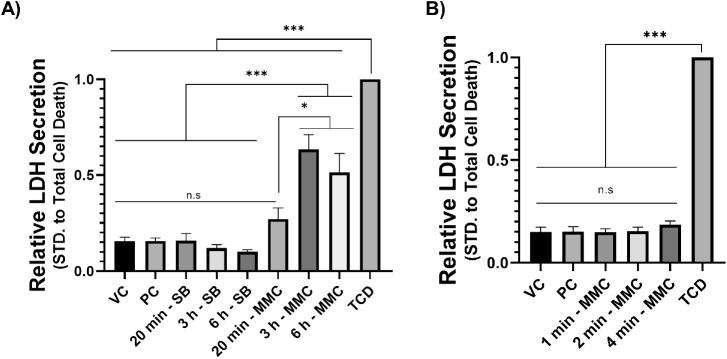
The average LDH concentration of HTCF after pretreatment with SB-431542 or MMC [3]
A Human Neural Tube Model Using 4D Self‐Folding Smart Scaffolds
Research Overview:
This study developed and validated a novel in vitro model of human neural tube ( 4D-NT ) that combines induced pluripotent stem cell ( iPSCs ) differentiation technology and 4D self-folding smart scaffolds ( bioprinted structures that can be deformed over time ) to more realistically simulate the neural tube formation process. The researchers prepared scaffolds composed of bilayer materials with different expansion properties. These scaffolds spontaneously folded after hydration to form a three-dimensional structure similar to a neural tube, and then iPSC-derived neural progenitor cells were seeded on its surface. Compared with traditional 2D monolayer or static 3D models, this 4D-NT not only supports efficient neural fate induction and polar neural precursor tissue, but also its cell spatial arrangement and structural characteristics are closer to the development of early human embryonic neural tube in morphology and molecular markers. At the same time, the study also demonstrated the use of this platform to reproduce the pathological features of primary microcephaly associated with WDR62 gene mutation, indicating that 4D-NT is a dynamic in vitro model that can be used to study human neural development and related disease mechanisms. [4]
In this study, SB-431542 ( Cat.No.T1726 ) was used as an inhibitor of TGF-β / Activin / Nodal signaling pathway, and its main purpose was to promote neural induction at the early stage of iPSC differentiation into neuroectoderm. By inhibiting the activity of ALK4 / 5 / 7 receptor, SB-431542 blocked Smad2 / 3-dependent TGF-β signaling, thereby inhibiting the differentiation tendency of mesoderm and endoderm, and promoting cells to enter the neural progenitor cell lineage more efficiently and more purely.
4. References
[1] Akhurst RJ, Hata A. Targeting the TGFβ signalling pathway in disease. Nat Rev Drug Discov. 2012 Oct;11(10):790-811. doi: 10.1038/nrd3810
[2] Inman GJ, Nicolás FJ, Callahan JF, Harling JD, Gaster LM, Reith AD, Laping NJ, Hill CS. SB-431542 is a potent and specific inhibitor of transforming growth factor-beta superfamily type I activin receptor-like kinase (ALK) receptors ALK4, ALK5, and ALK7. Mol Pharmacol. 2002 Jul;62(1):65-74. doi: 10.1124/mol.62.1.65
[3] Teplitsky JE, Vinokurtseva A, Armstrong JJ, Denstedt J, Liu H, Hutnik CML. ALK5 Inhibition of Subconjunctival Scarring From Glaucoma Surgery: Effects of SB-431542 Compared to Mitomycin C in Human Tenon's Capsule Fibroblasts. Transl Vis Sci Technol. 2023 Feb 1;12(2):31. doi: 10.1167/tvst.12.2.31
[4] Dell'Amico C, Chiesa I, Toffano A, Esposito A, Mancini P, Magliaro C, Louvi A, De Maria C, Onorati M. A Human Neural Tube Model Using 4D Self-Folding Smart Scaffolds. Adv Healthc Mater. 2026 Feb;15(5):e01405. doi: 10.1002/adhm.202501405

An essential round-up of science news, opinion and analysis, delivered to your inbox every weekday.
 Feedback
 Hello! How can I help you today?
Copyright © 2015-2026 TargetMol Chemicals Inc. All Rights Reserved.