















Shopping Cart
Remove All Your shopping cart is currently empty
TargetMol—Biochemical Tool—Tween 80 (Cat. No. T13947, Cas. 9005-65-6), A Powerful Tool for Enhancing the Dispersion of Poorly Soluble Drugs
1. Product Introduction
Tween 80 (Cat. No. T13947, Cas. 9005-65-6), also known as Polysorbate 80 (PS80). Tween 80 is a non-ionic surfactant and emulsifier. Tween 80 can effectively improve the solubility of compounds in aqueous phase, so it is widely used as a cosolvent in pharmacological experiments.
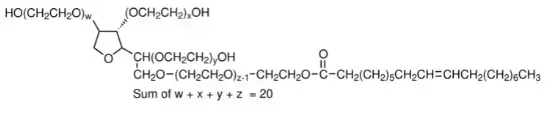
Molecular structure of Tween 80
2. Background Introduction
Tween 80 (Polysorbate 80) is a commonly used nonionic surfactant and emulsifier. It is composed of hydrophilic polyoxyethylene sorbitol and lipophilic oleic acid ester groups. Because of its amphiphilic structure, it can effectively reduce interfacial tension and is widely used in food, cosmetics and pharmaceutical preparations to stabilize oil / water systems and emulsion systems. Tween 80 is often used as a cosolvent in pharmacology and pharmaceutical science to enhance the solubility of hydrophobic compounds in the aqueous phase by forming micelles or improving the wettability of the medium, thereby improving the dissolution behavior and formulation uniformity of poorly soluble drugs. In addition to traditional emulsification and solubilization, some experimental studies have also shown that Tween 80 can reduce bacterial attachment and inhibit biofilm formation. For example, Tween 80 was found to reduce biofilm development in Pseudomonas aeruginosa and methicillin-resistant Staphylococcus aureus (MRSA) models, which may be related to its surface activity interfering with the initial attachment stage of bacteria. [1, 2, 3]
3. Application References
Polysorbate 80 Inhibition of Pseudomonas aeruginosa Biofilm Formation and Its Cleavage by the Secreted Lipase LipA▿
Research Overview:
In this study, the effect of nonionic surfactant Polysorbate 80 (Tween 80) on bacterial biofilm formation and its potential mechanism were systematically investigated using Pseudomonas aeruginosa as a model. The authors found that the addition of Tween 80 to the medium significantly inhibited the initial attachment of P.aeruginosa on the solid surface and the subsequent biofilm development, but this inhibition was not due to direct toxicity to bacterial growth, but was related to the change of bacteria-interface interaction by surfactants. Further mechanism studies showed that the lipase LipA secreted by P.aeruginosa could hydrolyze the ester bond in Tween 80 and destroy its surface activity, thus weakening its inhibitory effect on biofilm formation. This finding reveals that bacteria can secrete exogenous enzymes to degrade surfactants in the environment to restore adhesion and biofilm ability, and elucidates the basis of surfactant inhibition of biofilm and the adaptive response mechanism of bacteria, which provides a new idea for understanding biofilm regulation and anti-adhesion strategies. [2]
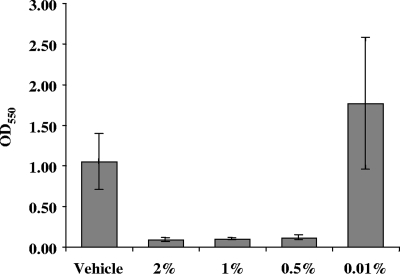
The high concentration of PS80 will lead to the destruction of PA14 biofilm
4. References
[1] Schwartzberg LS, Navari RM. Safety of Polysorbate 80 in the Oncology Setting. Adv Ther. 2018 Jun;35(6):754-767. doi: 10.1007/s12325-018-0707-z. Epub 2018 May 23. PMID: 29796927; PMCID: PMC6015121.
[2] Toutain-Kidd CM, Kadivar SC, Bramante CT, Bobin SA, Zegans ME. Polysorbate 80 inhibition of Pseudomonas aeruginosa biofilm formation and its cleavage by the secreted lipase LipA. Antimicrob Agents Chemother. 2009 Jan;53(1):136-45. doi: 10.1128/AAC.00500-08. Epub 2008 Oct 27. PMID: 18955535; PMCID: PMC2612155.
[3] Ueda Y, Mashima K, Miyazaki M, Hara S, Takata T, Kamimura H, Takagi S, Jimi S. Inhibitory effects of polysorbate 80 on MRSA biofilm formed on different substrates including dermal tissue. Sci Rep. 2019 Feb 28;9(1):3128. doi: 10.1038/s41598-019-39997-3. PMID: 30816342; PMCID: PMC6395670.

An essential round-up of science news, opinion and analysis, delivered to your inbox every weekday.
 Feedback
 Hello! How can I help you today?
Copyright © 2015-2026 TargetMol Chemicals Inc. All Rights Reserved.