


Shopping Cart
Remove All Your shopping cart is currently empty


Synonyms: Umbellatine, Berberin
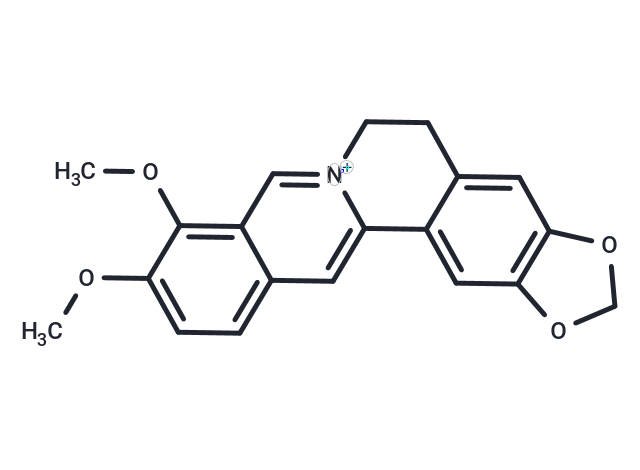
| Pack Size | Price | USA Stock | Global Stock | Quantity |
|---|---|---|---|---|
| 5 mg | $30 | In Stock | In Stock | |
| 10 mg | $37 | In Stock | In Stock | |
| 25 mg | $57 | In Stock | In Stock | |
| 50 mg | $85 | In Stock | In Stock | |
| 100 mg | $127 | In Stock | In Stock | |
| 500 mg | $280 | In Stock | In Stock | |
| 1 mL x 10 mM (in DMSO) | $50 | In Stock | In Stock |
| Description | 1. Berberine (Umbellatine) is a potent oral hypoglycemic agent with beneficial effects on lipid metabolism. 2. Berberine may as a broad-spectrum anti-microbial medicine, a complementary therapeutic agent for HIV/AIDS. 3. Berberine seems to act as an herbal antidepressant and a neuroprotector against neurodegenerative disorders. 4. Berberine is used in histology for staining heparin in mast cells. As a natural dye, berberine has a colour index of 7516. 5. Berberine reduces hepatic fat content in rats with nonalcoholic fatty liver disease; also prevents proliferation of hepatic stellate cells (HSCs), which are central for the development of fibrosis during liver injury. 6. Berberine can ameliorate proinflammatory cytokines-induced intestinal epithelial tight junction damage in vitro, and berberine may be one of the targeted therapeutic agents that can restore barrier function in intestinal disease states. 7. Berberine has antineoplastic effects, including breast cancer, leukemia, melanoma, epidermoid carcinoma, hepatoma, pancreatic cancer, oral carcinoma, tongue carcinoma, glioblastoma, prostate carcinoma and gastric carcinoma, etc. |
| Targets & IC50 | LX-2 cells:> 50 μM, Hep 3B2:> 50 μM, Vero cells:71.14 μg/mL, HepG2 cells:> 50 μM, Huh7 cells:> 50 μM, HeLa cells:12.08 μg/mL, HUVECs:18.34 μM, HeLa229 cells:42.93 μM, 3T3-L1 cells:21.84 μM, SMMC-7721 cells:18.34 μM, SW1990 cells:18.34 μM |
| In vitro | METHODS: Human osteosarcoma cells MG-63 were treated with Berberine (20-80 µM) for 12-24 h. Cell viability was measured by MTT assay. RESULTS: Berberine induced a concentration- and time-dependent decrease in MG-63 cell viability. [1] METHODS: The NPC cell line HONE1 was treated with Berberine (25-50 µM) for 24 h, and the expression levels of target proteins were measured by Western Blot. RESULTS: Berberine effectively inhibited the level of p-STAT3 in HONE1 cells, and the down-regulation of STAT3 activation was associated with the inhibition of Mcl-1 expression and an increase in cleaved PARP-1 levels. [2] |
| In vivo | METHODS: To test the antitumor activity in vivo, Berberine (5-10 mg/kg) was injected intraperitoneally every two days for thirty days into nude mice bearing NPC tumor C666-1. RESULTS: Berberine effectively inhibited the tumorigenicity and growth of EBV-positive NPC cell line (C666-1) in nude mice. Inhibition of tumorigenic growth of NPC cells in vivo correlated with effective inhibition of STAT3 activation in NPC cells within tumor xenografts in nude mice. [2] |
| Synonyms | Umbellatine, Berberin |
| Molecular Weight | 336.36 |
| Formula | C20H18NO4 |
| Cas No. | 2086-83-1 |
| Smiles | O(C)C1=C2C=[N+]3C(C=4C(=CC5=C(C4)OCO5)CC3)=CC2=CC=C1OC |
| Relative Density. | 1.2976 g/cm3 (Estimated) |
| Storage | Keep away from direct sunlight,Keep away from moisture,Store at low temperature Powder: -20°C for 3 years | In solvent: -80°C for 1 year Shipping with blue ice/Shipping at ambient temperature. | |||||||||||||||||||||||||
| Solubility Information | Chloroform, Dichloromethane, Ethyl Acetate, Acetone, etc.: Soluble DMSO: 9.8 mg/mL (29.14 mM), Sonication is recommended.  H2O: < 1 mg/mL (insoluble or slightly soluble) | |||||||||||||||||||||||||
| In Vivo Formulation | 10% DMSO+40% PEG300+5% Tween 80+45% Saline: 2.05 mg/mL (6.09 mM), Suspension. Please add the solvents sequentially, clarifying the solution as much as possible before adding the next one. Dissolve by heating and/or sonication if necessary. Working solution is recommended to be prepared and used immediately. The formulation provided above is for reference purposes only. In vivo formulations may vary and should be modified based on specific experimental conditions. | |||||||||||||||||||||||||
Solution Preparation Table | ||||||||||||||||||||||||||
DMSO
Note : The dilution table applies only to solid products. For liquid products, please calculate the stock solution based on the stated concentration and/or density. | ||||||||||||||||||||||||||
 For example, if the intended dosage is 10 mg/kg for animals weighing 20 g , with a dosing volume of 100 μL per animal, and a total of 10 animals are to be administered, using a formulation of
  10% DMSO+ 40% PEG300+ 5% Tween 80+ 45% Saline/PBS/ddH2O , the resulting working solution concentration would be 2 mg/mL.
Dissolve 2 mg of the compound in 100 μL DMSO to obtain a stock solution at a concentration of 20 mg/mL . If the required concentration exceeds the compound's known solubility, please contact us for technical support before proceeding.
1) Add 100 μL of the DMSO stock solution to 400 µL PEG300 and mix thoroughly until the solution becomes clear.
2) Add 50 µL Tween 80 and mix well until fully clarified.
3) Add 450 µL Saline,PBS or ddH2O and mix thoroughly until a homogeneous solution is obtained.
| Size | Quantity | Unit Price | Amount | Operation |
|---|
 Feedback
 Hello! How can I help you today?
Copyright © 2015-2026 TargetMol Chemicals Inc. All Rights Reserved.
