


Shopping Cart
Remove All Your shopping cart is currently empty


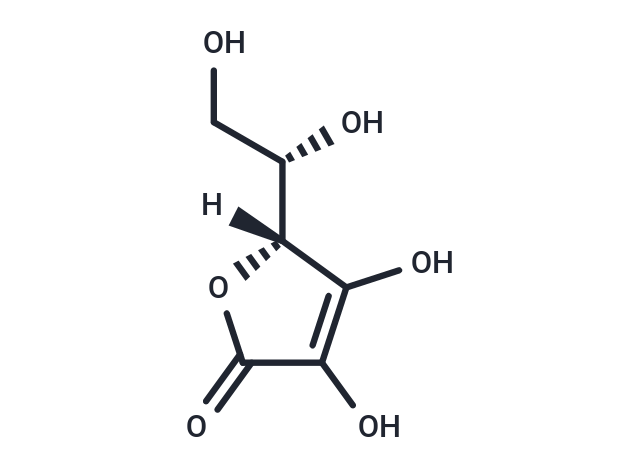
Synonyms: Vitamin C, L-Ascorbate, L(+)-Ascorbic acid, Ascorbic acid
| Pack Size | Price | USA Stock | Global Stock | Quantity |
|---|---|---|---|---|
| 1 g | $42 | In Stock | In Stock | |
| 1 mL x 10 mM (in DMSO) | $30 | In Stock | In Stock |
| Description | L-Ascorbic acid (Vitamin C) is a natural product that is a potent reducing agent and antioxidant. L-Ascorbic acid functions in fighting bacterial infections, in detoxifying reactions, and in the formation of collagen. L-Ascorbic acid is used in the treatment of scurvy. |
| Targets & IC50 | Tyrosinase:0.96 mg/mL |
| In vitro | METHODS: Human osteosarcoma cells MG-63 were treated with L-Ascorbic acid (62.5-1000 µM) for 3-24 h. Cell viability was measured by XTT Assay. RESULTS: Cell viability was consistently >95% when cells were treated with L-Ascorbic acid at concentrations of 0-250 µM. When higher concentrations were used, a dose-dependent decrease in cell viability was observed. [1] METHODS: Melanoma cells WM1366 were treated with L-Ascorbic acid (5-50 µM) for 24 h. The expression levels of target proteins were measured using Western Blot. RESULTS: The lowest concentration of L-Ascorbic acid (5 µM) significantly reduced the normoxic expression of HIF-1α protein in human melanoma cell lines. [2] |
| In vivo | METHODS: L-Ascorbic acid (1-4.5 g/kg) was administered intraperitoneally to irradiated C57BL/6 mice to detect radioprotective activity. RESULTS: Administration of 3 g/kg L-Ascorbic acid immediately after exposure significantly increased the survival rate of mice after 7-8 Gy WBI. However, administration of less than 3 g/kg L-Ascorbic acid was ineffective, and 4 g/kg and above was harmful to mice. [3] METHODS: To investigate the effects on amnesia, L-Ascorbic acid (60-160 mg/kg) was administered intraperitoneally to diazepam, scopolamine, and aging-induced amnesic Swiss mice once daily for 3-8 days. RESULTS: L-Ascorbic acid improved learning and memory in aging mice, as evidenced by decreased transfer latency and increased descending latency. [4] |
| Synonyms | Vitamin C, L-Ascorbate, L(+)-Ascorbic acid, Ascorbic acid |
| Molecular Weight | 176.12 |
| Formula | C6H8O6 |
| Cas No. | 50-81-7 |
| Smiles | [C@@H](CO)(O)[C@@]1(C(O)=C(O)C(=O)O1)[H] |
| Relative Density. | 1.7 |
| Storage | Keep away from direct sunlight Powder: -20°C for 3 years | In solvent: -80°C for 1 year Shipping with blue ice/Shipping at ambient temperature. | |||||||||||||||||||||||||||||||||||
| Solubility Information | H2O: 35.7 mg/mL (202.7 mM), Sonication is recommended.  DMSO: 255 mg/mL (1447.88 mM), Sonication is recommended. Ethanol: < 1 mg/mL (insoluble or slightly soluble) | |||||||||||||||||||||||||||||||||||
Solution Preparation Table | ||||||||||||||||||||||||||||||||||||
H2O/DMSO
Note : The dilution table applies only to solid products. For liquid products, please calculate the stock solution based on the stated concentration and/or density. | ||||||||||||||||||||||||||||||||||||
 For example, if the intended dosage is 10 mg/kg for animals weighing 20 g , with a dosing volume of 100 μL per animal, and a total of 10 animals are to be administered, using a formulation of
  10% DMSO+ 40% PEG300+ 5% Tween 80+ 45% Saline/PBS/ddH2O , the resulting working solution concentration would be 2 mg/mL.
Dissolve 2 mg of the compound in 100 μL DMSO to obtain a stock solution at a concentration of 20 mg/mL . If the required concentration exceeds the compound's known solubility, please contact us for technical support before proceeding.
1) Add 100 μL of the DMSO stock solution to 400 µL PEG300 and mix thoroughly until the solution becomes clear.
2) Add 50 µL Tween 80 and mix well until fully clarified.
3) Add 450 µL Saline,PBS or ddH2O and mix thoroughly until a homogeneous solution is obtained.
| Size | Quantity | Unit Price | Amount | Operation |
|---|
 Feedback
 Hello! How can I help you today?
Copyright © 2015-2026 TargetMol Chemicals Inc. All Rights Reserved.
