


Shopping Cart
Remove All Your shopping cart is currently empty

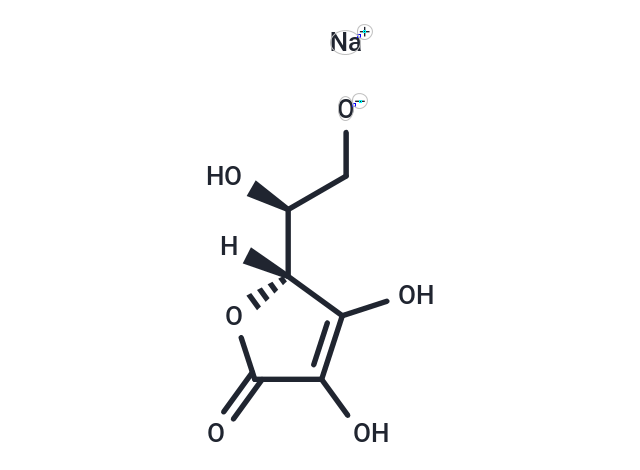
Synonyms: Vitamin C sodium salt, Sodium L-ascorbate, Sodium ascorbate, L-Ascorbic acid sodium, (+)-Sodium L-ascorbate
| Pack Size | Price | USA Stock | Global Stock | Quantity |
|---|---|---|---|---|
| 200 mg | $30 | In Stock | In Stock | |
| 500 mg | $40 | In Stock | In Stock | |
| 1 g | $48 | In Stock | In Stock | |
| 5 g | $113 | - | In Stock | |
| 10 g | $163 | - | In Stock | |
| 1 mL x 10 mM (in DMSO) | $39 | In Stock | In Stock |
| Description | L-Ascorbic acid sodium salt (Vitamin C sodium salt) is a more bioavailable form of vitamin C that is an alternative to taking ascorbic acid as a supplement. |
| In vitro | Sodium ascorbate has a growth inhibiting action only at high concentrations in cultured human neoplastic cell lines MCF-7 (breast carcinoma), KB (oral epidermoid carcinoma), and AN3-CA (endometrial adenocarcinoma). Sodium ascorbate combined with vitamin K3 demonstrates a synergistic inhibition of cell growth at 10 to 50 times lower concentrations in cultured human neoplastic cell lines MCF-7, KB, and AN3-CA, at this level separately given vitamins are not toxic. This tumor cell growth inhibitory effect is completely suppressed by the addition of catalase to the culture medium containing vitamins C and K3, suggesting an excessive production of hydrogen peroxide as being implied in mechanisms responsible for the above-mentioned effects. [1] Sodium ascorbate combined with vitamin K3 results in a synergistic effect on growth inhibition in cultured human endometrial adenocarcinoma (AN3CA) cells. [2] Sodium ascorbate results in a rapid increase in the intracellular concentration of Ca2+ ions and subsequent apoptotic cell death in HL-60 cells, characterized by cell shrinkage, nuclear fragmentation and cleavage of internucleosomal DNA to yield fragments that are multiples of 180-200 base pairs, are induced. [3] Sodium ascorbate (100 μM) induces DNA single-strand breaks in human cells, Fibroblasts and Molt-4 cells are significantly more sensitive than lymphocytes. Sodium ascorbate (50 μM) results in significant cell loss in Molt-4 cells, but not in lymphocyte and fibroblast cultures. [4] |
| In vivo | Tg rats treated with sodium?L-ascorbate show a higher incidence of carcinoma (29.6%), compared to those without sodium?L-ascorbate (15.4%). Independent of the sodium?L-ascorbate treatment, transgenic rats exhibit various kinds of malignant tumors in various organs[5]. After 12 weeks of PEITC-treatment, both simple hyperplasia and papillary or nodular (PN) hyperplasia have developed in all animals, but the majority of these lesions have disappeared at week 48, irrespective of the sodium?L-ascorbate-treatment. The same lesions after 24 weeks of PEITC-treatment have progressed to dysplasia and carcinoma, in a small number of cases by week 48, but enhancement by the sodium?L-ascorbate-treatment is evident only with simple hyperplasias and PN hyperplasias in rats[6]. |
| Synonyms | Vitamin C sodium salt, Sodium L-ascorbate, Sodium ascorbate, L-Ascorbic acid sodium, (+)-Sodium L-ascorbate |
| Molecular Weight | 198.11 |
| Formula | C6H7NaO6 |
| Cas No. | 134-03-2 |
| Smiles | [O-]C[C@@H]([C@]1([H])C(O)=C(C(O1)=O)O)O.[Na+] |
| Relative Density. | 1.88. Temperature:19.7 °C. |
| Storage | Powder: -20°C for 3 years | In solvent: -80°C for 1 year Shipping with blue ice/Shipping at ambient temperature. | ||||||||||||||||||||||||||||||||||||||||
| Solubility Information | DMSO: 6.25 mg/mL (31.55 mM), Sonication is recommended.  H2O: 198.9 mM, Sonication is recommended. | ||||||||||||||||||||||||||||||||||||||||
Solution Preparation Table | |||||||||||||||||||||||||||||||||||||||||
DMSO/H2O
H2O
Note : The dilution table applies only to solid products. For liquid products, please calculate the stock solution based on the stated concentration and/or density. | |||||||||||||||||||||||||||||||||||||||||
 For example, if the intended dosage is 10 mg/kg for animals weighing 20 g , with a dosing volume of 100 μL per animal, and a total of 10 animals are to be administered, using a formulation of
  10% DMSO+ 40% PEG300+ 5% Tween 80+ 45% Saline/PBS/ddH2O , the resulting working solution concentration would be 2 mg/mL.
Dissolve 2 mg of the compound in 100 μL DMSO to obtain a stock solution at a concentration of 20 mg/mL . If the required concentration exceeds the compound's known solubility, please contact us for technical support before proceeding.
1) Add 100 μL of the DMSO stock solution to 400 µL PEG300 and mix thoroughly until the solution becomes clear.
2) Add 50 µL Tween 80 and mix well until fully clarified.
3) Add 450 µL Saline,PBS or ddH2O and mix thoroughly until a homogeneous solution is obtained.
| Size | Quantity | Unit Price | Amount | Operation |
|---|
 Feedback
 Hello! How can I help you today?
Copyright © 2015-2026 TargetMol Chemicals Inc. All Rights Reserved.
