


Shopping Cart
Remove All Your shopping cart is currently empty

Synonyms:

| Pack Size | Price | USA Stock | Global Stock | Quantity |
|---|---|---|---|---|
| 1 mg | $197 | In Stock | In Stock | |
| 5 mg | $438 | In Stock | In Stock | |
| 10 mg | $647 | In Stock | In Stock | |
| 25 mg | $987 | In Stock | In Stock | |
| 50 mg | $1,380 | In Stock | In Stock | |
| 100 mg | $1,860 | - | In Stock | |
| 1 mL x 10 mM (in DMSO) | $472 | In Stock | In Stock |
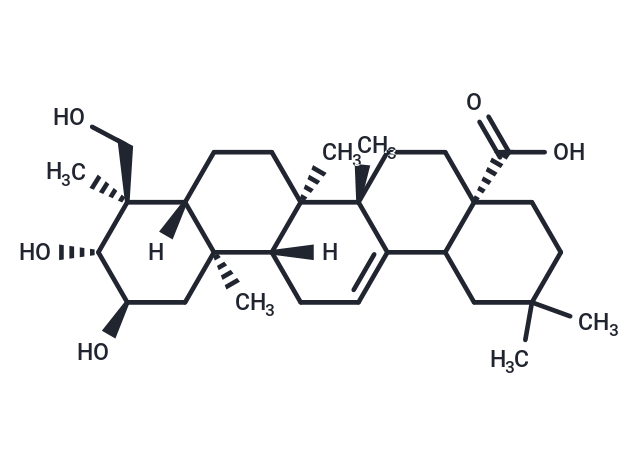
| Description | Arjunolic acid has antioxidant, anti-inflammatory, antinociceptive and anticholinesterasic (AChE and BuChE) activities, it may as promising targets for the development of innovative multi-functional medicines for Alzheimer desease treatment. |
| In vitro | This review highlights the beneficial role of Arjunolic acid, a naturally occurring chiral triterpenoid saponin, in various organ pathophysiology and the underlying mechanism of its protective action. Studies on the biochemistry and pharmacology suggest the potential use of Arjunolic acid as a novel promising therapeutic strategy. WHAT THE READERS WILL GAIN: The multifunctional therapeutic application of Arjunolic acid has already been documented by its various biological functions including antioxidant, anti-fungal, anti-bacterial, anticholinesterase, antitumor, antiasthmatic, wound healing and insect growth inhibitor activities. The scientific basis behind its therapeutic application as a cardioprotective agent in traditional medicine is justified by its ability to prevent myocardial necrosis and apoptosis, platelet aggregation, coagulation and lowering of blood pressure, heart rate, as well as cholesterol levels. Its antioxidant property coupled with metal chelating property (by its two hydroxyl groups) protects different organs from metal and drug-induced organ pathophysiology. Arjunolic acid also plays a beneficial role in the pathogenesis of diabetes and its associated complications. The mechanism of cytoprotection of Arjunolic acid, at least in part, results from the detoxification of reactive oxygen species (ROS) produced in the respective pathophysiology. In addition to its other biological functions, it also possesses vibrant insecticidal properties and it has the potential to be used as a structural molecular framework for the design of molecular receptors in the general area of supramolecular chemistry and nanochemistry. Esters of Arjunolic acid function as organogelators which has wide application in designing thermochromic switches and sensor devices. Arjunolic acid derived crown ether is an attractive candidate for the design of molecular receptors, biomimetics and supramolecular systems capable of performing some biological functions[1] |
| Molecular Weight | 488.7 |
| Formula | C30H48O5 |
| Cas No. | 465-00-9 |
| Smiles | [H][C@@]12CC[C@]3(C)[C@]([H])(CC=C4C5CC(C)(C)CC[C@@]5(CC[C@@]34C)C(O)=O)[C@@]1(C)C[C@@H](O)[C@H](O)[C@@]2(C)CO |
| Relative Density. | 1.19 g/cm3 (Predicted) |
| Storage | Powder: -20°C for 3 years | In solvent: -80°C for 1 year Shipping with blue ice/Shipping at ambient temperature. | |||||||||||||||||||||||||||||||||||
| Solubility Information | DMSO: 50 mg/mL (102.31 mM), Sonication is recommended.  | |||||||||||||||||||||||||||||||||||
| In Vivo Formulation | 10% DMSO+40% PEG300+5% Tween 80+45% Saline: 2 mg/mL (4.09 mM), Sonication is recommended. Please add the solvents sequentially, clarifying the solution as much as possible before adding the next one. Dissolve by heating and/or sonication if necessary. Working solution is recommended to be prepared and used immediately. The formulation provided above is for reference purposes only. In vivo formulations may vary and should be modified based on specific experimental conditions. | |||||||||||||||||||||||||||||||||||
Solution Preparation Table | ||||||||||||||||||||||||||||||||||||
DMSO
Note : The dilution table applies only to solid products. For liquid products, please calculate the stock solution based on the stated concentration and/or density. | ||||||||||||||||||||||||||||||||||||
 For example, if the intended dosage is 10 mg/kg for animals weighing 20 g , with a dosing volume of 100 μL per animal, and a total of 10 animals are to be administered, using a formulation of
  10% DMSO+ 40% PEG300+ 5% Tween 80+ 45% Saline/PBS/ddH2O , the resulting working solution concentration would be 2 mg/mL.
Dissolve 2 mg of the compound in 100 μL DMSO to obtain a stock solution at a concentration of 20 mg/mL . If the required concentration exceeds the compound's known solubility, please contact us for technical support before proceeding.
1) Add 100 μL of the DMSO stock solution to 400 µL PEG300 and mix thoroughly until the solution becomes clear.
2) Add 50 µL Tween 80 and mix well until fully clarified.
3) Add 450 µL Saline,PBS or ddH2O and mix thoroughly until a homogeneous solution is obtained.
| Size | Quantity | Unit Price | Amount | Operation |
|---|
 Feedback
 Hello! How can I help you today?
Copyright © 2015-2026 TargetMol Chemicals Inc. All Rights Reserved.
