Shopping Cart
Remove All
  • TargetMol
    Your shopping cart is currently empty

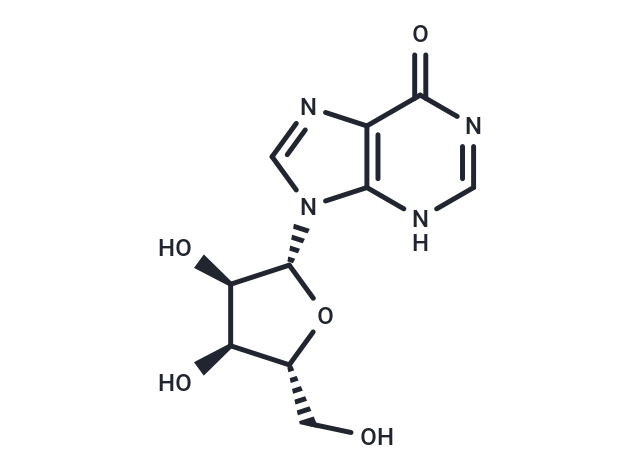
Inosine

Copy Product Info
🥰Excellent
Catalog No. T0437Cas No. 58-63-9
Alias NSC 20262, INO 495

Inosine (NSC-20262), an endogenous purine nucleoside produced by the catabolism of adenosine, is an agonist of adenosine receptors A1R and A2AR. Inosine has anti-inflammatory, immunomodulatory, antinociceptive and neuroprotective effects.

Inosine

Inosine

Copy Product Info
🥰Excellent
Purity: 99.89%
Catalog No. T0437Alias NSC 20262, INO 495Cas No. 58-63-9
Inosine (NSC-20262), an endogenous purine nucleoside produced by the catabolism of adenosine, is an agonist of adenosine receptors A1R and A2AR. Inosine has anti-inflammatory, immunomodulatory, antinociceptive and neuroprotective effects.
Pack SizePriceUSA WarehouseGlobal WarehouseQuantity
1 g$29In StockIn Stock
1 mL x 10 mM (in DMSO)$29In StockIn Stock
Add to Cart
Add to Quotation
In Stock Estimated shipping dateUSA Warehouse[1-2 days] Global Warehouse[5-7 days]
All TargetMol products are for research purposes only and cannot be used for human consumption. We do not provide products or services to individuals. Please comply with the intended use and do not use TargetMol products for any other purpose.
Questions
TargetMol
View More

Batch Information

Select Batch
Purity:99.89%
Color:White
Contact us for more batch information

Resource Download

Product Introduction

Bioactivity
Description
Inosine (NSC-20262), an endogenous purine nucleoside produced by the catabolism of adenosine, is an agonist of adenosine receptors A1R and A2AR. Inosine has anti-inflammatory, immunomodulatory, antinociceptive and neuroprotective effects.
Targets&IC50
PvENT1:3.8 μM
In vitro
METHODS: Rat C6, DU-145, HaCaT, L6, and MCF7 cells were treated with Inosine (0-250 μM) for 48 hours, and MTT assay was used to detect the inhibition of cell growth.
RESULTS: Inosine did not inhibit the growth of C6, DU-145, HaCaT, L6 and MCF7 cells at 250 μM. [1]
In vivo
METHODS: To study the analgesic effect of Inosine, Inosine (1 mg/kg, 10 mg/kg, and 100 mg/kg) was injected intraperitoneally to mice 20 min before formalin treatment.
RESULTS: Inosine reduced formalin-induced leg withdrawal. [2]
Disease Modeling Protocol
Hyperuricemia model
  • Modeling Mechanism:

    Inosine, a key precursor in purine metabolism, induces hyperuricemia through a core pathway: ① It is catalyzed by hepatic purine nucleoside phosphorylase (PNP) to produce hypoxanthine, which is then converted into uric acid by xanthine oxidase (XO). Excessive inosine intake disrupts the balance between uric acid production and excretion; ② It upregulates hepatic PNP mRNA expression while downregulating XO mRNA and protein expression (possibly as a compensatory inhibition of excessive uric acid production); ③ It does not affect the mRNA and protein expression of renal uric acid transporters (URAT1, OAT4, ABCG2, etc.). The core pathology is increased uric acid production, consistent with the mechanism of some subtypes of primary hyperuricemia in humans.

  • Related Products:

    Inosine (T0437)

  • Modeling Method:

    Experimental Subject:

    Rhesus macaque, Macaca mulatta, Male, 9–12 years old, Housed singly post-acclimatisation

    Dosage and Administration Route:

    ① Core modelling: Inosine, 200 mg/kg, dissolved in 0.9% saline, intraperitoneal injection, single-dose administration;
    ② Dose gradient validation: Three groups at 75 mg/kg, 100 mg/kg, and 200 mg/kg to identify optimal modelling dose;
    ③ Control treatment: Equal volume saline solution administered via intraperitoneal injection using the same method;
    ④ Model validation (optional):
    - Uric acid synthesis inhibitor intervention: Allopurinol (2.5 mg/kg), Febuxostat (2 mg/kg), Urodiol (2 mg/kg) administered intraperitoneally as required following inosine dosing;

    Dosing Frequency and Duration Model:

    Single dose

  • Validation:

    Key indicators (serum uric acid, SUA): - 30 minutes after modeling, SUA levels increased from baseline 51.77±14.48 μmol/L to 178.32±14.47 μmol/L, peaking at 201.41±42.73 μmol/L at 1 hour (p<0.01), gradually declining after 4 hours, and approaching baseline at 8 hours; - No significant increase in SUA was observed in the 75 mg/kg and 100 mg/kg dose groups, with 200 mg/kg being the optimal modeling dose; Molecular indicators: - Liver: PNP mRNA expression was upregulated 2.36-fold (p<0.05), while XO mRNA and protein expression were significantly decreased (p<0.05); - Kidney: No significant changes were observed in the mRNA and protein expression of transporters such as URAT1, OAT4, and ABCG2; Specificity verification: Allopurinol, febuxostat, and urodixin significantly reversed inosine-induced SUA. The increase (p<0.01) confirms that the model can be used for screening anti-hyperuric acid drugs.

*Precautions: No animals died during the study, and all animals fully recovered by the end of the experiment.

*References:Tang DH,et,al. Inosine induces acute hyperuricaemia in rhesus monkey (Macaca mulatta) as a potential disease animal model. Pharm Biol. 2021 Dec;59(1):175-182.

SynonymsNSC 20262, INO 495
Chemical Properties
Molecular Weight268.23
FormulaC10H12N4O5
Cas No.58-63-9
SmilesO[C@H]1[C@H](N2C3=C(N=C2)C(=O)N=CN3)O[C@H](CO)[C@H]1O
Relative Density.2.08 g/cm3
Storage & Solubility Information
StoragePowder: -20°C for 3 years | In solvent: -80°C for 1 year | Shipping with blue ice/Shipping at ambient temperature.
Solubility Information
Ethanol: < 1 mg/mL (insoluble or slightly soluble)
DMSO: 245 mg/mL (913.4 mM), Sonication is recommended.

H2O: 43 mg/mL (160.31 mM), Sonication is recommended.
In Vivo Formulation
10% DMSO+40% PEG300+5% Tween 80+45% Saline: 5 mg/mL (18.64 mM), Sonication is recommended.
Please add the solvents sequentially, clarifying the solution as much as possible before adding the next one. Dissolve by heating and/or sonication if necessary. Working solution is recommended to be prepared and used immediately. The formulation provided above is for reference purposes only. In vivo formulations may vary and should be modified based on specific experimental conditions.
Solution Preparation Table
H2O/DMSO
1mg5mg10mg50mg
1 mM3.7281 mL18.6407 mL37.2814 mL186.4072 mL
5 mM0.7456 mL3.7281 mL7.4563 mL37.2814 mL
10 mM0.3728 mL1.8641 mL3.7281 mL18.6407 mL
20 mM0.1864 mL0.9320 mL1.8641 mL9.3204 mL
50 mM0.0746 mL0.3728 mL0.7456 mL3.7281 mL
100 mM0.0373 mL0.1864 mL0.3728 mL1.8641 mL

Calculator

  • Molarity Calculator
  • Dilution Calculator
  • Reconstitution Calculator
  • Molecular Weight Calculator

In Vivo Formulation Calculator (Clear solution)

Please enter your animal experiment information in the following box and click Calculate to obtain the stock solution preparation method and in vivo formula preparation method:
TargetMol | Animal experiments For example, if the intended dosage is 10 mg/kg for animals weighing 20 g , with a dosing volume of 100 μL per animal, TargetMol | Animal experiments and a total of 10 animals are to be administered, using a formulation of TargetMol | reagent 10% DMSO+ 40% PEG300+ 5% Tween 80+ 45% Saline/PBS/ddH2O , the resulting working solution concentration would be 2 mg/mL.

Stock Solution Preparation:

Dissolve 2 mg of the compound in 100 μL DMSOTargetMol | reagent to obtain a stock solution at a concentration of 20 mg/mL . If the required concentration exceeds the compound's known solubility, please contact us for technical support before proceeding.

Preparation of the In Vivo Formulation:

1) Add 100 μL of the DMSOTargetMol | reagent stock solution to 400 μL PEG300TargetMol | reagent and mix thoroughly until the solution becomes clear.

2) Add 50 μL Tween 80 and mix well until fully clarified.

3) Add 450 μL Saline,PBS or ddH2OTargetMol | reagent and mix thoroughly until a homogeneous solution is obtained.

This example is provided solely to demonstrate the use of the In Vivo Formulation Calculator and does not constitute a recommended formulation for any specific compound. Please select an appropriate dissolution and formulation strategy based on your experimental model and route of administration.
All co-solvents required for this protocol, includingDMSO, PEG300/PEG400, Tween 80, SBE-β-CD, and Corn oil, are available for purchase on the TargetMol website.
1 Enter information below:
mg/kg
g
μL
2 Enter the in vivo formulation:
% DMSO
%
% Tween 80
% Saline/PBS/ddH2O

Dose Conversion

You can also refer to dose conversion for different animals. More Dose Conversion

Tech Support

Please see Inhibitor Handling Instructions for more frequently ask questions. Topics include: how to prepare stock solutions, how to store products, and cautions on cell-based assays & animal experiments, etc

Keywords

Related Tags: buy Inosine | purchase Inosine | Inosine cost | order Inosine | Inosine chemical structure | Inosine in vivo | Inosine in vitro | Inosine formula | Inosine molecular weight