


Shopping Cart
Remove All Your shopping cart is currently empty

Synonyms:
| Pack Size | Price | USA Stock | Global Stock | Quantity |
|---|---|---|---|---|
| 1 mg | $40 | In Stock | In Stock | |
| 5 mg | $93 | In Stock | In Stock | |
| 10 mg | $156 | In Stock | In Stock | |
| 25 mg | $288 | In Stock | In Stock | |
| 50 mg | $428 | In Stock | In Stock | |
| 100 mg | $619 | In Stock | In Stock | |
| 200 mg | $877 | - | In Stock | |
| 1 mL x 10 mM (in DMSO) | $91 | In Stock | In Stock |
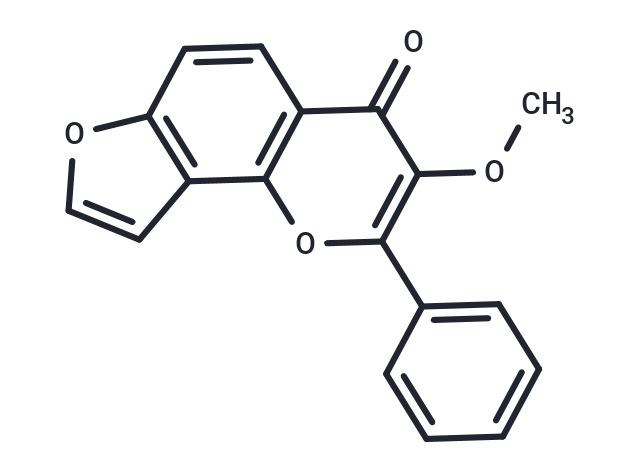
| Description | Karanjin is a flavonoid obtained from the seeds of the karanja tree.Karanjin induces GLUT4 translocation in skeletal muscle cells by increasing AMPK activity. Karanjin can induce cancer cell death through cell cycle arrest and enhance apoptosis. |
| In vitro | Karanjin is a furanoflavonol, insecticidal and acaricidal activities.?The present study was intended to evaluate the biochemical interactions of karanjin with bovine serum albumin (BSA) and study its toxicological effects on mammalian and bacterial cell lines.?Karanjin bound to BSA at a single site with a dissociation constant of 19.7 μM.?Evaluation of BSA-karanjin interactions at three different temperatures indicated the involvement of static mode of quenching.?Binding experiments in the presence of warfarin and computational docking analysis indicated that karanjin bound closer to the warfarin binding site located in the Subdomain IIA of BSA.?Using F?rster resonance energy transfer analysis the distance between TRP 213 of BSA and karanjin was found to be 20 ?.?Collective results from synchronous fluorescence spectra analysis, differential scanning calorimetry, and circular dichroism analysis indicated that binding of karanjin induced conformational changes in the secondary structure of BSA.?Karanjin exhibited low toxicity against human cervical cancer cells and normal mouse fibroblast L929 cells and modestly inhibited the growth of B. subtilis and E. coli cells[3]. |
| Molecular Weight | 292.29 |
| Formula | C18H12O4 |
| Cas No. | 521-88-0 |
| Smiles | O=C1C2=C(C3=C(C=C2)OC=C3)OC(=C1OC)C4=CC=CC=C4 |
| Relative Density. | 1.36g/cm3 |
| Storage | Powder: -20°C for 3 years | In solvent: -80°C for 1 year Shipping with blue ice/Shipping at ambient temperature. | ||||||||||||||||||||||||||||||
| Solubility Information | DMSO: 25 mg/mL (85.53 mM), Sonication is recommended.  | ||||||||||||||||||||||||||||||
Solution Preparation Table | |||||||||||||||||||||||||||||||
DMSO
Note : The dilution table applies only to solid products. For liquid products, please calculate the stock solution based on the stated concentration and/or density. | |||||||||||||||||||||||||||||||
 For example, if the intended dosage is 10 mg/kg for animals weighing 20 g , with a dosing volume of 100 μL per animal, and a total of 10 animals are to be administered, using a formulation of
  10% DMSO+ 40% PEG300+ 5% Tween 80+ 45% Saline/PBS/ddH2O , the resulting working solution concentration would be 2 mg/mL.
Dissolve 2 mg of the compound in 100 μL DMSO to obtain a stock solution at a concentration of 20 mg/mL . If the required concentration exceeds the compound's known solubility, please contact us for technical support before proceeding.
1) Add 100 μL of the DMSO stock solution to 400 µL PEG300 and mix thoroughly until the solution becomes clear.
2) Add 50 µL Tween 80 and mix well until fully clarified.
3) Add 450 µL Saline,PBS or ddH2O and mix thoroughly until a homogeneous solution is obtained.
| Size | Quantity | Unit Price | Amount | Operation |
|---|
 Feedback
 Hello! How can I help you today?
Copyright © 2015-2026 TargetMol Chemicals Inc. All Rights Reserved.
