


Shopping Cart
Remove All Your shopping cart is currently empty

Synonyms: D-Allulose
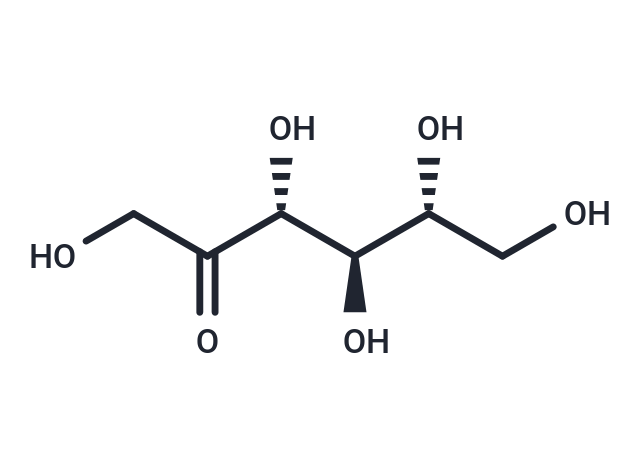
| Pack Size | Price | USA Stock | Global Stock | Quantity |
|---|---|---|---|---|
| 10 g | $29 | - | In Stock | |
| 1 mL x 10 mM (in DMSO) | $29 | - | In Stock |
| Description | D-Psicose (D-Allulose) is an orally active rare sugar. It effectively inhibits p38-MAPK phosphorylation and MCP-1 expression, while blocking the AGEs/RAGE/NF-kappaB signaling pathway. D-Psicose demonstrates significant bioactivity in research involving pancreatic beta-islet protection, hyperglycemia improvement, lipid metabolism regulation, and the mitigation of high-fat diet-induced non-alcoholic fatty liver disease (NAFLD). |
| In vitro | In experiments with human umbilical vein endothelial cells (HUVECs), cells were treated with D-Psicose at concentrations of 5.6–22.4 mM for 3 to 5 days. The results showed that D-Psicose significantly downregulated high-glucose-induced MCP-1 mRNA and protein expression in a dose-dependent manner by inhibiting p38-MAPK phosphorylation; however, no significant effect was observed at the lower concentration of 2.8 mM. This experiment confirmed that D-Psicose inhibits the expression of inflammatory factors and protects the vascular endothelium in vascular endothelial cells [1]. |
| In vivo | In models including OLETF rats, db/db mice, and high-fat diet-induced NAFLD mice, D-Psicose was administered orally via drinking water (5%) or gavage (200 mg/kg) for 4 to 13 weeks. Results showed that D-Psicose effectively attenuated pancreatic beta-islet fibrosis, preserved islet structure, and improved insulin resistance and glucose tolerance. Furthermore, D-Psicose significantly reduced hepatic triglyceride and total cholesterol levels, modulated gut microbiota (e.g., increasing Akkermansia abundance), and mitigated hepatic inflammation and oxidative stress damage by inhibiting the AGEs/RAGE/NF-kappaB pathway [2][3][4]. |
| Synonyms | D-Allulose |
| Molecular Weight | 180.16 |
| Formula | C6H12O6 |
| Cas No. | 551-68-8 |
| Smiles | [C@H]([C@H](C(CO)=O)O)([C@@H](CO)O)O |
| Storage | Keep away from direct sunlight Powder: -20°C for 3 years | In solvent: -80°C for 1 year Shipping with blue ice/Shipping at ambient temperature. | |||||||||||||||||||||||||||||||||||
| Solubility Information | H2O: 100 mg/mL (555.06 mM), Sonication is recommended. DMSO: 100 mg/mL (555.06 mM), Sonication is recommended. | |||||||||||||||||||||||||||||||||||
Solution Preparation Table | ||||||||||||||||||||||||||||||||||||
H2O/DMSO
Note : The dilution table applies only to solid products. For liquid products, please calculate the stock solution based on the stated concentration and/or density. | ||||||||||||||||||||||||||||||||||||
 For example, if the intended dosage is 10 mg/kg for animals weighing 20 g , with a dosing volume of 100 μL per animal, and a total of 10 animals are to be administered, using a formulation of
  10% DMSO+ 40% PEG300+ 5% Tween 80+ 45% Saline/PBS/ddH2O , the resulting working solution concentration would be 2 mg/mL.
Dissolve 2 mg of the compound in 100 μL DMSO to obtain a stock solution at a concentration of 20 mg/mL . If the required concentration exceeds the compound's known solubility, please contact us for technical support before proceeding.
1) Add 100 μL of the DMSO stock solution to 400 µL PEG300 and mix thoroughly until the solution becomes clear.
2) Add 50 µL Tween 80 and mix well until fully clarified.
3) Add 450 µL Saline,PBS or ddH2O and mix thoroughly until a homogeneous solution is obtained.
| Size | Quantity | Unit Price | Amount | Operation |
|---|
 Feedback
 Hello! How can I help you today?
Copyright © 2015-2026 TargetMol Chemicals Inc. All Rights Reserved.
