Shopping Cart
Remove All
  • TargetMol
    Your shopping cart is currently empty

Glucosamine

Copy Product Info
🥰Excellent
Catalog No. T0429Cas No. 3416-24-8
Alias D-Glucosamine, Chitosamine

Glucosamine (Chitosamine) is a natural product. Glucosamine is used as a dietary supplement. Glucosamine has pharmacological effects on cartilage and chondrocytes in osteoarthritis when used externally. Glucosamine regulates sugar metabolism. Glucosamine reduces the activity of glucoskinase in pancreatic islet homogenate.

Glucosamine

Glucosamine

Copy Product Info
🥰Excellent
Purity: 99.8%
Catalog No. T0429Alias D-Glucosamine, ChitosamineCas No. 3416-24-8
Glucosamine (Chitosamine) is a natural product. Glucosamine is used as a dietary supplement. Glucosamine has pharmacological effects on cartilage and chondrocytes in osteoarthritis when used externally. Glucosamine regulates sugar metabolism. Glucosamine reduces the activity of glucoskinase in pancreatic islet homogenate.
Pack SizePriceUSA WarehouseGlobal WarehouseQuantity
50 mg$50In StockIn Stock
1 mL x 10 mM (in DMSO)$50In StockIn Stock
Add to Cart
Add to Quotation
In Stock Estimated shipping dateUSA Warehouse[1-2 days] Global Warehouse[5-7 days]
All TargetMol products are for research purposes only and cannot be used for human consumption. We do not provide products or services to individuals. Please comply with the intended use and do not use TargetMol products for any other purpose.
Questions
TargetMol
View More

Batch Information

Select Batch
Purity:99.8%
Color:White
Contact us for more batch information

Resource Download

Product Introduction

Glucosamine AI Summary
Glucosamine shows a binding affinity for the 16S ribosomal RNA A-site of Escherichia coli, with a Kd value of approximately 1000000.0 nM. It has demonstrated various biological activities in different assays. In rat studies, it affected plasma GPT and GOT levels, and altered concentrations of several ceramides in plasma and liver tissues, indicating potential impacts on liver function and lipid metabolism. It also increased plasma and hepatic vitamin C levels in Wistar rats when administered intraperitoneally at 1 g/kg, with effects observed over 24 hours. The compound exhibited anti-inflammatory activity in carrageenan-induced paw edema and antiarthritic activity in a Mycobacterium tuberculosis-induced rat arthritic model, with notable reduction at 250 mg/kg. In human OCT1 studies, it inhibited the uptake of 4-(4-(dimethylamino)styryl)-N-methylpyridinium at 100 uM. In bovine articular cartilage explants, it reduced IL1-induced glycosaminoglycan release and showed cytotoxicity against bovine chondrocytes at various concentrations. Furthermore, Glucosamine exhibited antifungal activity by inhibiting mycelial growth of Poria placenta FPRL 280 and Trametes versicolor Quel. CTB 863-A at specified concentrations. It induced the activity of Heparan-alpha-glucosaminide N-acetyltransferase N273K mutant in skin fibroblasts at 14 mM concentration. However, in anti-viral activity assays against SARS-CoV-2, it showed a low hit score of 0.1709. The compound also inhibited the binding affinity to V5-His tagged FIBCD1 ecto-domain at 50 mM. Despite these varied effects, Glucosamine showed no significant bioactivity in multiple receptor and enzyme assays, with AC50 values exceeding 30000.0 nM..
Note: Summary generated by AI. Data source: ChEMBL
Bioactivity
Description
Glucosamine (Chitosamine) is a natural product. Glucosamine is used as a dietary supplement. Glucosamine has pharmacological effects on cartilage and chondrocytes in osteoarthritis when used externally. Glucosamine regulates sugar metabolism. Glucosamine reduces the activity of glucoskinase in pancreatic islet homogenate.
Targets&IC50
superoxide:47.67 mM (IC20), hydroxyl:14.04 mM, DPPH:21.32 mM
In vitro
METHODS: YD-8 human tongue cancer cells were treated with Glucosamine (10 mM) for 4 hours, and the phosphorylation levels of related proteins were detected by western blot.
RESULTS: Glucosamine inhibits HIF-1α and reduces the phosphorylation of p70S6K and S6 translation-related proteins. [1]
METHODS: Renal cells were treated with Glucosamine (5 mM) for 12, 24 and 36 hours, and the expression level of target proteins was detected by western blot.
RESULTS: Glucosamine significantly reduced the renal expressions of α -smooth muscle actin, collagen I and fibronectin in obstructive kidneys and renal cells treated with TGF-β1. [2]
In vivo
METHODS: To study the effect of Glucosamine on bone injury, Glucosamine (20 mg/kg/day) was orally administered to mice for 30 consecutive days.
RESULTS: Glucosamine significantly reduces cartilage damage and osteophyte formation. [3]
SynonymsD-Glucosamine, Chitosamine
Chemical Properties
Molecular Weight179.17
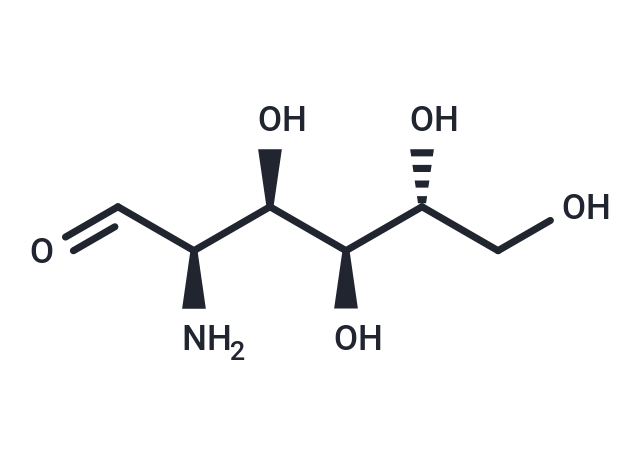
FormulaC6H13NO5
Cas No.3416-24-8
SmilesN[C@@H](C=O)[C@@H](O)[C@H](O)[C@H](O)CO
Relative Density.1.563 g/cm3
Storage & Solubility Information
StorageIn solvent: -80°C for 1 year | Shipping with blue ice/Shipping at ambient temperature.
Solubility Information
H2O: 200.9 mM, Sonication is recommended.
DMSO: 58 mg/mL (323.71 mM), Sonication is recommended.

Solution Preparation Table
H2O/DMSO
1mg5mg10mg50mg
1 mM5.5813 mL27.9065 mL55.8129 mL279.0646 mL
5 mM1.1163 mL5.5813 mL11.1626 mL55.8129 mL
10 mM0.5581 mL2.7906 mL5.5813 mL27.9065 mL
20 mM0.2791 mL1.3953 mL2.7906 mL13.9532 mL
50 mM0.1116 mL0.5581 mL1.1163 mL5.5813 mL
100 mM0.0558 mL0.2791 mL0.5581 mL2.7906 mL

Calculator

  • Molarity Calculator
  • Dilution Calculator
  • Reconstitution Calculator
  • Molecular Weight Calculator

In Vivo Formulation Calculator (Clear solution)

Please enter your animal experiment information in the following box and click Calculate to obtain the stock solution preparation method and in vivo formula preparation method:
TargetMol | Animal experiments For example, if the intended dosage is 10 mg/kg for animals weighing 20 g , with a dosing volume of 100 μL per animal, TargetMol | Animal experiments and a total of 10 animals are to be administered, using a formulation of TargetMol | reagent 10% DMSO+ 40% PEG300+ 5% Tween 80+ 45% Saline/PBS/ddH2O , the resulting working solution concentration would be 2 mg/mL.

Stock Solution Preparation:

Dissolve 2 mg of the compound in 100 μL DMSOTargetMol | reagent to obtain a stock solution at a concentration of 20 mg/mL . If the required concentration exceeds the compound's known solubility, please contact us for technical support before proceeding.

Preparation of the In Vivo Formulation:

1) Add 100 μL of the DMSOTargetMol | reagent stock solution to 400 μL PEG300TargetMol | reagent and mix thoroughly until the solution becomes clear.

2) Add 50 μL Tween 80 and mix well until fully clarified.

3) Add 450 μL Saline,PBS or ddH2OTargetMol | reagent and mix thoroughly until a homogeneous solution is obtained.

This example is provided solely to demonstrate the use of the In Vivo Formulation Calculator and does not constitute a recommended formulation for any specific compound. Please select an appropriate dissolution and formulation strategy based on your experimental model and route of administration.
All co-solvents required for this protocol, includingDMSO, PEG300/PEG400, Tween 80, SBE-β-CD, and Corn oil, are available for purchase on the TargetMol website.
1 Enter information below:
mg/kg
g
μL
2 Enter the in vivo formulation:
% DMSO
%
% Tween 80
% Saline/PBS/ddH2O

Dose Conversion

You can also refer to dose conversion for different animals. More Dose Conversion

Tech Support

Please see Inhibitor Handling Instructions for more frequently ask questions. Topics include: how to prepare stock solutions, how to store products, and cautions on cell-based assays & animal experiments, etc

Keywords

Related Tags: buy Glucosamine | purchase Glucosamine | Glucosamine cost | order Glucosamine | Glucosamine chemical structure | Glucosamine in vivo | Glucosamine in vitro | Glucosamine formula | Glucosamine molecular weight