Shopping Cart
Remove All
  • TargetMol
    Your shopping cart is currently empty

Dexamethasone (Alias: Prednisolone F, NSC 34521, MK 125, Hexadecadrol)

Catalog No. T1076 Copy Product Info
Purity: 99.91%
😃Good
Hot
Dexamethasone is a glucocorticoid receptor agonist and IL receptor modulator with anti-inflammatory, immunosuppressive, and apoptosis-inducing activities. It inhibits the production of inflammatory miRNA-155 exosomes in macrophages, significantly reduces inflammatory cytokine expression in neutrophils and monocytes, suppresses LPS-induced macrophage inflammation, and induces autophagy. It is commonly used to induce animal models of depression, muscle atrophy, and hypertension, and holds potential in COVID-19 research.

Dexamethasone

Copy Product Info
😃Good
Hot
Catalog No. T1076
Alias Prednisolone F, NSC 34521, MK 125, Hexadecadrol
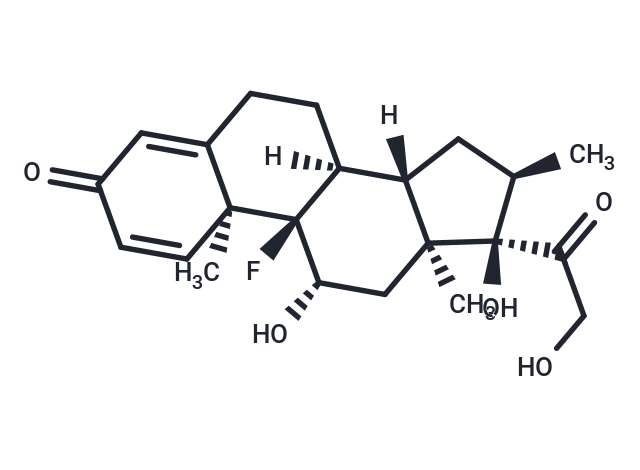
Dexamethasone is a glucocorticoid receptor agonist and IL receptor modulator with anti-inflammatory, immunosuppressive, and apoptosis-inducing activities. It inhibits the production of inflammatory miRNA-155 exosomes in macrophages, significantly reduces inflammatory cytokine expression in neutrophils and monocytes, suppresses LPS-induced macrophage inflammation, and induces autophagy. It is commonly used to induce animal models of depression, muscle atrophy, and hypertension, and holds potential in COVID-19 research.

Dexamethasone
Cas No. 50-02-2
Pack SizePriceUSA StockGlobal StockQuantity
50 mg$29In StockIn Stock
1 mL x 10 mM (in DMSO)$45In StockIn Stock
In stock · Estimated delivery: USA Stock (1-2 days) Global Stock (5-7 days)
Add to Cart
Add to Quotation
Custom-made molecule. TargetMol’s expert synthesis team delivers cost-effective solutions. Contact us for inquiries. Committed to serving you.
For research use only—not for human use. No sales to individuals. Use as intended only.
Questions
TargetMol
View More

Batch Information

Select Batch
Purity:99.91%
Color:White
Contact us for more batch information

Resource Download

Product Introduction

Bioactivity
Description
Dexamethasone is a glucocorticoid receptor agonist and IL receptor modulator with anti-inflammatory, immunosuppressive, and apoptosis-inducing activities. It inhibits the production of inflammatory miRNA-155 exosomes in macrophages, significantly reduces inflammatory cytokine expression in neutrophils and monocytes, suppresses LPS-induced macrophage inflammation, and induces autophagy. It is commonly used to induce animal models of depression, muscle atrophy, and hypertension, and holds potential in COVID-19 research.
Targets&IC50
CHO cells:> 20 μM, Macrophages:0.134 μM, A549 cells:> 15 μM, HEK293T cells:> 20 μM, HEK293 cells:> 500 μM, J774 cells:5.2 μM, B16 F10 cells:> 20 μM, NF-κB, IκBα, and IκBβ:0.5 nM, granulocyte-Macrophage cells colony stimulating factor:2.2 nM (EC50), transcription of the β2-receptor:36 nM (EC50), B-cell:0.8 μM, HeLa S3 cells:4.1 nM, COS-7 cells:7.2 nM (EC50), Fibroblast:> 15 μM, BV-2 cells:2.5 x 10⁻² μM
In vitro
METHODS: Human colorectal cancer cells LoVo and HCT116 were treated with Dexamethasone (10-300 µM) for 72 h. Cell growth inhibition was detected by MTT.
RESULTS: Dexamethasone dose-dependently inhibited the growth of LoVo and HCT116 cells, and the inhibition rates of 300 µM Dexamethasone were 52.6% and 58.8%, respectively. [1]
METHODS: Acute lymphoblastic leukemia cells RS4;11 were treated with Dexamethasone (100 nM) for 24-36 h. Cell morphology was examined using electron microscopy.
RESULTS: In cells treated with Dexamethasone for 24 h, vesicles were surrounded by double membranes, which are characteristic of autophagosomes, and contained membrane structures and/or part of the endoplasmic reticulum or a large amount of cytoplasm. In addition to the appearance of autophagosomes, the nucleus and cell morphology were initially intact, suggesting that autophagosome formation preceded cell death. Dexamethasone induces autophagy. [2]
METHODS: Activated mouse and human T cells were treated with Dexamethasone (0.001-10 μM) for 48 h, and PD-1 expression was detected by Flow Cytometry.
RESULTS: Dexamethasone enhanced the expression of PD-1 in mouse and human activated T cells. [3]
In vivo
METHODS: To investigate the anti-inflammatory effects, Dexamethasone (1-10 mg/kg) was administered as a single intraperitoneal injection to LPS-induced inflammation in C57Bl/6JBom mice.
RESULTS: 10 mg/kg Dexamethasone significantly reduced neutrophils in bronchoalveolar lavage fluid.Dexamethasone treatment significantly down-regulated the levels of TNF-α, IL-1α, IL-1β, IL-6, IL-12p40 and MIP-1α mRNA. Dexamethasone exerts anti-inflammatory and antioxidant functions in acute airway inflammation. [4]
METHODS: To detect anti-tumor activity in vivo, Dexamethasone (1 mg/kg) was intraperitoneally injected into SCID mice harboring the human myeloma tumor OPM2 five days per week for three weeks.
RESULTS: Dexamethasone treatment significantly inhibited the growth of OPM2 tumors, indicating antitumor activity in vivo. [5]
Disease Modeling Protocol
Sarcopenia model
  • Modeling Mechanism:

    Dexamethasone induces sarcopenic pathological changes through core pathways: ① It activates the ubiquitin-proteasome system (UPS), upregulates the expression of transcription factor FoxO3α, and then promotes the expression of muscle-specific E3 ubiquitin ligases MAFbx/atrogin-1 and MuRF1, accelerating muscle protein degradation; ② It selectively damages fast-twitch muscle fibers (type II fibers), inhibits muscle protein synthesis, and leads to thinner muscle fibers and reduced muscle mass; ③ It induces muscle function decline, manifested as decreased muscle strength and reduced exercise capacity, fully mimicking the core phenotype of sarcopenic disease: "dual loss of muscle mass and muscle function".

  • Related Products:

    Dexamethasone (T1076)

  • Modeling Method:

    Experimental Subject:

    Rats: Sprague-Dawley (SD) strain, male, 6 weeks old, average body weight 180 g

    Dosage and Administration Route:

    ① Core modelling: Dexamethasone 500 μg/kg, intraperitoneal injection;
    ② Control treatments: Blank control group (saline intraperitoneal injection), solvent control group (distilled water oral administration);
    ③ Intervention validation (optional): beLP-K (1 mg/kg or 2 mg/kg), diluted in distilled water, administered orally daily

    Dosing Frequency and Duration Model:

    DEX administered once daily for 5 consecutive days.

  • Validation:

    1. Muscle mass and morphology: - Micro-CT scans showed a significant reduction in the volume of the gastrocnemius and tibialis anterior muscles in the hind limbs of rats in the DEX group, and beLP-K intervention could inhibit the decrease in muscle mass; - After dissection and weighing, the weight of the gastrocnemius and tibialis anterior muscles in the DEX group was significantly lower than that in the control group (p<0.05), and the muscle weight recovered after beLP-K treatment; 2. Muscle function: Grip strength was significantly decreased in rats in the DEX group (p<0.001), and the grip strength improved in a dose-dependent manner after beLP-K intervention; 3. Molecular markers: Western blot analysis of rat gastrocnemius muscle tissue showed that the expression of MAFbx/atrogin-1 and MuRF1 proteins was significantly increased in the DEX group (p<0.05), and beLP-K could significantly downregulate their expression (p<0.05).

*Precautions: At the end of the experiment, the rats were euthanized by inhaling CO2.

*References:Moon J,et,al. Protective Efficacy of Lactobacillus plantarum Postbiotic beLP-K in a Dexamethasone-Induced Sarcopenia Model. Int J Mol Sci. 2025 Aug 3;26(15):7504.

Hypertension model
  • Modeling Mechanism:

    Dexamethasone induces hypertension pathological changes through multiple pathways: ① It activates the NADPH oxidase pathway, promoting the generation of reactive oxygen species (ROS) and triggering oxidative stress (manifested as elevated plasma lipid peroxidation marker F₂-isoprostaglandins); ② It inhibits the expression of endothelial nitric oxide synthase (eNOS) and inducible nitric oxide synthase (iNOS), reducing nitric oxide (NO) production and impairing vasodilatory function; ③ It increases renal vascular resistance, affecting the regulation of renal water and sodium excretion, thereby raising blood pressure; ④ It does not depend on mitochondrial superoxide generation, and its antihypertensive mechanism is unrelated to mitochondrial ROS inhibition.

  • Related Products:

    Dexamethasone (T1076)

  • Modeling Method:

    Experimental Subject:

    Rats, Sprague-Dawley (SD), Male, Body weight 200–300 g

    Dosage and Administration Route:

    ① Core modelling: Dexamethasone, 10 μg/animal/day, subcutaneous injection;
    ② Control treatments: Blank control group (subcutaneous injection of 0.1 mL saline solution per animal per day), solvent control group (no additional solvent, matching injection procedure only);
    ③ Intervention validation (optional): Alpha-lipoic acid (antioxidant), 10 mg/animal/day, Administered orally mixed with ground feed, Commencing 4 days prior to modelling, continuing for 15 nights (covering the entire modelling period).

    Dosing Frequency and Duration Model:

    Once daily for 7 consecutive days (from experimental day 5 to day 11)

  • Validation:

    1. Core Indicator (Blood Pressure): - Systolic blood pressure (SBP) in conscious rats was measured using a tail-cuff sphygmomanometer. After modeling, SBP increased from baseline 115±3 mmHg to 139±4 mmHg (p<0.005), significantly higher than the saline control group (119±3 mmHg); - Pretreatment with α-lipoic acid completely blocked the DEX-induced increase in SBP (SBP after modeling was 126±5 mmHg, no statistical difference), but could not reverse the established hypertension; 2. Oxidative Stress Indicators: - Plasma F₂-isoprostaglandin concentration was significantly increased (DEX group 7.1±0.6 nmol/L vs control group 4.7±0.3 nmol/L, p<0.01), and α-lipoic acid pretreatment reduced this indicator (5.7±0.2 nmol/L, p<0.05); 3. Specific Indicators: - Thymus weight was significantly reduced (DEX group 48±4.1 nmol/L). mg/100g body weight vs. control group 127±7.2 mg/100g body weight, p<0.005), verifying glucocorticoid activity; - No significant increase in renal mitochondrial superoxide (MitoSOX fluorescence detection), excluding mitochondrial ROS-mediated hypertension; 4. Auxiliary indicators: - Weight gain stagnation (DEX group body weight before and after modeling 272±9 g vs 277±7 g, no significant difference), which was significantly different from the control group (270±6 g increased to 306±7 g) (p<0.005).

*Precautions: During T11, rats were bled to death under isoflurane anesthesia between 09:00 and 11:00 AM.

*References:Ong SL,et,al. The effect of alpha-lipoic acid on mitochondrial superoxide and glucocorticoid-induced hypertension. Oxid Med Cell Longev. 2013;2013:517045.

Animal Research
NAC was administered at three different doses (10, 100 and 500 mg/kg body weight). At the highest concentration, the acidic pH of the NAC solution was adjusted by adding NaOH. Dexamethasone was administered as a single injection of 1 or 10 mg/kg. Both drugs were dissolved in saline and 400 μl were injected intraperitoneally, either 1 h before or 1 h after LPS exposure. In one experiment, NAC (100 and 500 mg/kg) was injected successively every 4·5 h, starting 1 h before challenge (five injections in total). A control group of LPS-exposed animals were injected intraperitoneally with solvent alone (saline). Intratracheal administration was performed by instillation of 100 μl NAC (50, 100 or 500 mg/kg) or dexamethasone (10 mg/kg) into the lungs of mice anaesthetized with 15 mg/kg Rapinovet (i.v.) [4].
SynonymsPrednisolone F, NSC 34521, MK 125, Hexadecadrol
Chemical Properties
Molecular Weight392.46
FormulaC22H29FO5
Cas No.50-02-2
SmilesF[C@@]12[C@]([C@]3([C@](C)(C[C@@H]1O)[C@](C(CO)=O)(O)[C@H](C)C3)[H])(CCC=4[C@]2(C)C=CC(=O)C4)[H]
Relative Density.1.32 g/cm3
Storage & Solubility Information
Storagekeep away from direct sunlight | Powder: -20°C for 3 years | In solvent: -80°C for 1 year | Shipping with blue ice/Shipping at ambient temperature.
Solubility Information
H2O: insoluble
Ethanol: 6 mg/mL (15.29 mM), Sonication is recommended.
DMSO: 250 mg/mL (637.01 mM), Sonication is recommended.
In Vivo Formulation
10% DMSO+40% PEG300+5% Tween 80+45% Saline: 7.3 mg/mL (18.6 mM), Suspension.
Please add the solvents sequentially, clarifying the solution as much as possible before adding the next one. Dissolve by heating and/or sonication if necessary. Working solution is recommended to be prepared and used immediately. The formulation provided above is for reference purposes only. In vivo formulations may vary and should be modified based on specific experimental conditions.
Solution Preparation Table
Ethanol/DMSO
1mg5mg10mg50mg
1 mM2.5480 mL12.7402 mL25.4803 mL127.4015 mL
5 mM0.5096 mL2.5480 mL5.0961 mL25.4803 mL
10 mM0.2548 mL1.2740 mL2.5480 mL12.7402 mL
DMSO
1mg5mg10mg50mg
20 mM0.1274 mL0.6370 mL1.2740 mL6.3701 mL
50 mM0.0510 mL0.2548 mL0.5096 mL2.5480 mL
100 mM0.0255 mL0.1274 mL0.2548 mL1.2740 mL
Note : The dilution table applies only to solid products. For liquid products, please calculate the stock solution based on the stated concentration and/or density.

Calculator

  • Molarity Calculator
  • Dilution Calculator
  • Reconstitution Calculator
  • Molecular Weight Calculator

In Vivo Formulation Calculator (Clear solution)

Please enter your animal experiment information in the following box and click Calculate to obtain the stock solution preparation method and in vivo formula preparation method:
TargetMol | Animal experiments For example, if the intended dosage is 10 mg/kg for animals weighing 20 g , with a dosing volume of 100 μL per animal, TargetMol | Animal experiments and a total of 10 animals are to be administered, using a formulation of TargetMol | reagent 10% DMSO+ 40% PEG300+ 5% Tween 80+ 45% Saline/PBS/ddH2O , the resulting working solution concentration would be 2 mg/mL.

Stock Solution Preparation:

Dissolve 2 mg of the compound in 100 μL DMSOTargetMol | reagent to obtain a stock solution at a concentration of 20 mg/mL . If the required concentration exceeds the compound's known solubility, please contact us for technical support before proceeding.

Preparation of the In Vivo Formulation:

1) Add 100 μL of the DMSOTargetMol | reagent stock solution to 400 μL PEG300TargetMol | reagent and mix thoroughly until the solution becomes clear.

2) Add 50 μL Tween 80 and mix well until fully clarified.

3) Add 450 μL Saline,PBS or ddH2OTargetMol | reagent and mix thoroughly until a homogeneous solution is obtained.

This example is provided solely to demonstrate the use of the In Vivo Formulation Calculator and does not constitute a recommended formulation for any specific compound. Please select an appropriate dissolution and formulation strategy based on your experimental model and route of administration.
All co-solvents required for this protocol, includingDMSO, PEG300/PEG400, Tween 80, SBE-β-CD, and Corn oil, are available for purchase on the TargetMol website.
1 Enter information below:
mg/kg
g
μL
2 Enter the in vivo formulation:
% DMSO
%
% Tween 80
% Saline/PBS/ddH2O

Dose Conversion

You can also refer to dose conversion for different animals. More Dose Conversion

Tech Support

Please see Inhibitor Handling Instructions for more frequently ask questions. Topics include: how to prepare stock solutions, how to store products, and cautions on cell-based assays & animal experiments, etc

Keywords

Related Tags: buy Dexamethasone | purchase Dexamethasone | Dexamethasone cost | order Dexamethasone | Dexamethasone chemical structure | Dexamethasone in vivo | Dexamethasone in vitro | Dexamethasone formula | Dexamethasone molecular weight