


Shopping Cart
Remove All Your shopping cart is currently empty


Synonyms: RG3635, AL-39324, ABT-869
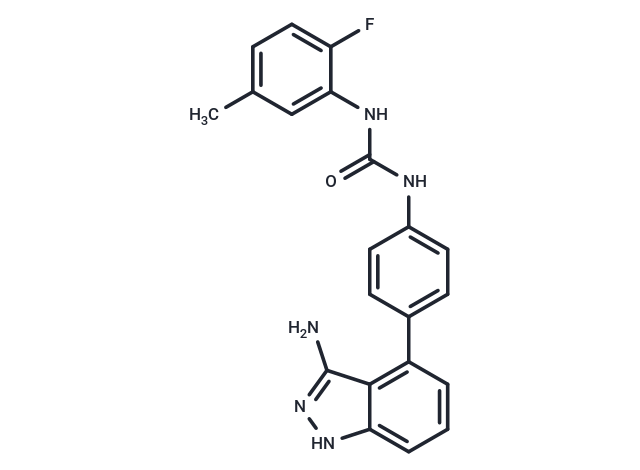

| Pack Size | Price | USA Stock | Global Stock | Quantity |
|---|---|---|---|---|
| 5 mg | $43 | In Stock | In Stock | |
| 10 mg | $77 | In Stock | In Stock | |
| 25 mg | $128 | In Stock | In Stock | |
| 50 mg | $198 | In Stock | In Stock | |
| 100 mg | $288 | In Stock | In Stock | |
| 200 mg | $531 | In Stock | In Stock | |
| 500 mg | $858 | In Stock | In Stock | |
| 1 mL x 10 mM (in DMSO) | $48 | In Stock | In Stock |
| Description | Linifanib (AL-39324) (ABT-869) is a novel, potent ATP-competitive VEGFR/PDGFR inhibitor for KDR (IC50: 4 nM), CSF-1R (IC50: 3 nM), Flt-1/3 (IC50: 3/4 nM) and PDGFRβ (IC50: 66 nM). Linifanib may exhibit potent antiproliferative and apoptotic effects on tumor cells whose proliferation is dependent on mutant kinases, such as FMS-related tyrosine kinase receptor-3 (FLT3). |
| Targets & IC50 | PDGFRβ:66 nM, c-Kit:14 nM, KDR:4 nM, CSF1R:3 nM, FLT3:4 nM, FLK1:3 nM |
| In vitro | In lung tissue, Linifanib (0.3 mg/kg) completely inhibits the phosphorylation of vascular endothelial growth factor receptors. On the cornea, Linifanib administered twice daily at doses of 7.5/15 mg/kg significantly inhibits vascularization induced by recombinant basic fibroblast growth factor and vascular endothelial growth factor. In MDA-231 xenograft tumors, Linifanib (12.5 mg/kg, twice daily) reduces microvessel density. Linifanib also suppresses the edema response (ED50: 0.5 mg/kg). When applied to xenograft tumor models including HT1080, H526, MX-1, and DLD-1, Linifanib inhibits tumor growth (ED75: 4.5-12 mg/kg). In the HT1080 fibrosarcoma model, the Cmax and AUC24 of Linifanib are 0.4 μg/mL and 2.7 μg·hour/mL, respectively. |
| In vivo | Linifanib (ABT-869) inhibits the proliferation of human umbilical vein endothelial cells stimulated by vascular endothelial growth factor, exhibiting an inhibitory concentration (IC50) of 0.2 nM. In kinase assays, Linifanib shows inhibition of Kit (IC50: 14 nM), PDGFRβ (IC50: 66 nM), and Flt4 (IC50: 190 nM). It also suppresses ligand-induced phosphorylation of KDR (IC50: 2 nM), PDGFR-β (IC50: 2 nM), KIT (IC50: 31 nM), and CSF-1R (IC50: 10 nM) at the cellular level, with serum proteins affecting its potency. In Ba/F3 FLT3 ITD cells, Linifanib (10 nM) reduces the phosphorylation of Akt at Ser473 and GSK3β at Ser9. However, ABT-869 has minimal impact on tumor cells not stimulated by vascular endothelial growth factor or platelet-derived growth factor, except for MV4-11 leukemia cells, which possess a constitutively active form of Flt3 (IC50: 4 nM). Linifanib binds to the ATP-binding site of CSF-1R (Ki: 3 nM). |
| Synonyms | RG3635, AL-39324, ABT-869 |
| Kinase Assay | Kinase assays: Potencies (IC50 values) are determined by assays of active kinase domains cloned and expressed in baculovirus using the FastBacbaculovirus expression system or obtained commercially. For tyrosine kinase assays, a biotinylated peptide substrate containing a single tyrosine is used with 1 mM ATP, anEu-cryptate–labeled anti-phosphotyrosine antibody (PT66), and Strepavidin-APC in a homogeneous time-resolved fluorescence assay. Serine/threonine kinases are assayed using 5 μM ATP, [33P]ATP, and a biotinylated peptide substrate with peptide capture and incorporation of 33P determined using a SA-Flashplate. Linifanib is assayed at multiple concentrations prepared by serial dilution of a DMSO stock solution of Linifanib. The concentration resulting in 50% inhibition of activity is calculated using nonlinear regression analysis of the concentration response data. |
| Cell Research | Cells are seeded into 96-well plates at 2.5 × 10³ per well and incubated with serum-free medium for 24 hours. Linifanib and VEGF (final, 10 ng/mL) are added and incubated for 72 hours in serum-free medium. For carcinoma cell lines, 3 × 10³ cells/well are plated overnight in full growth medium. Linifanib is added to the cells in full growth medium and incubated for 72 hours. For leukemia cells, generally 5 × 10⁴ per well are plated in full growth medium, Linifanib is added, and incubated for 72 hours. The effects on proliferation are determined by addition of Alamar Blue (final solution, 10%), incubation for 4 hours at 37 °C in a CO2 incubator and analysis in a fluorescence plate reader (544 nm, excitation: 590 nm, emission(Only for Reference) |
| Molecular Weight | 375.4 |
| Formula | C21H18FN5O |
| Cas No. | 796967-16-3 |
| Smiles | Cc1ccc(F)c(NC(=O)Nc2ccc(cc2)-c2cccc3[nH]nc(N)c23)c1 |
| Relative Density. | 1.424 g/cm3 |
| Storage | Powder: -20°C for 3 years | In solvent: -80°C for 1 year Shipping with blue ice/Shipping at ambient temperature. | |||||||||||||||||||||||||||||||||||
| Solubility Information | Ethanol: < 1 mg/mL (insoluble or slightly soluble) DMSO: 250 mg/mL (665.96 mM), Sonication is recommended.  H2O: < 1 mg/mL (insoluble or slightly soluble) | |||||||||||||||||||||||||||||||||||
| In Vivo Formulation | 10% DMSO+40% PEG300+5% Tween 80+45% Saline: 10 mg/mL (26.64 mM), Solution. 10% DMSO+90% Saline: < 10 mg/mL (26.64 mM), Lower concentrations may be soluble, but exact solubility limit is unknown. Please add the solvents sequentially, clarifying the solution as much as possible before adding the next one. Dissolve by heating and/or sonication if necessary. Working solution is recommended to be prepared and used immediately. The formulation provided above is for reference purposes only. In vivo formulations may vary and should be modified based on specific experimental conditions. | |||||||||||||||||||||||||||||||||||
Solution Preparation Table | ||||||||||||||||||||||||||||||||||||
DMSO
Note : The dilution table applies only to solid products. For liquid products, please calculate the stock solution based on the stated concentration and/or density. | ||||||||||||||||||||||||||||||||||||
 For example, if the intended dosage is 10 mg/kg for animals weighing 20 g , with a dosing volume of 100 μL per animal, and a total of 10 animals are to be administered, using a formulation of
  10% DMSO+ 40% PEG300+ 5% Tween 80+ 45% Saline/PBS/ddH2O , the resulting working solution concentration would be 2 mg/mL.
Dissolve 2 mg of the compound in 100 μL DMSO to obtain a stock solution at a concentration of 20 mg/mL . If the required concentration exceeds the compound's known solubility, please contact us for technical support before proceeding.
1) Add 100 μL of the DMSO stock solution to 400 µL PEG300 and mix thoroughly until the solution becomes clear.
2) Add 50 µL Tween 80 and mix well until fully clarified.
3) Add 450 µL Saline,PBS or ddH2O and mix thoroughly until a homogeneous solution is obtained.
| Size | Quantity | Unit Price | Amount | Operation |
|---|
 Feedback
 Hello! How can I help you today?
Copyright © 2015-2026 TargetMol Chemicals Inc. All Rights Reserved.
