


Shopping Cart
Remove All Your shopping cart is currently empty

Synonyms: L-Arg, (S)-(+)-Arginine
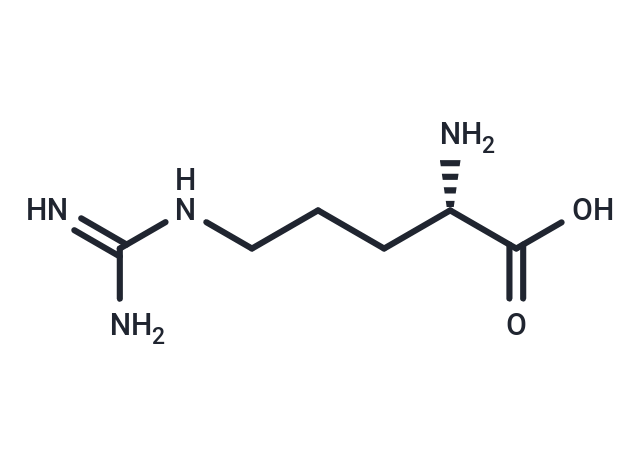
| Pack Size | Price | USA Stock | Global Stock | Quantity |
|---|---|---|---|---|
| 1 g | $31 | In Stock | In Stock | |
| 5 g | $40 | - | In Stock |

| Description | L-Arginine (L-Arg) is a substrate for endothelial nitric oxide synthase (eNOS), participating in protein synthesis, polyamine production, and cellular signaling regulation. L-Arginine is transported into vascular smooth muscle cells via the cationic amino acid transporter family and metabolized into nitric oxide, polyamines, or L-proline. L-Arginine is an effective vasodilator and can be used to induce experimental acute pancreatitis. |
| Targets & IC50 | L-homoarginine:115.8 μM, HEK293 cells:283 μM (EC50) |
| In vitro | Methods: Primary human naive CD4+ and CD8+ T cells were cultured with L-Arginine (3-12 mM) for 48 hours. After 4 days, IL-2 was added and the cells were cultured for an additional 3 days. Following this, IL-2 was withdrawn and the cells were cultured further. Annexin V staining and flow cytometry were used to assess survival rates. Results: High L-Arginine significantly increased the survival rate of CD4+ and CD8+ T cells after IL-2 withdrawal. [1] Methods: Adult (8–10 weeks old) WT mouse hippocampal neural stem/progenitor cells (aNPCs) were treated with L-Arginine (100 or 500 μM) concurrently with BrdU labeling for 6–8 hours. BrdU incorporation assays assessed cell proliferation. Results: L-Arginine treatment significantly increased the proliferation rate of WT-aNPCs. [2] |
| In vivo | Methods: To investigate the effect of L-Arginine on T cell survival, BALB/c mice underwent adoptive transfer of HA-TCR transgenic CD4+ T cells, followed by immunization with HA peptide + CFA. Mice were then administered oral L-Arginine (1.5 mg/g body weight/day). Fifteen days post-immunization, the number of CD44hi donor T cells in draining lymph nodes was quantified by flow cytometry. Results: In arginine-fed mice, donor T cell numbers were threefold higher than in controls. [1] Methods: Nestin-GFP transgenic mice received continuous L-Arginine (100 μM) infusion via microosmotic pump for 7 days. Analysis assessed activation status and cell cycle exit of Nestin-GFP+ radial glial-like cells (RGLs). Results: L-Arginine infusion increased the proportion of activated RGLs and decreased the proportion of RGLs exiting the cell cycle. [2] Methods: To investigate the acute effects of L-Arginine on catecholamine levels, normal rats received intraperitoneal injections of L-Arginine (600 mg/kg). Blood samples were collected 30 minutes post-administration, and plasma levels of epinephrine (AD), norepinephrine (NA), dopamine (DA), and DOPA were measured by high-performance liquid chromatography or fluorescence assay. Results: L-Arginine increased AD, NA, and DOPA levels by approximately 2-fold, while DA increased by 77.5%. [3] |
| Synonyms | L-Arg, (S)-(+)-Arginine |
| Disease Modeling Protocol | Gastric ulcer model
*Precautions: All mice were sacrificed in batches at 1, 4, 7, and 15 days after modeling, and gastric tissue samples were collected simultaneously. Mice were fasted for 24 hours before indomethacin induction (with free access to water). Pancreatitis model
*Precautions: Seventy-two hours after modeling, the mice were anesthetized and euthanized by cervical dislocation. |
| Molecular Weight | 174.20 |
| Formula | C6H14N4O2 |
| Cas No. | 74-79-3 |
| Smiles | C(CCNC(=N)N)[C@@H](C(O)=O)N |
| Relative Density. | Ca. 1.36 - 1.56 g/cm3. Temperature:20 °C. |
| Storage | Powder: -20°C for 3 years | In solvent: -80°C for 1 year Shipping with blue ice/Shipping at ambient temperature. | |||||||||||||||||||||||||||||||||||
| Solubility Information | DMSO: Insoluble H2O: 104.00 mg/mL (597.01 mM), Sonication is recommended.  | |||||||||||||||||||||||||||||||||||
Solution Preparation Table | ||||||||||||||||||||||||||||||||||||
H2O
Note : The dilution table applies only to solid products. For liquid products, please calculate the stock solution based on the stated concentration and/or density. | ||||||||||||||||||||||||||||||||||||
 For example, if the intended dosage is 10 mg/kg for animals weighing 20 g , with a dosing volume of 100 μL per animal, and a total of 10 animals are to be administered, using a formulation of
  10% DMSO+ 40% PEG300+ 5% Tween 80+ 45% Saline/PBS/ddH2O , the resulting working solution concentration would be 2 mg/mL.
Dissolve 2 mg of the compound in 100 μL DMSO to obtain a stock solution at a concentration of 20 mg/mL . If the required concentration exceeds the compound's known solubility, please contact us for technical support before proceeding.
1) Add 100 μL of the DMSO stock solution to 400 µL PEG300 and mix thoroughly until the solution becomes clear.
2) Add 50 µL Tween 80 and mix well until fully clarified.
3) Add 450 µL Saline,PBS or ddH2O and mix thoroughly until a homogeneous solution is obtained.
| Size | Quantity | Unit Price | Amount | Operation |
|---|
 Feedback
 Hello! How can I help you today?
Copyright © 2015-2026 TargetMol Chemicals Inc. All Rights Reserved.
