


Shopping Cart
Remove All
  • TargetMol
    Your shopping cart is currently empty

L-Arginine hydrochloride (Alias: L-arginine monohydrochloride, L-Arginine HCl (L-Arg), (S)-(+)-Arginine hyd...)

Catalog No. T0670 Copy Product Info
Purity: 99.51%
🥰Excellent
L-Arginine hydrochloride serve as substrates and nitrogen donors for endothelial nitric oxide synthase (eNOS) to produce nitric oxide (NO). They are transported into vascular smooth muscle cells via cationic amino acid transporters, where they are metabolized into NO, polyamines, or L-proline. As effective vasodilators, they are commonly used to induce experimental acute pancreatitis models.

L-Arginine hydrochloride

Copy Product Info
🥰Excellent
Catalog No. T0670
Alias L-arginine monohydrochloride, L-Arginine HCl (L-Arg), (S)-(+)-Arginine hydrochloride
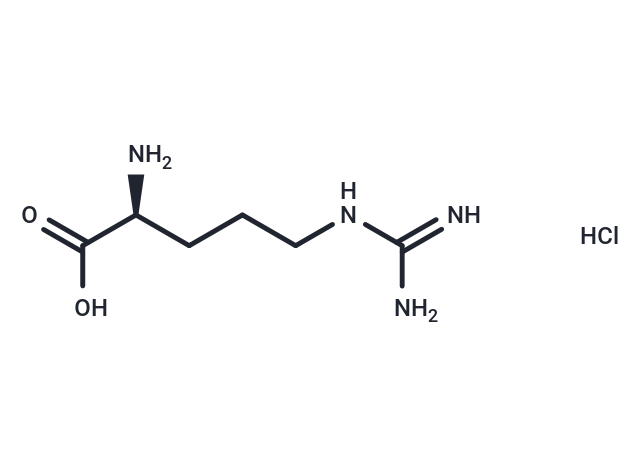
L-Arginine hydrochloride serve as substrates and nitrogen donors for endothelial nitric oxide synthase (eNOS) to produce nitric oxide (NO). They are transported into vascular smooth muscle cells via cationic amino acid transporters, where they are metabolized into NO, polyamines, or L-proline. As effective vasodilators, they are commonly used to induce experimental acute pancreatitis models.

L-Arginine hydrochloride
Cas No. 1119-34-2
Pack SizePriceUSA StockGlobal StockQuantity
1 g$33In StockIn Stock
2 g$36-In Stock
5 g$42-In Stock
10 g$59-In Stock
In stock · Estimated delivery: USA Stock (1-2 days) Global Stock (5-7 days)
Add to Cart
Add to Quotation
For research use only—not for human use. No sales to individuals. Use as intended only.
Questions
TargetMol
View More

Batch Information

Select Batch
Purity:99.51%
Appearance:Solid
Color:White
Contact us for more batch information

Resource Download

Product Introduction

Bioactivity
Description
L-Arginine hydrochloride serve as substrates and nitrogen donors for endothelial nitric oxide synthase (eNOS) to produce nitric oxide (NO). They are transported into vascular smooth muscle cells via cationic amino acid transporters, where they are metabolized into NO, polyamines, or L-proline. As effective vasodilators, they are commonly used to induce experimental acute pancreatitis models.
In vitro
In individuals with sickle cell anemia, oral administration of L-Arginine (0.1 g/kg) significantly reduces pulmonary arterial systolic pressure after 5 days. Continuous treatment with L-Arginine (4 mg/kg per minute for 1 hour) in rabbit limbs subjected to regional ischemia/reperfusion reduced superoxide production by cNOS, thereby increasing NO accumulation. In SV-129 mice, subcutaneous injection of L-Arginine (2 mg/kg) resulted in the upregulation of eNOS.
In vivo
Treatment with L-Arginine (0.3 mM) for 30 minutes significantly increases nitric oxide (NO) production in bovine aortic endothelial cells exposed to n-LDL and oxidized-LDL.
Disease Modeling Protocol
Gastric ulcer model
  • Modeling Mechanism:

    L-Arginine hydrochloride, as a substrate of nitric oxide synthase (NOS), can dilate blood vessels in the gastric mucosa, increase blood flow, and at the same time reduce myeloperoxidase (MPO) activity, reduce inflammatory infiltration, and promote ulcer healing.

  • Related Products:

    L-Arginine hydrochloride (T0670)

  • Modeling Method:

    Experimental Subject:

    Mice, Swiss Albino mice, Male, 6–8 weeks old, 25–30 g

    Dosage and Administration Route:

    Indomethacin 18 mg/kg, Oral (single dose, ulcer induction);Resveratrol 10 mg/kg, Oral (starting 6 hours after ulcer induction, once daily); L-Arginine hydrochloride 25-75 mg/kg, Intraperitoneal injection (administered concurrently with resveratrol, once daily)

    Dosing Frequency and Duration Model:

    Indomethacin single dose, resveratrol and L-arginine hydrochloride administered once daily until ulcer healing (maximum 15 days).

  • Validation:

    The ulcer damage score (DS) decreased, with the L-arginine 75 mg/kg group showing significant improvement compared to the resveratrol group; MPO activity decreased, and inflammatory cell infiltration was reduced; NO synthesis in gastric tissue increased, and the eNOS/iNOS ratio increased; PGE₂ synthesis gradually recovered, and ulcer mucosal healing was accelerated.

*Precautions: All mice were sacrificed in batches at 1, 4, 7, and 15 days after modeling, and gastric tissue samples were collected simultaneously. Mice were fasted for 24 hours before indomethacin induction (with free access to water).

*References:Guha P, et,al. Pro-ulcer effects of resveratrol in mice with indomethacin-induced gastric ulcers are reversed by L-arginine. Br J Pharmacol. 2010 Feb 1;159(3):726-34.

Pancreatitis model
  • Modeling Mechanism:

    L-Arginine hydrochloride is metabolized to produce large amounts of nitric oxide (NO). NO reacts with oxygen free radicals to produce toxic peroxynitrite, which damages pancreatic acinar cells. At the same time, it interferes with pancreatic enzyme secretion, leading to pancreatic tissue edema, necrosis and inflammatory infiltration, which in turn indirectly damages the intestinal mucosal barrier and causes intestinal flora imbalance.

  • Related Products:

    L-Arginine hydrochloride (T0670)

  • Modeling Method:

    Experimental Subject:

    Mice, C57BL/6J, Male, 20–22 g, 6–8 weeks old

    Dosage and Administration Route:

    4 g/kg, 10% L-Arginine, dissolved in distilled water and administered intraperitoneally

    Dosing Frequency and Duration Model:

    Administered twice at 1-hour intervals

  • Validation:

    Serum lipase activity was significantly increased, calcium ion concentration was significantly decreased, and pancreatic MPO expression was upregulated; small intestinal villus necrosis, edema, and inflammatory cell infiltration were observed, and Occludin and ZO-1 expression was decreased; the richness and diversity of the gut microbiota decreased, with increased abundance of Bacteroidetes and Proteobacteria and decreased abundance of Firmicutes.

*Precautions: Seventy-two hours after modeling, the mice were anesthetized and euthanized by cervical dislocation.

*References:Zhang P,et,al.Comprehensive analysis of intestinal barrier function and microbial diversity changes in L-arginine-induced acute pancreatitis mice. Eur J Med Res. 2025 Sep 29;30(1):912.

SynonymsL-arginine monohydrochloride, L-Arginine HCl (L-Arg), (S)-(+)-Arginine hydrochloride
Chemical Properties
Molecular Weight210.66
FormulaC6H15ClN4O2
Cas No.1119-34-2
SmilesC(=O)([C@@H](N)CCCNC(=N)N)O.Cl
Relative Density.1.42 g/cm3. Temperature:20 °C.
Storage & Solubility Information
StoragePowder: -20°C for 3 years | In solvent: -80°C for 1 year | Shipping with blue ice/Shipping at ambient temperature.
Solubility Information
DMSO: Insoluble
H2O: 10 mM, Sonication is recommended.
Solution Preparation Table
H2O
1mg5mg10mg50mg
1 mM4.7470 mL23.7349 mL47.4699 mL237.3493 mL
5 mM0.9494 mL4.7470 mL9.4940 mL47.4699 mL
10 mM0.4747 mL2.3735 mL4.7470 mL23.7349 mL
Note : The dilution table applies only to solid products. For liquid products, please calculate the stock solution based on the stated concentration and/or density.

Calculator

  • Molarity Calculator
  • Dilution Calculator
  • Reconstitution Calculator
  • Molecular Weight Calculator

In Vivo Formulation Calculator (Clear solution)

Please enter your animal experiment information in the following box and click Calculate to obtain the stock solution preparation method and in vivo formula preparation method:
TargetMol | Animal experiments For example, if the intended dosage is 10 mg/kg for animals weighing 20 g , with a dosing volume of 100 μL per animal, TargetMol | Animal experiments and a total of 10 animals are to be administered, using a formulation of TargetMol | reagent 10% DMSO+ 40% PEG300+ 5% Tween 80+ 45% Saline/PBS/ddH2O , the resulting working solution concentration would be 2 mg/mL.

Stock Solution Preparation:

Dissolve 2 mg of the compound in 100 μL DMSOTargetMol | reagent to obtain a stock solution at a concentration of 20 mg/mL . If the required concentration exceeds the compound's known solubility, please contact us for technical support before proceeding.

Preparation of the In Vivo Formulation:

1) Add 100 μL of the DMSOTargetMol | reagent stock solution to 400 μL PEG300TargetMol | reagent and mix thoroughly until the solution becomes clear.

2) Add 50 μL Tween 80 and mix well until fully clarified.

3) Add 450 μL Saline,PBS or ddH2OTargetMol | reagent and mix thoroughly until a homogeneous solution is obtained.

This example is provided solely to demonstrate the use of the In Vivo Formulation Calculator and does not constitute a recommended formulation for any specific compound. Please select an appropriate dissolution and formulation strategy based on your experimental model and route of administration.
All co-solvents required for this protocol, includingDMSO, PEG300/PEG400, Tween 80, SBE-β-CD, and Corn oil, are available for purchase on the TargetMol website.
1 Enter information below:
mg/kg
g
μL
2 Enter the in vivo formulation:
% DMSO
%
% Tween 80
% Saline/PBS/ddH2O

Dose Conversion

You can also refer to dose conversion for different animals. More Dose Conversion

Tech Support

Please see Inhibitor Handling Instructions for more frequently ask questions. Topics include: how to prepare stock solutions, how to store products, and cautions on cell-based assays & animal experiments, etc

Keywords

Related Tags: buy L-Arginine hydrochloride | purchase L-Arginine hydrochloride | L-Arginine hydrochloride cost | order L-Arginine hydrochloride | L-Arginine hydrochloride chemical structure | L-Arginine hydrochloride in vivo | L-Arginine hydrochloride in vitro | L-Arginine hydrochloride formula | L-Arginine hydrochloride molecular weight





