


Shopping Cart
Remove All Your shopping cart is currently empty

Synonyms: CHIR-265
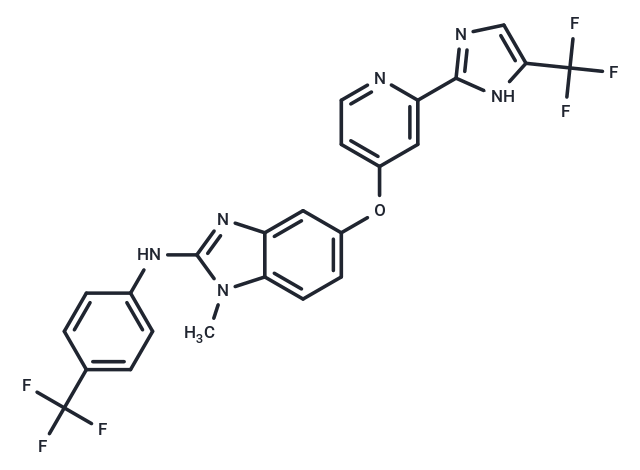

| Pack Size | Price | USA Stock | Global Stock | Quantity |
|---|---|---|---|---|
| 1 mg | $39 | In Stock | In Stock | |
| 2 mg | $57 | In Stock | In Stock | |
| 5 mg | $89 | In Stock | In Stock | |
| 10 mg | $150 | In Stock | In Stock | |
| 25 mg | $280 | In Stock | In Stock | |
| 50 mg | $458 | - | In Stock | |
| 100 mg | $673 | - | In Stock | |
| 1 mL x 10 mM (in DMSO) | $101 | In Stock | In Stock |
| Description | RAF265 (CHIR-265) (CHIR-265) is a potent selective inhibitor of C-Raf/B-Raf/B-Raf V600E with IC50 of 3-60 nM, and exhibits potent inhibition on VEGFR2 phosphorylation with EC50 of 30 nM. Phase 2. |
| Targets & IC50 | C-Raf:3-60 nM, B-Raf:3-60 nM, VEGFR2:30 nM(EC50) |
| In vitro | RAF265 inhibits C-Raf, wild type B-Raf and mutant (V600E) B-Raf. RAF265 effectively block phosphorylation of Raf's downstream substrates MEK and ERK in cells and also kill melanoma and colorectal cancer cell lines harboring B-Raf mutations independent of PTEN mutation status. Raf kinase inhibition by RAF265 in mutant B-Raf melanoma cell lines causes cell cycle arrest and induces apoptosis, mimicking the effect of Raf RNAi in these cells. RAF265 also potently inhibits the phosphorylation of VEGFR2 and proliferation of VEGF-stimulated hMVEC. [1] In HT29 and MDAMB231 cells, RAF265 shows inhibitory activity with IC20 of 1 to 3 μM and IC50 of 5 to 10 μM, respectively. While RAF265 leads to a significant decrease in clonogenic survival in all tested cell lines, which means that RAF265 induces a dominant effect on clonogenic survival. Addition of RAF265 to RAD001 in HCT116 cells could lead to moderately decreased AKT, S6 protein, and 4EBP1 phosphorylation. [2] Raf265 markedly reduces the protein level of Bcl-2 and great inhibitory in CM- and NCI-H727 cells, while having no effect on the TRAIL susceptibility of BON1 and GOT1 cells. [3] Protein kinase D3 (PRKD3) that when knocked down could enhance cell killing by RAF265 in A2058 melanoma cells, which prevent reactivation of MAPK signaling, induce PARP cleavage, increase caspase activity, interrupt cell-cycle progression, and inhibit colony formation. [4] |
| In vivo | RAF265 shows 71% to 72% TVI% (tumor volume inhibition percentage) in HCT116 xenografts at 12 mg/kg. While the combination of RAF265 and RAD001 shows enhanced antitumor activity with increased T10 (time to achieve a relative tumor volume of 10 times the initial tumor volume) and tumor growth delay. The combination of RAD001 and RAF265 also significantly enhances the activation of caspase-3 in HCT116 and MDAMB231 but not in A549 xenografts. [2] RAF265 inhibits FDG (2-deoxy-2-[18F]fluoro-d-glucose) accumulation and decreases the tumor volumes in A375M xenografts by orally dosed of 100 mg/kg. [5] |
| Synonyms | CHIR-265 |
| Kinase Assay | Assay Protocol: Raf and Mek are combined at 2 × final concentrations in assay buffer (50 mM Tris, pH 7.5, 15 mM MgCl2. 0.1 mM EDTA and 1 mM DTT) and dispensed 15 μL per well in polypropylene assay plates. Background levels are determined in wells containing Mek and DMSO without Raf. To the Raf/Mek containing wells is added 3 μL of 10 × of RAF265 diluted in 100% DMSO. The raf kinase activity reaction is started by the addition of 12 μL per well of 2.5 × 33P-ATP diluted in assay buffer. After 45-60 minutes, the reactions are stopped with the addition of 70 μL of stop reagent (30 mM EDTA). Filtration plates are pre-wetted for 5 min with 70% ethanol, and then rinsed by filtration with wash buffer. Samples (90 μL) from the reaction wells are then transferred to the filtration plates. The filtration plates are washed 6 × with wash buffer using Millipore filtration apparatus. The plates are dried and 100 μL per well of scintillation fluid is added. The CPM is then determined using a Wallac Microbeta 1450 reader. |
| Cell Research | The MTT assay and Bliss additivism model are used to assess the effect of RAF265 on cell viability. In each well of a 96-well plate, 1 × 10⁴ cells are grown in 200 μL of medium. After 24 hours, RAF265 is added to achieve a final concentration of 0.1 to 10 μM. After 48 hours of treatment, 20 μL of 5 mg/mL MTT solution in PBS is added to each well. After 4 hours, supernatant is removed and formazan crystals are discarded in 200 μL of DMSO. Absorbance is then measured at 595 nm using an absorbance plate reader. Data are expressed as the percentage of viable cells.(Only for Reference) |
| Molecular Weight | 518.41 |
| Formula | C24H16F6N6O |
| Cas No. | 927880-90-8 |
| Smiles | Cn1c(Nc2ccc(cc2)C(F)(F)F)nc2cc(Oc3ccnc(c3)-c3ncc([nH]3)C(F)(F)F)ccc12 |
| Relative Density. | 1.50 g/cm3 |
| Storage | Powder: -20°C for 3 years | In solvent: -80°C for 1 year Shipping with blue ice/Shipping at ambient temperature. | |||||||||||||||||||||||||||||||||||
| Solubility Information | DMSO: 51.8 mg/mL (99.92 mM), Sonication is recommended. Ethanol: 10.4 mg/mL (20.06 mM), Sonication is recommended. | |||||||||||||||||||||||||||||||||||
Solution Preparation Table | ||||||||||||||||||||||||||||||||||||
Ethanol/DMSO
DMSO
Note : The dilution table applies only to solid products. For liquid products, please calculate the stock solution based on the stated concentration and/or density. | ||||||||||||||||||||||||||||||||||||
 For example, if the intended dosage is 10 mg/kg for animals weighing 20 g , with a dosing volume of 100 μL per animal, and a total of 10 animals are to be administered, using a formulation of
  10% DMSO+ 40% PEG300+ 5% Tween 80+ 45% Saline/PBS/ddH2O , the resulting working solution concentration would be 2 mg/mL.
Dissolve 2 mg of the compound in 100 μL DMSO to obtain a stock solution at a concentration of 20 mg/mL . If the required concentration exceeds the compound's known solubility, please contact us for technical support before proceeding.
1) Add 100 μL of the DMSO stock solution to 400 µL PEG300 and mix thoroughly until the solution becomes clear.
2) Add 50 µL Tween 80 and mix well until fully clarified.
3) Add 450 µL Saline,PBS or ddH2O and mix thoroughly until a homogeneous solution is obtained.
| Size | Quantity | Unit Price | Amount | Operation |
|---|
 Feedback
 Hello! How can I help you today?
Copyright © 2015-2026 TargetMol Chemicals Inc. All Rights Reserved.
