


Shopping Cart
Remove All Your shopping cart is currently empty


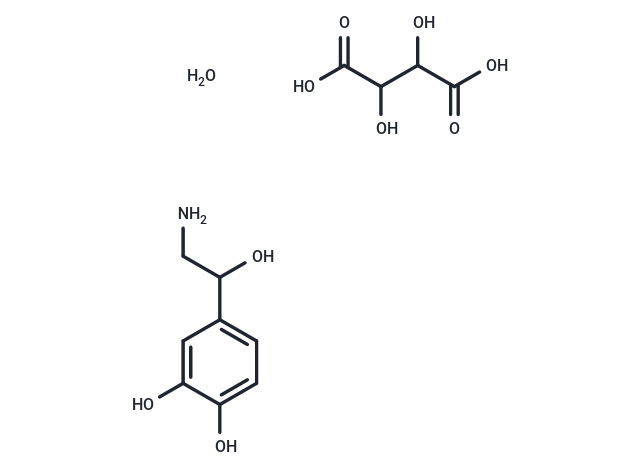
Synonyms: Noradrenaline bitartrate monohydrate, Levophed, 69815-49-2
| Pack Size | Price | USA Stock | Global Stock | Quantity |
|---|---|---|---|---|
| 200 mg | $33 | In Stock | In Stock | |
| 500 mg | $54 | In Stock | In Stock | |
| 1 g | $85 | In Stock | In Stock | |
| 1 mL x 10 mM (in DMSO) | $50 | In Stock | In Stock |
| Description | Norepinephrine bitartrate monohydrate is an effective adrenergic receptor (AR) agonist that directly activates α1, α2, and β1 receptors, and is commonly used to induce cardiomyopathy models. |
| Targets & IC50 | β1-adrenoceptor:5.37 μM(EC50) |
| In vitro | Noradrenaline modulates the gain of evoked activity, especially in sensory areas. Noradrenaline promotes long-term synaptic plasticity, in addition to these data emphasizing its short-term influence. Noradrenaline would signal ‘gross changes in the environment that produce sensory information strongly violating top-down expectations' and would, through an enhancement of ‘bottom-up' information processing at the expense of irrelevant ‘top-down' expectations, favor behavioral adjustment. [1] Noradrenaline modulates drive and energy and exerts a fine regulation of specific processes including learning, memory, sleep, arousal and adaptation. Noradrenaline system is intimately involved in a range of psychological processes which, when disrupted, lead to the expression of classifiable psychiatric disorders. Noradrenaline appears to be involved in a range of psychological processes, including arousal (vigilance), cognition, learning and sleep regulation, and also in regulating response to stressors which might initiate or exacerbate depressive symptomatology. Noradrenaline deficiency in this pathway may reduce concentration, affect working memory and cause psychomotor retardation, resulting in apathy and depression,while an increase in noradrenaline in this pathway is predicted to alleviate poor concentration, apathy and depression. [2] Noradrenaline effects are complex and depending on experimental conditions (ponto-medullary and medullary preparations) and species (rats or mice), exogenous Noradrenaline mainly facilitates or mainly inhibits the neonatal RRG, with a mixture of α1 facilitatory and α2 inhibitory effects. [3] |
| Synonyms | Noradrenaline bitartrate monohydrate, Levophed, 69815-49-2 |
| Disease Modeling Protocol | Sepsis-associated cardiomyopathy model
*Precautions: |
| Cell Research | Norepinephrine (NE)is dissolved in DMSO and stored, and then diluted with appropriate media before use[2]. Subcutaneous preadipocytes derived from a 38-year old non-diabetic female donor are immortalized with TERT and HPV E6/E7. For the current studies, a stable diploid clone (referred to as clone B) with consistent differentiation capacity is isolated by ring cloning. Cells are grown in preadipocyte PGM2 media. Once cells are confluent, differentiation is induced by incubation in differentiation media consisting of dexamethasone, IBMX, indomethacin, and additional insulin. Cells are differentiated for 10 days. Prior to treatment, media is replaced with PGM2 media for one day and then switched to serum-free media overnight for treatments. Adipocytes are treated for 6 hours with vehicle, Norepinephrine (NE, 10 μM), CGP (10 nM), or Norepinephrine (NE) and CGP[2]. |
| Molecular Weight | 337.28 |
| Formula | C8H11NO3·C4H6O6·H2O |
| Cas No. | 108341-18-0 |
| Smiles | O.OC(C(O)C(O)=O)C(O)=O.NCC(O)c1ccc(O)c(O)c1 |
| Relative Density. | no data available |
| Storage | Powder: -20°C for 3 years | In solvent: -80°C for 1 year Shipping with blue ice/Shipping at ambient temperature. | ||||||||||||||||||||||||||||||||||||||||
| Solubility Information | H2O: 31.9 mg/mL (94.58 mM), Sonication is recommended. DMSO: 125 mg/mL (370.61 mM), Sonication is recommended.  | ||||||||||||||||||||||||||||||||||||||||
| In Vivo Formulation | 10% DMSO+40% PEG300+5% Tween 80+45% Saline: 2 mg/mL (5.93 mM), Sonication is recommended. 10% DMSO+90% Saline: 10 mg/mL (29.65 mM), Solution. Please add the solvents sequentially, clarifying the solution as much as possible before adding the next one. Dissolve by heating and/or sonication if necessary. Working solution is recommended to be prepared and used immediately. The formulation provided above is for reference purposes only. In vivo formulations may vary and should be modified based on specific experimental conditions. | ||||||||||||||||||||||||||||||||||||||||
Solution Preparation Table | |||||||||||||||||||||||||||||||||||||||||
H2O/DMSO
DMSO
Note : The dilution table applies only to solid products. For liquid products, please calculate the stock solution based on the stated concentration and/or density. | |||||||||||||||||||||||||||||||||||||||||
 For example, if the intended dosage is 10 mg/kg for animals weighing 20 g , with a dosing volume of 100 μL per animal, and a total of 10 animals are to be administered, using a formulation of
  10% DMSO+ 40% PEG300+ 5% Tween 80+ 45% Saline/PBS/ddH2O , the resulting working solution concentration would be 2 mg/mL.
Dissolve 2 mg of the compound in 100 μL DMSO to obtain a stock solution at a concentration of 20 mg/mL . If the required concentration exceeds the compound's known solubility, please contact us for technical support before proceeding.
1) Add 100 μL of the DMSO stock solution to 400 µL PEG300 and mix thoroughly until the solution becomes clear.
2) Add 50 µL Tween 80 and mix well until fully clarified.
3) Add 450 µL Saline,PBS or ddH2O and mix thoroughly until a homogeneous solution is obtained.
| Size | Quantity | Unit Price | Amount | Operation |
|---|
 Feedback
 Hello! How can I help you today?
Copyright © 2015-2026 TargetMol Chemicals Inc. All Rights Reserved.
