Shopping Cart
Remove All
  • TargetMol
    Your shopping cart is currently empty

Norepinephrine hydrochloride

Catalog No. T60245 Copy Product Info
Purity: 99.98%
🥰Excellent
Norepinephrine hydrochloride is a β1-selective adrenergic receptor agonist with an EC₅₀ of 5.37 μM and can be used to induce cardiomyopathy models.

Norepinephrine hydrochloride

Copy Product Info
🥰Excellent
Catalog No. T60245

Norepinephrine hydrochloride is a β1-selective adrenergic receptor agonist with an EC₅₀ of 5.37 μM and can be used to induce cardiomyopathy models.

Norepinephrine hydrochloride
Cas No. 329-56-6
Pack SizePriceUSA StockGlobal StockQuantity
200 mg$33-In Stock
500 mg$52-In Stock
1 g$75-In Stock
1 mL x 10 mM (in DMSO)$39-In Stock
In stock · Estimated delivery: USA Stock (1-2 days) Global Stock (5-7 days)
Add to Cart
Add to Quotation
Custom-made molecule. TargetMol’s expert synthesis team delivers cost-effective solutions. Contact us for inquiries. Committed to serving you.
For research use only—not for human use. No sales to individuals. Use as intended only.
Questions
TargetMol
View More

Batch Information

Select Batch
Purity:99.98%
Appearance:Solid
Color:White
Contact us for more batch information

Resource Download

Product Introduction

Bioactivity
Description
Norepinephrine hydrochloride is a β1-selective adrenergic receptor agonist with an EC₅₀ of 5.37 μM and can be used to induce cardiomyopathy models.
In vitro
Norepinephrine (NE) bitartrate monohydrate predominantly acts as a β1-subtype selective adrenergic agonist, with higher concentrations also engaging the β2-adrenoceptor [1]. In a study utilizing adipocytes derived from the inguinal (iWA) or interscapular (BA) fat pads of neonatal C57BL/6J mice, the impact of AT2 activation on β-adrenergic signaling was investigated by measuring cAMP levels in response to NE (10 μM), both alone and in conjunction with CGP (10 nM). Results showed that NE enhanced cAMP production in iWA as predicted, and this increase was unaffected by CGP. Additionally, NE was observed to promote lipolysis, a process essential for UCP1 protein activation and subsequent heat generation. Furthermore, NE treatment elevated CREB phosphorylation at Ser133, an effect noticeably diminished by CGP co-administration in iWA samples [2].
Disease Modeling Protocol
Sepsis-associated cardiomyopathy model
  • Modeling Mechanism:

    Norepinephrine hydrochloride works synergistically with lipopolysaccharide (LPS) to induce cardiomyopathy through SIRT3/HO-1 axis-mediated ferroptosis: ① NE alone has no significant cardiotoxicity, but it can exacerbate LPS-induced oxidative stress, increasing reactive oxygen species (ROS) and lipid peroxidation levels (4-HNE and MDA are elevated); ② It inhibits SIRT3 activity, relieves its inhibition of p300, promotes HO-1 acetylation and enhances stability, accelerates heme degradation and releases ferrous ions, and induces iron overload; ③ Iron overload and lipid peroxidation together induce cardiomyocyte ferroptosis, accompanied by myocardial hypertrophy and fibrosis, ultimately leading to heart failure.

  • Related Products:

    Norepinephrine hydrochloride (T60245)

  • Modeling Method:

    Experimental Subject:

    Mice, C57BL/6, 8–12 weeks old, Body weight 25–28 g

    Dosage and Administration Route:

    ① Core modelling (two-hit protocol):
    - First challenge: Intraperitoneal (i.p.) injection of LPS at 5 mg/kg, single dose;
    - Second challenge: Simultaneous LPS administration with subcutaneous implantation of osmotic pump; Norepinephrine at 2 µg/kg/min via continuous infusion for 9 days;
    ② Control treatment:
    - LPS-only group: intraperitoneal injection of 5 mg/kg LPS+osmotic pump infusion of physiological saline;
    - NE-only group: Intraperitoneal injection of physiological saline+osmotic pump infusion of 2 µg/kg/min Norepinephrine;
    - Blank control: Intraperitoneal injection of saline+osmotic pump infusion of saline;
    ③ Intervention validation group (optional):
    - Ferroptosis inhibitor: Ferrostatin-1 (Fer-1), 2 mg/kg/day, intraperitoneal injection, administered concurrently with modelling;
    - SIRT3 activator: 2-APQC, 30 mg/kg, intraperitoneal injection, administered continuously throughout modelling period

    Dosing Frequency and Duration Model:

    First strike: single-dose administration;
    Secondary challenge: Continuous infusion for 9 days

  • Validation:

    1. Pathological Indicators: - Myocardial Injury: HE staining showed cardiomyocyte hypertrophy (cross-sectional area increased by more than 250), and Masson staining showed an increased proportion of interstitial fibrosis area (p<0.01); - Ferroplasmosis Characteristics: Transmission electron microscopy showed mitochondrial shrinkage, DHE staining showed increased ROS levels (fluorescence intensity more than 3 times that of the control group), and significantly increased ferrous ion content in tissues (OD value ≥0.4, p<0.001); 2. Molecular Indicators: - Ferroplasmosis Pathway: Western blot showed upregulated expression of HO-1 and 4-HNE proteins and downregulated expression of SIRT3 (p<0.01); - Myocardial Markers: Serum troponin T (cTnT) and creatine kinase isoenzyme (CK-MB) levels were significantly increased (p<0.001); 3. Functional Indicators: - Cardiac Function: Echocardiography showed that the left ventricular ejection fraction (EF%) decreased to below 60% (control group ≥80%, p<0.01); Survival status: The 9-day survival rate after modeling was more than 30% lower than that of the LPS group alone (p<0.05).

*Precautions:

*References:Ma D,et,al. Norepinephrine exacerbates LPS-induced cardiomyopathy via SIRT3/HO-1 axis-mediated ferroptosis. Crit Care. 2025 Aug 13;29(1):354.

Chemical Properties
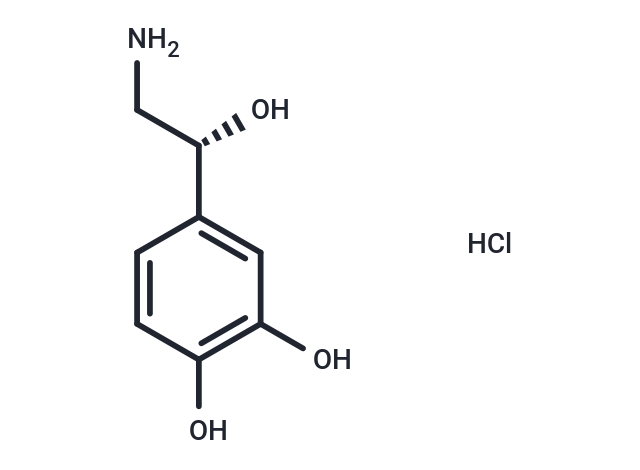
Molecular Weight205.64
FormulaC8H12ClNO3
Cas No.329-56-6
SmilesCl.NC[C@H](O)c1ccc(O)c(O)c1
Storage & Solubility Information
StoragePowder: -20°C for 3 years | In solvent: -80°C for 1 year | Shipping with blue ice/Shipping at ambient temperature.

Calculator

  • Molarity Calculator
  • Dilution Calculator
  • Reconstitution Calculator
  • Molecular Weight Calculator

In Vivo Formulation Calculator (Clear solution)

Please enter your animal experiment information in the following box and click Calculate to obtain the stock solution preparation method and in vivo formula preparation method:
TargetMol | Animal experiments For example, if the intended dosage is 10 mg/kg for animals weighing 20 g , with a dosing volume of 100 μL per animal, TargetMol | Animal experiments and a total of 10 animals are to be administered, using a formulation of TargetMol | reagent 10% DMSO+ 40% PEG300+ 5% Tween 80+ 45% Saline/PBS/ddH2O , the resulting working solution concentration would be 2 mg/mL.

Stock Solution Preparation:

Dissolve 2 mg of the compound in 100 μL DMSOTargetMol | reagent to obtain a stock solution at a concentration of 20 mg/mL . If the required concentration exceeds the compound's known solubility, please contact us for technical support before proceeding.

Preparation of the In Vivo Formulation:

1) Add 100 μL of the DMSOTargetMol | reagent stock solution to 400 μL PEG300TargetMol | reagent and mix thoroughly until the solution becomes clear.

2) Add 50 μL Tween 80 and mix well until fully clarified.

3) Add 450 μL Saline,PBS or ddH2OTargetMol | reagent and mix thoroughly until a homogeneous solution is obtained.

This example is provided solely to demonstrate the use of the In Vivo Formulation Calculator and does not constitute a recommended formulation for any specific compound. Please select an appropriate dissolution and formulation strategy based on your experimental model and route of administration.
All co-solvents required for this protocol, includingDMSO, PEG300/PEG400, Tween 80, SBE-β-CD, and Corn oil, are available for purchase on the TargetMol website.
1 Enter information below:
mg/kg
g
μL
2 Enter the in vivo formulation:
% DMSO
%
% Tween 80
% Saline/PBS/ddH2O

Dose Conversion

You can also refer to dose conversion for different animals. More Dose Conversion

Tech Support

Please see Inhibitor Handling Instructions for more frequently ask questions. Topics include: how to prepare stock solutions, how to store products, and cautions on cell-based assays & animal experiments, etc
Related Tags: buy Norepinephrine hydrochloride | purchase Norepinephrine hydrochloride | Norepinephrine hydrochloride cost | order Norepinephrine hydrochloride | Norepinephrine hydrochloride chemical structure | Norepinephrine hydrochloride in vitro | Norepinephrine hydrochloride formula | Norepinephrine hydrochloride molecular weight