


Shopping Cart
Remove All Your shopping cart is currently empty


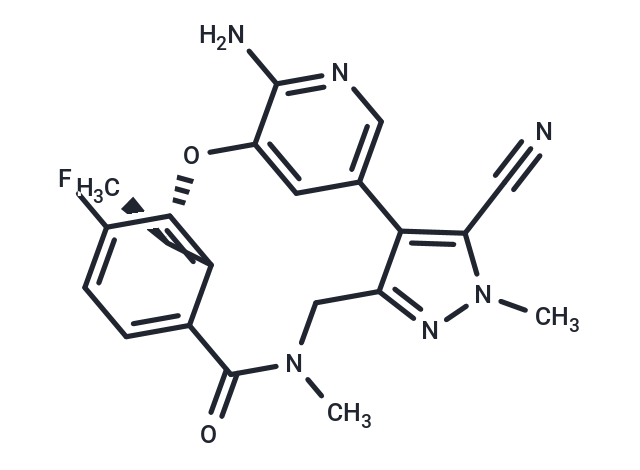
Synonyms: PF-6463922, PF-06463922, Loratinib
| Pack Size | Price | USA Stock | Global Stock | Quantity |
|---|---|---|---|---|
| 1 mg | $30 | In Stock | In Stock | |
| 2 mg | $37 | In Stock | In Stock | |
| 5 mg | $58 | In Stock | In Stock | |
| 10 mg | $86 | In Stock | In Stock | |
| 25 mg | $147 | In Stock | In Stock | |
| 50 mg | $236 | In Stock | In Stock | |
| 100 mg | $415 | In Stock | In Stock | |
| 1 mL x 10 mM (in DMSO) | $64 | In Stock | In Stock |
| Description | Lorlatinib (PF-6463922) is an orally available, ATP-competitive inhibitor of the receptor tyrosine kinases, anaplastic lymphoma kinase (ALK) and C-ros oncogene 1 (Ros1), with potential antineoplastic activity. |
| Targets & IC50 | ROS1:<0.02 nM(Ki), ALK:<0.07 nM(Ki), TYK1/LTK:2.7 nM, ALK (L1196M):0.07 nM(Ki), FER:3.3 nM |
| In vitro | Methods: Add Lorlatinib (5, 50, 500 nM) to BaF3/CD74-ROS1 (G2032R) cells and treat for 2 hours. Detect p-ROS1, p-SHP2, p-AKT, and p-ERK levels via Western blot. Results: In cells expressing the G2032R resistance mutation, Lorlatinib (50 nM and 500 nM) effectively inhibited downstream signaling. [1] Methods: SH-SY5Y human neuroblastoma cells (hypoxia/reoxygenation injury model) were treated with Lorlatinib (1, 10 μmol/L) after 4 h of hypoxia. Cells were cultured for an additional 24 h post-treatment, and cell viability was assessed using the CCK-8 assay. Results: 1 μM lorlatinib significantly enhanced post-injury cell survival with protective effects, while 10 μM lorlatinib exhibited cytotoxic effects on normal cells. [2] |
| In vivo | Methods: BaF3/CD74-ROS1 (G2032R) cells were subcutaneously implanted into nude mice. Following successful implantation, Lorlatinib (30 mg/kg) was administered orally via gavage once daily for 14 consecutive days. Results: Lorlatinib at 30 mg/kg effectively inhibited tumor growth. [1] Methods: SD rats received intraperitoneal injections of Lorlatinib (7 mg/kg), Borneol (250 mg/kg), or saline for 7 consecutive days. Following tail vein injection of EB, brain tissue was collected to measure EB content (spectrophotometry) and evaluate blue staining intensity in histological sections. Results: Repeated Lorlatinib administration significantly increased blood-brain barrier (BBB) permeability. [2] |
| Synonyms | PF-6463922, PF-06463922, Loratinib |
| Kinase Assay | Recombinant human wild-type and mutant ALK kinase domain proteins (amino acids 1093–1411) are produced in-house using baculoviral expression, preactivated via autophosphorylation with MgATP, and assayed for kinase activity using a microfluidic mobility shift assay. The reactions contained 1.3 nM wild-type ALK or 0.5 nM mutant ALK (appropriate to produce 15-20% phosphorylation of peptide substrate after 1 h of reaction), 3 μM 5-FAM-KKSRGDYMTMQIG-CONH2), 5 mM MgCl2, and the Km level of ATP in 25 mM Hepes, pH 7.1. The inhibitors are shown to be ATP-competitive from kinetic and crystallographic studies. The Ki values are calculated by fitting the conversion (%) to a competitive inhibition equation. ROS1 enzyme is assayed as described above for ALK, except using 0.25 nM recombinant human ROS1 catalytic domain (amino acids 1883-2347). Kinase inhibitor selectivity is evaluated using a 206-kinase panel. |
| Cell Research | Cells are seeded in 96-well plates in growth medium containing 10% FBS and are cultured overnight at 37°C. The following day, serial dilutions of PF-06463922 or appropriate controls are added to the designated wells, and cells are incubated at 37°C for 72 h. A CellTiter-Glo assay is performed to determine the relative cell numbers. IC50 values are calculated by concentration-response curve fitting using a four-parameter analytical method. |
| Molecular Weight | 406.41 |
| Formula | C21H19FN6O2 |
| Cas No. | 1454846-35-5 |
| Smiles | C[C@H]1Oc2cc(cnc2N)-c2c(CN(C)C(=O)c3ccc(F)cc13)nn(C)c2C#N |
| Relative Density. | 1.42 g/cm3 (Predicted) |
| Storage | Keep away from moisture,Store under nitrogen,Store at low temperature Powder: -20°C for 3 years | In solvent: -80°C for 1 year Shipping with blue ice/Shipping at ambient temperature. | |||||||||||||||||||||||||||||||||||
| Solubility Information | Ethanol: 40.6 mg/mL (99.9 mM), Sonication is recommended. DMSO: 13 mg/mL (31.99 mM), Sonication is recommended.  | |||||||||||||||||||||||||||||||||||
| In Vivo Formulation | 10% DMSO+40% PEG300+5% Tween 80+45% Saline: 2 mg/mL (4.92 mM), Sonication is recommended. Please add the solvents sequentially, clarifying the solution as much as possible before adding the next one. Dissolve by heating and/or sonication if necessary. Working solution is recommended to be prepared and used immediately. The formulation provided above is for reference purposes only. In vivo formulations may vary and should be modified based on specific experimental conditions. | |||||||||||||||||||||||||||||||||||
Solution Preparation Table | ||||||||||||||||||||||||||||||||||||
DMSO/Ethanol
Ethanol
Note : The dilution table applies only to solid products. For liquid products, please calculate the stock solution based on the stated concentration and/or density. | ||||||||||||||||||||||||||||||||||||
 For example, if the intended dosage is 10 mg/kg for animals weighing 20 g , with a dosing volume of 100 μL per animal, and a total of 10 animals are to be administered, using a formulation of
  10% DMSO+ 40% PEG300+ 5% Tween 80+ 45% Saline/PBS/ddH2O , the resulting working solution concentration would be 2 mg/mL.
Dissolve 2 mg of the compound in 100 μL DMSO to obtain a stock solution at a concentration of 20 mg/mL . If the required concentration exceeds the compound's known solubility, please contact us for technical support before proceeding.
1) Add 100 μL of the DMSO stock solution to 400 µL PEG300 and mix thoroughly until the solution becomes clear.
2) Add 50 µL Tween 80 and mix well until fully clarified.
3) Add 450 µL Saline,PBS or ddH2O and mix thoroughly until a homogeneous solution is obtained.
| Size | Quantity | Unit Price | Amount | Operation |
|---|
 Feedback
 Hello! How can I help you today?
Copyright © 2015-2026 TargetMol Chemicals Inc. All Rights Reserved.
