Shopping Cart
Remove All
  • TargetMol
    Your shopping cart is currently empty

Dizocilpine

Copy Product Info
😃Good
Catalog No. T6259Cas No. 77086-21-6
Alias MK-801

Dizocilpine (MK-801) is a selective non-competitive NMDA receptor antagonist with a Kd of 37.2 nM that exhibits anticonvulsant effects. It acts by binding to a site within the NMDA-associated ion channel, blocking the flow of Ca²⁺, and is commonly used to establish schizophrenia models.

Dizocilpine

Dizocilpine

Copy Product Info
😃Good
Purity: 99.97%
Catalog No. T6259Alias MK-801Cas No. 77086-21-6
Dizocilpine (MK-801) is a selective non-competitive NMDA receptor antagonist with a Kd of 37.2 nM that exhibits anticonvulsant effects. It acts by binding to a site within the NMDA-associated ion channel, blocking the flow of Ca²⁺, and is commonly used to establish schizophrenia models.
Pack SizePriceUSA WarehouseGlobal WarehouseQuantity
5 mg$35In StockIn Stock
10 mg$56In StockIn Stock
25 mg$113In StockIn Stock
50 mg$198In StockIn Stock
100 mg$297In StockIn Stock
200 mg$455-In Stock
Add to Cart
Add to Quotation
In Stock Estimated shipping dateUSA Warehouse[1-2 days] Global Warehouse[5-7 days]
All TargetMol products are for research purposes only and cannot be used for human consumption. We do not provide products or services to individuals. Please comply with the intended use and do not use TargetMol products for any other purpose.
Questions
TargetMol
View More

Batch Information

Select Batch
Purity:99.97%
Color:White
Contact us for more batch information

Resource Download

Product Introduction

Dizocilpine AI Summary
Dizocilpine exhibits potent bioactivity related to NMDA receptor modulation. It shows high binding affinity for the PCP site of the NMDA receptor, with Ki values of 1.2 nM, 2.2 nM, 2.9 nM, and 3.4 nM across various assays. It also effectively displaces [3H]TCP from this site with varying IC50 values of 3.0 nM, 5.3 nM, and 4.6 nM, highlighting its ability to modulate NMDA receptor functions. In vivo studies demonstrate that Dizocilpine prevents NMDA-induced lethality in mice with an ED50 of 0.34 mg/kg and reduces NMDA-induced necrosis. The compound shows neuroprotective effects by inhibiting glutamate-stimulated calcium accumulation in rat cortical neurons with an IC50 of 58.0 nM. Additionally, Dizocilpine exhibits antinociceptive and anticonvulsant properties, further supporting its potential therapeutic applications. It possesses a LogD value of 2.1 at pH 7.4, indicating moderate lipophilicity and good membrane permeability..
Note: Summary generated by AI. Data source: ChEMBL
Bioactivity
Description
Dizocilpine (MK-801) is a selective non-competitive NMDA receptor antagonist with a Kd of 37.2 nM that exhibits anticonvulsant effects. It acts by binding to a site within the NMDA-associated ion channel, blocking the flow of Ca²⁺, and is commonly used to establish schizophrenia models.
Targets&IC50
NMDA:30.5 nM(Ki)
Disease Modeling Protocol
Schizophrenia modeling
  • Modeling Mechanism:

    Dizocilpine (MK801), as a non-competitive NMDA receptor antagonist, induces schizophrenia-related pathology through NMDA receptor dysfunction: ① It disrupts the balance of excitatory/inhibitory neurotransmitters in the brain, causing dopamine system dysfunction and mimicking positive symptoms such as hallucinations and delusions; ② It inhibits normal exploratory and self-care behaviors, mimicking negative symptoms such as lack of will and emotional blunting; ③ It exhibits significant gender differences, highly consistent with the gender differences in schizophrenia symptoms (men are more likely to exhibit negative symptoms, and women are more likely to exhibit positive symptoms), providing model support for studying gender-related pathogenesis.

  • Related Products:

    Dizocilpine (T6259)

  • Modeling Method:

    Experimental Subject:Rats, Sprague-Dawley (SD), Male / Female (female must be oestrus-cycled), Adult (5-6 months old)

    Dosage and Administration Route:① Core modelling: Dizocilpine (0.05, 0.1, 0.2 mg/kg) dissolved in physiological saline, administered via intraperitoneal injection (to avoid gender differences caused by first-pass metabolism); ② Pre-treatment (optional): Typical antipsychotic haloperidol (0.04, 0.08 mg/kg) or atypical antipsychotic clozapine (5, 10 mg/kg), Subcutaneous injection, Administered 15 minutes prior to modelling; ③ Control treatment: equal volume saline solution administered via the same route; ④ Female rat control: Daily vaginal lavage for 10 days prior to experimentation; only rats in the proestrus phase (cyclically stable with peak oestrogen levels) selected for studies

    Dosing Frequency and Duration Model:Single dose

  • Validation:

    Behavioral indicators (core validation): Positive symptom-related: - Locomotion: Females in the 0.1 and 0.2 mg/kg Dizocilpine groups showed a significant increase in locomotion frequency (P<0.001), while males only showed a significant increase in the 0.2 mg/kg group, indicating that females are more sensitive to positive symptom-related behaviors; - Stereotypy: Males in the 0.1 and 0.2 mg/kg groups showed a significant prolongation of stereotypy behaviors (head swaying, circling) duration (P<0.001), while females only showed a significant increase in the 0.2 mg/kg group; - Ataxia: Both males and females in the 0.2 mg/kg Dizocilpine group experienced frequent falls and failed standing postures, with a higher incidence in females; Negative symptom-related: - Rearing: Males in the 0.05 and 0.1 mg/kg groups showed a significant decrease in the number of standing postures (P<0.001), indicating that males are more sensitive to negative symptoms; Grooming: Grooming time was significantly shortened in males at 0.1 and 0.2 mg/kg (P<0.001), while it was slightly increased in females at 0.05 mg/kg and significantly decreased in females at 0.2 mg/kg; Stationary behavior: Stationary behavior was significantly reduced in both males and females at 0.2 mg/kg Dizocilpine (P<0.05), with a more significant reduction in females; Anxiety-related (comorbidity features): Thigmotaxis: The proportion of time spent moving against a wall was significantly increased in males at 0.1 and 0.2 mg/kg (P<0.001), while there was no significant change in females.

*Precautions: Animals were euthanized humanely in accordance with ethical requirements after the experiment. If long-term observation is required, behavioral changes should be monitored regularly, and animals exhibiting severe abnormal behavior should be euthanized promptly.

*References:Feinstein I,and Kritzer MF. Acute N-methyl-D-aspartate receptor hypofunction induced by Dizocilpine evokes sex-specific changes in behaviors observed in open-field testing in adult male and proestrus female rats. Neuroscience. 2013 Jan 3;228:200-14.

SynonymsMK-801
Chemical Properties
Molecular Weight221.3
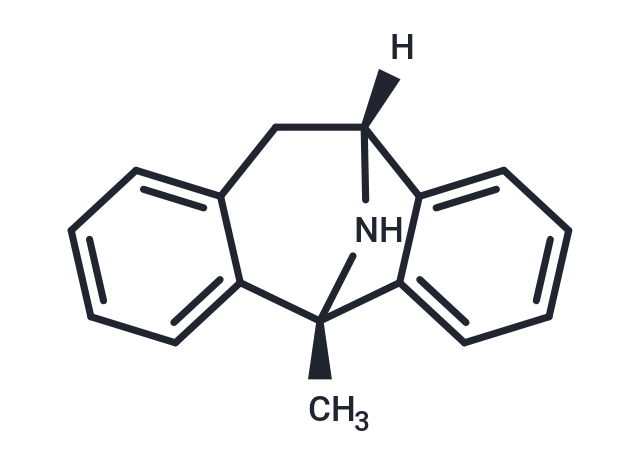
FormulaC16H15N
Cas No.77086-21-6
SmilesC[C@]12C=3C([C@](N1)(CC=4C2=CC=CC4)[H])=CC=CC3
Relative Density.1.144 g/cm3 (Predicted)
Storage & Solubility Information
StoragePowder: -20°C for 3 years | In solvent: -80°C for 1 year | Shipping with blue ice/Shipping at ambient temperature.
Solubility Information
DMSO: 255 mg/mL (1152.28 mM), Sonication is recommended.

In Vivo Formulation
10% DMSO+40% PEG300+5% Tween 80+45% Saline: 5 mg/mL (22.59 mM), Sonication is recommended.
Please add the solvents sequentially, clarifying the solution as much as possible before adding the next one. Dissolve by heating and/or sonication if necessary. Working solution is recommended to be prepared and used immediately. The formulation provided above is for reference purposes only. In vivo formulations may vary and should be modified based on specific experimental conditions.
Solution Preparation Table
DMSO
1mg5mg10mg50mg
1 mM4.5188 mL22.5938 mL45.1875 mL225.9376 mL
5 mM0.9038 mL4.5188 mL9.0375 mL45.1875 mL
10 mM0.4519 mL2.2594 mL4.5188 mL22.5938 mL
20 mM0.2259 mL1.1297 mL2.2594 mL11.2969 mL
50 mM0.0904 mL0.4519 mL0.9038 mL4.5188 mL
100 mM0.0452 mL0.2259 mL0.4519 mL2.2594 mL

Calculator

  • Molarity Calculator
  • Dilution Calculator
  • Reconstitution Calculator
  • Molecular Weight Calculator

In Vivo Formulation Calculator (Clear solution)

Please enter your animal experiment information in the following box and click Calculate to obtain the stock solution preparation method and in vivo formula preparation method:
TargetMol | Animal experiments For example, if the intended dosage is 10 mg/kg for animals weighing 20 g , with a dosing volume of 100 μL per animal, TargetMol | Animal experiments and a total of 10 animals are to be administered, using a formulation of TargetMol | reagent 10% DMSO+ 40% PEG300+ 5% Tween 80+ 45% Saline/PBS/ddH2O , the resulting working solution concentration would be 2 mg/mL.

Stock Solution Preparation:

Dissolve 2 mg of the compound in 100 μL DMSOTargetMol | reagent to obtain a stock solution at a concentration of 20 mg/mL . If the required concentration exceeds the compound's known solubility, please contact us for technical support before proceeding.

Preparation of the In Vivo Formulation:

1) Add 100 μL of the DMSOTargetMol | reagent stock solution to 400 μL PEG300TargetMol | reagent and mix thoroughly until the solution becomes clear.

2) Add 50 μL Tween 80 and mix well until fully clarified.

3) Add 450 μL Saline,PBS or ddH2OTargetMol | reagent and mix thoroughly until a homogeneous solution is obtained.

This example is provided solely to demonstrate the use of the In Vivo Formulation Calculator and does not constitute a recommended formulation for any specific compound. Please select an appropriate dissolution and formulation strategy based on your experimental model and route of administration.
All co-solvents required for this protocol, includingDMSO, PEG300/PEG400, Tween 80, SBE-β-CD, and Corn oil, are available for purchase on the TargetMol website.
1 Enter information below:
mg/kg
g
μL
2 Enter the in vivo formulation:
% DMSO
%
% Tween 80
% Saline/PBS/ddH2O

Dose Conversion

You can also refer to dose conversion for different animals. More Dose Conversion

Tech Support

Please see Inhibitor Handling Instructions for more frequently ask questions. Topics include: how to prepare stock solutions, how to store products, and cautions on cell-based assays & animal experiments, etc

Keywords

Related Tags: buy Dizocilpine | purchase Dizocilpine | Dizocilpine cost | order Dizocilpine | Dizocilpine chemical structure | Dizocilpine formula | Dizocilpine molecular weight