


Shopping Cart
Remove All Your shopping cart is currently empty

Synonyms:
| Pack Size | Price | USA Stock | Global Stock | Quantity |
|---|---|---|---|---|
| 10 g | $29 | - | In Stock | |
| 25 g | $48 | - | In Stock | |
| 50 g | $68 | - | In Stock |
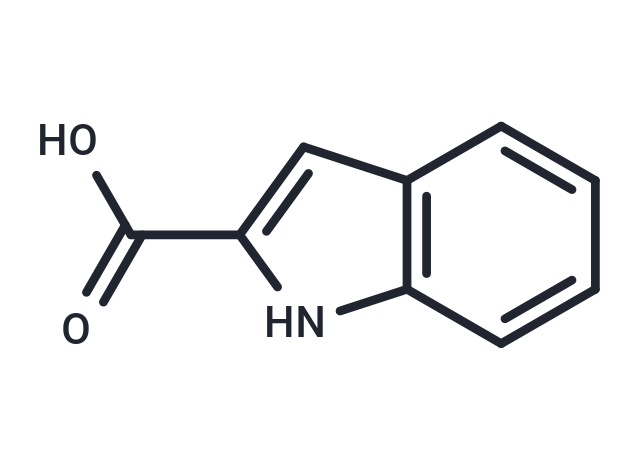
| Description | Indole-2-carboxylic acid is an indole carboxylic acid compound with multi-target biological activity, exhibiting neuroprotective, antiviral, and antioxidant properties. Indole-2-carboxylic acid is a competitive antagonist at the glycine site of the NMDA receptor (Ki = 15 μM). Indole-2-carboxylic acid specifically inhibits the potentiating effect of glycine on NMDA-gated currents, blocking the neurotoxicity caused by excessive NMDA receptor activation, and can be used in research on the treatment of neurodegenerative diseases and cerebral ischemic injury. Indole-2-carboxylic acid is also an HIV-1 integrase inhibitor; it interferes with the integration of viral DNA into the host genome and can be used in the development of anti-HIV drugs. |
| In vitro | Methods: Rat (Long Evans, 1–10 days old) cortical or spinal cord neurons were preincubated with indole-2-carboxylic acid (0.01–1000 μM) and glycine (10 nM–40 μM). Following preincubation, NMDA (30 μM) was applied, and steady-state currents were recorded (averaged over the final 10–20 s) . Results: Indole-2-carboxylic acid (0.01–1000 μM) competitively inhibited the potentiating effect of glycine on NMDA receptors in rat cortical/spinal cord neurons, with an IC₅₀ of 105 μM.[1] |
| In vivo | Methods: Male Sprague-Dawley rats underwent lateral fluid-impact brain injury. Indole-2-carboxylic acid (20 or 50 mg/kg) was administered intravenously 15 minutes after injury. Behavioral assessments continued for 2 weeks post-injury, and neurochemical markers were measured 48 hours post-injury. Results: Indole-2-carboxylic acid significantly improved trauma-induced cognitive impairment, and at 2 weeks post-injury, it improved neuromotor function. [2] |
| Molecular Weight | 161.16 |
| Formula | C9H7NO2 |
| Cas No. | 1477-50-5 |
| Smiles | O=C(O)C1=CC=2C=CC=CC2N1 |
| Relative Density. | 1.2480 g/cm3 (Estimated) |
| Storage | Powder: -20°C for 3 years | In solvent: -80°C for 1 year Shipping with blue ice/Shipping at ambient temperature. | |||||||||||||||||||||||||||||||||||
| Solubility Information | H2O: < 1?mg/mL?(insoluble) DMSO: 80 mg/mL (496.4 mM), Sonication is recommended. | |||||||||||||||||||||||||||||||||||
Solution Preparation Table | ||||||||||||||||||||||||||||||||||||
DMSO
Note : The dilution table applies only to solid products. For liquid products, please calculate the stock solution based on the stated concentration and/or density. | ||||||||||||||||||||||||||||||||||||
 For example, if the intended dosage is 10 mg/kg for animals weighing 20 g , with a dosing volume of 100 μL per animal, and a total of 10 animals are to be administered, using a formulation of
  10% DMSO+ 40% PEG300+ 5% Tween 80+ 45% Saline/PBS/ddH2O , the resulting working solution concentration would be 2 mg/mL.
Dissolve 2 mg of the compound in 100 μL DMSO to obtain a stock solution at a concentration of 20 mg/mL . If the required concentration exceeds the compound's known solubility, please contact us for technical support before proceeding.
1) Add 100 μL of the DMSO stock solution to 400 µL PEG300 and mix thoroughly until the solution becomes clear.
2) Add 50 µL Tween 80 and mix well until fully clarified.
3) Add 450 µL Saline,PBS or ddH2O and mix thoroughly until a homogeneous solution is obtained.
| Size | Quantity | Unit Price | Amount | Operation |
|---|
 Feedback
 Hello! How can I help you today?
Copyright © 2015-2026 TargetMol Chemicals Inc. All Rights Reserved.
