


Shopping Cart
Remove All Your shopping cart is currently empty

Synonyms: C13737, (-)-MK 801 Maleate, (-)-MK 801 (Maleate)
| Pack Size | Price | USA Stock | Global Stock | Quantity |
|---|---|---|---|---|
| 10 mg | $43 | In Stock | In Stock | |
| 25 mg | $74 | In Stock | In Stock | |
| 50 mg | $122 | In Stock | In Stock | |
| 100 mg | $228 | Inquiry | Inquiry | |
| 1 mL x 10 mM (in DMSO) | $30 | In Stock | In Stock |
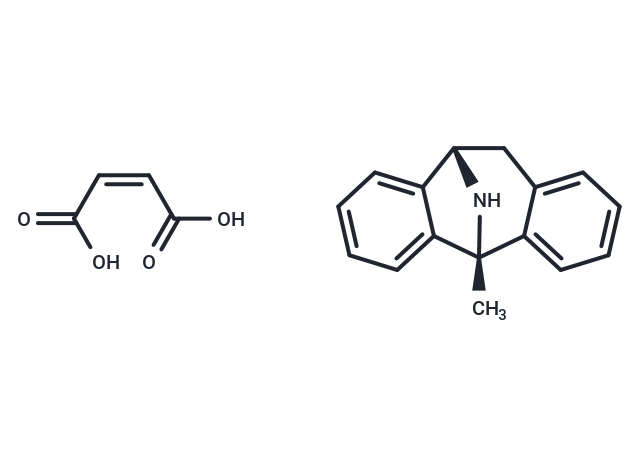
| Description | (-)-Dizocilpine maleate ((-)-MK 801 (Maleate)) is a potent, selective, and non-competitive NMDA receptor antagonist, with a Kd of 37.2 nM in rat brain membranes. |
| Targets & IC50 | NMEA:Kd:37.2nM |
| In vitro | Neurophysiological studies in vitro, using a rat cortical-slice preparation, demonstrates a potent, selective, and noncompetitive antagonistic action of dizocilpine on depolarizing responses to N-Me-D-Asp but not to kainate or quisqualate. The potencies of phencyclidine, ketamine, SKF 10047, and the enantiomers of dizocilpine as N-Me-D-Asp antagonists correlate closely (r = 0.99) with their potencies as inhibitors of [3H] dizocilpine binding. This suggests that the dizocilpine binding sites are associated with N-Me-D-Asp receptors and provides an explanation for the mechanism of action of dizocilpine as an anticonvulsant. |
| In vivo | All the control rats have severe permanent neurological deficits after ischemic spinal cord injury (ISCI), whereas the dizocilpine–treated rats have statistically (P < .05) better neurological outcome and good recovery. Histopathology reveals severe neuronal necrosis in the lumbar gray matter of control rats, whereas dizocilpine–treated rats show mild injury. These results demonstrate that a single dose of dizocilpine given before ISCI provides significant neuroprotection. |
| Synonyms | C13737, (-)-MK 801 Maleate, (-)-MK 801 (Maleate) |
| Kinase Assay | In vitro binding assays:For in vitro binding assays, cerebral cortices from male Sprague-Dawley rats (200-300 g) are homogenized in 9 volumes of ice-cold sucrose by nine strokes with a Teflon/glass homogenizer at 500 rpm. The homogenate is centrifuged for 10 min at 1000 x g, and the supernatant is recentrifuged at 10,000 x g for 20 min at 4 ℃. The pellet is suspended in assay buffer and incubated for 20 min prior to final centrifugation at 10,000 x g for 20 min at 4 ℃. The pellet is resuspended in assay buffer (70 ml per gram of original tissue). Binding of [3H] dizocilpine is measured by incubating 750 ul duplicate aliquots of this crude membrane suspension (=0.75 mg of protein) with 100 ul of buffer containing displacer or of buffer alone (total binding), 100 ul of 50 nM [3H] dizocilpine, and 50 ul of buffer for 60 min at 23 ℃. Nonspecific binding is defined by unlabeled dizocilpine. Incubation is terminated by rapid filtration through Whatman GF/B filters, which are washed immediately with two 5-ml portions of ice-cold assay buffer in a Brandel M 24-R cell harvester. The time required for the complete filtration and washing procedure is less than 10 sec. Radioactivity on the filters is determined by liquid scintillation counting in standard vials with 10 ml of Hydrofluor at 41% counting efficiency. |
| Cell Research | Cell lines: mixed neuronal/glial cell culturesConcentrations: 10 μMIncubation Time: 30 minutesMethod: Primary mixed neuronal/glial cultures are prepared from fetal rat brains. Mature cultures are exposed to dissolved isoflurane [0.4 mM (1.8 minimum alveolar concentration) or 1.6 mM (7 minimum alveolar concentration)] or dizocilpine (10 μM), and NMDA (0 or 3 μM) at 37 ℃ for 30 minutes. Apoptosis is assessed using terminal-deoxy-nucleotidyl end-nick labeling oligonucleosomal DNA fragmentation enzyme-linked immunosorbent assay, and caspases-3 and -9 activation assays. |
| Animal Research | Animal Models: ischemic spinal cord injury medelFormulation: N/ADosages: 1 mg/kgAdministration: IV |
| Molecular Weight | 337.37 |
| Formula | C20H19NO4 |
| Cas No. | 121917-57-5 |
| Smiles | OC(=O)\C=C/C(O)=O.C[C@@]12N[C@@H](Cc3ccccc13)c1ccccc21 |
| Relative Density. | no data available |
| Storage | Powder: -20°C for 3 years | In solvent: -80°C for 1 year Shipping with blue ice/Shipping at ambient temperature. | ||||||||||||||||||||||||||||||||||||||||
| Solubility Information | Ethanol: 7 mg/mL (20.75 mM), Sonication is recommended. DMSO: 68 mg/mL (201.56 mM), Sonication is recommended. | ||||||||||||||||||||||||||||||||||||||||
| In Vivo Formulation | 10% DMSO+40% PEG300+5% Tween 80+45% Saline: 2 mg/mL (5.93 mM), Sonication is recommended. Please add the solvents sequentially, clarifying the solution as much as possible before adding the next one. Dissolve by heating and/or sonication if necessary. Working solution is recommended to be prepared and used immediately. The formulation provided above is for reference purposes only. In vivo formulations may vary and should be modified based on specific experimental conditions. | ||||||||||||||||||||||||||||||||||||||||
Solution Preparation Table | |||||||||||||||||||||||||||||||||||||||||
Ethanol/DMSO
DMSO
Note : The dilution table applies only to solid products. For liquid products, please calculate the stock solution based on the stated concentration and/or density. | |||||||||||||||||||||||||||||||||||||||||
 For example, if the intended dosage is 10 mg/kg for animals weighing 20 g , with a dosing volume of 100 μL per animal, and a total of 10 animals are to be administered, using a formulation of
  10% DMSO+ 40% PEG300+ 5% Tween 80+ 45% Saline/PBS/ddH2O , the resulting working solution concentration would be 2 mg/mL.
Dissolve 2 mg of the compound in 100 μL DMSO to obtain a stock solution at a concentration of 20 mg/mL . If the required concentration exceeds the compound's known solubility, please contact us for technical support before proceeding.
1) Add 100 μL of the DMSO stock solution to 400 µL PEG300 and mix thoroughly until the solution becomes clear.
2) Add 50 µL Tween 80 and mix well until fully clarified.
3) Add 450 µL Saline,PBS or ddH2O and mix thoroughly until a homogeneous solution is obtained.
| Size | Quantity | Unit Price | Amount | Operation |
|---|
 Feedback
 Hello! How can I help you today?
Copyright © 2015-2026 TargetMol Chemicals Inc. All Rights Reserved.
