


Shopping Cart
Remove All Your shopping cart is currently empty


Synonyms: Chloroquine diphosphate, Chingamin phosphate, Aralen phosphate
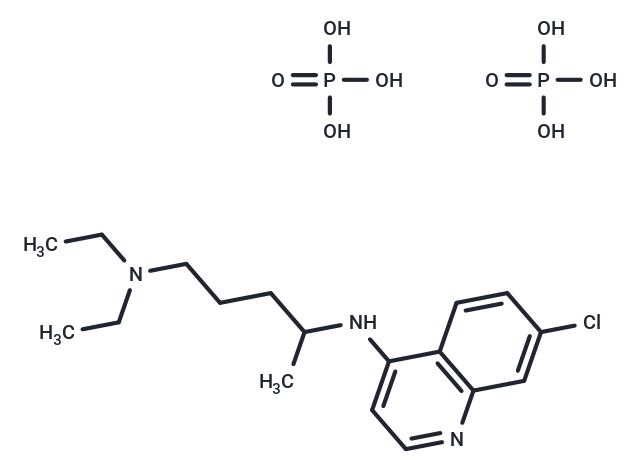
| Pack Size | Price | USA Stock | Global Stock | Quantity |
|---|---|---|---|---|
| 100 mg | $42 | In Stock | In Stock | |
| 200 mg | $50 | In Stock | In Stock | |
| 500 mg | $66 | In Stock | In Stock |
| Description | Chloroquine phosphate (Aralen phosphate) is an antimalarial and anti-inflammatory agent widely used for malaria and rheumatoid arthritis. Chloroquine phosphate acts as an inhibitor of autophagy and toll-like receptors, effectively suppressing SARS-CoV-2 (COVID-19) infection (EC50 = 1.13 μM). Chloroquine phosphate can be utilized in research on autophagy, lysosomal function, and tumor diseases. |
| Targets & IC50 | Cytotoxicity against human K562 cells:31.83 nM, Cytotoxicity against hμMan KB cells by microplate method:0.6 μM |
| In vitro | Methods: Vero E6 cells + SARS-CoV Frankfurt 1 strain (infectious dose: 100 CCID₅₀) were used. Chloroquine phosphate (1–100 μM) was added simultaneously with the virus and incubated for 3 days. Cell viability was assessed using the MTS assay. Results: Chloroquine phosphate demonstrated efficacy at low micromolar concentrations and exhibited a broad therapeutic window. [1] Methods: Add ATRA (1 mM) and Chloroquine phosphate (10 μM) to human/mouse cancer-associated fibroblast (CAF) cell lines. Detect autophagy markers via immunofluorescence and Western blot. Results: Chloroquine phosphate treatment inhibits CAF activation. [2] |
| In vivo | Methods: Mice implanted with KPC cells in situ received intraperitoneal injections of free chloroquine phosphate (70 mg/kg, once daily), intravenous injections of free chloroquine phosphate (70 mg/kg, once daily), or intravenous injections of CQ-MSC-Lipo (80 μg/mouse, every 3 days). All groups received intraperitoneal injections of anti-PD-1 (200 μg) intraperitoneally. Results: Chloroquine phosphate-MSC-Lipo combined with anti-PD-1 demonstrated superior efficacy compared to free chloroquine phosphate combination therapy, significantly inhibiting tumor growth.[2] |
| Synonyms | Chloroquine diphosphate, Chingamin phosphate, Aralen phosphate |
| Cell Research | The cells are cultured in 6-well plates with normal culture medium in the presence of vehicle or 25 or 50 μM chloroquine, until near confluency, after which they are rinsed with sterile phosphate-buffered saline (PBS) and cultured further for the indicated times in serum-free culture medium. At the desired time-points, the culture medium is discarded and the cells are quickly harvested in lysis buffer and clarified by centrifugation. Subsequent to boiling the supernatants in reducing sodium dodecyl sulfate (SDS) sample buffer, equal amounts of protein (100 μg) are loaded per lane and the samples are electrophoresed into 10 or 4-20% gradient polyacrylamide SDS gels, then transferred to a nitrocellulose membrane. To detect TLR9, the blots were incubated overnight at 4°C with anti-TLR9 antibodies, diluted 1:500 in Tris-buffered saline with 0.1% (v/v) Tween-20 (TBST). Equal loading is confirmed with polyclonal rabbit anti-actin. Secondary detection is performed with horseradish peroxidase-linked secondary antibodies. The protein bands are visualized by chemiluminescence using an ECL kit [2]. |
| Animal Research | Control and TLR9 siRNA MDA-MB-231 cells (5×10⁵ cells in 100 μL) are inoculated into the mammary fat pads of four-week-old, immune-deficient mice (athymic nude/nu Foxn1). Treatments are started seven days after tumor cell inoculation. The mice are treated daily either with intraperitoneal (i.p.) chloroquine (80 mg/kg) or vehicle (PBS). The animals are monitored daily for clinical signs. Tumor measurements are performed twice a week and tumor volume is calculated according to the formula V=(π/6) (d1×d2)3/2, where d1 and d2 are perpendicular tumor diameters. The tumors are allowed to grow for 22 days, at which point the mice are sacrificed and the tumors are dissected for a final measurement. Throughout the experiments, the animals are maintained under controlled pathogen-free environmental conditions (20-21°C, 30-60% relative humidity and a 12-h lighting cycle). The mice are fed with small-animal food pellets and supplied with sterile water ad libitum [2]. |
| Molecular Weight | 515.87 |
| Formula | C18H26CLN3·2(H3PO4) |
| Cas No. | 50-63-5 |
| Smiles | OP(O)(O)=O.OP(O)(O)=O.CCN(CC)CCCC(C)NC1=CC=NC2=C1C=CC(Cl)=C2 |
| Relative Density. | no data available |
| Storage | Powder: -20°C for 3 years | In solvent: -80°C for 1 year Shipping with blue ice/Shipping at ambient temperature. | |||||||||||||||||||||||||||||||||||
| Solubility Information | DMSO: Insoluble H2O: 65.625 mg/mL (127.21 mM), Sonication is recommended.  | |||||||||||||||||||||||||||||||||||
Solution Preparation Table | ||||||||||||||||||||||||||||||||||||
H2O
Note : The dilution table applies only to solid products. For liquid products, please calculate the stock solution based on the stated concentration and/or density. | ||||||||||||||||||||||||||||||||||||
 For example, if the intended dosage is 10 mg/kg for animals weighing 20 g , with a dosing volume of 100 μL per animal, and a total of 10 animals are to be administered, using a formulation of
  10% DMSO+ 40% PEG300+ 5% Tween 80+ 45% Saline/PBS/ddH2O , the resulting working solution concentration would be 2 mg/mL.
Dissolve 2 mg of the compound in 100 μL DMSO to obtain a stock solution at a concentration of 20 mg/mL . If the required concentration exceeds the compound's known solubility, please contact us for technical support before proceeding.
1) Add 100 μL of the DMSO stock solution to 400 µL PEG300 and mix thoroughly until the solution becomes clear.
2) Add 50 µL Tween 80 and mix well until fully clarified.
3) Add 450 µL Saline,PBS or ddH2O and mix thoroughly until a homogeneous solution is obtained.
| Size | Quantity | Unit Price | Amount | Operation |
|---|
 Feedback
 Hello! How can I help you today?
Copyright © 2015-2026 TargetMol Chemicals Inc. All Rights Reserved.
