


Shopping Cart
Remove All Your shopping cart is currently empty

Synonyms:
| Pack Size | Price | USA Stock | Global Stock | Quantity |
|---|---|---|---|---|
| 5 mg | $61 | In Stock | In Stock | |
| 10 mg | $101 | In Stock | In Stock | |
| 25 mg | $215 | In Stock | In Stock | |
| 50 mg | $322 | In Stock | In Stock | |
| 100 mg | $483 | In Stock | In Stock | |
| 500 mg | $1,080 | - | In Stock | |
| 1 mL x 10 mM (in DMSO) | $68 | In Stock | In Stock |
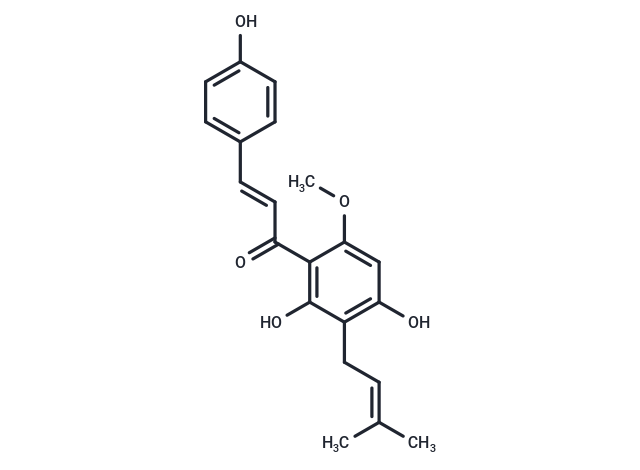
| Description | Xanthohumol, also known as 2', 4, 4'-trihydroxy-6'-methoxy-3'-prenylchalcone or desmethylxanthohumol, is a member of the class of compounds known as 3-prenylated chalcones. It inhibits COX-1 and COX-2 activity and shows chemopreventive effects. |
| Targets & IC50 | DGAT-2:40 μM (IC50), DGAT-1:40 μM (IC50) |
| In vitro | Xanthohumol inhibits Cyp1A activity and induces QR activity in mouse hepatoma cell culture. Xanthohumol scavenges reactive oxygen species and inhibits superoxide anion radical and nitric oxide production. In addition, Xanthohumol prevents carcinogenesis via inhibition of DNA synthesis and induction of cell cycle arrest in S phase, apoptosis, and cell differentiation. [1] Xanthohumol shows potent anti-HIV-1 activity. [2] |
| In vivo | In CETP-Tg mice, xanthohumol (p.o.) prevents cholesterol accumulation leading to atherosclerosis. [3] In TRAMP mice, xanthohumol (p.o.) induces a decrease in the average weight of the urogenital (UG) tract, delays advanced tumor progression and inhibits the growth of poorly differentiated prostate carcinoma. [4] |
| Kinase Assay | Inhibition of Cox Activity: Inhibition of Cox-1 activity is measured by monitoring oxygen consumption during the conversion of arachidonic acid to PGs using a Clark-type O2-electrode. The reaction mixture contains ~0.2 units Cox-1 in 100 μL of microsome fraction derived from ram seminal vesicles as a crude source of Cox-1 (specific activity 0.2–1 units/mg protein) or 0.23 units of recombinant human Cox-2 (specific activity 43 units/mg protein). For calculation, the rate of O2 consumption is compared with a DMSO control (100% activity). Piroxicam, a nonsteroidal anti-inflammatory drug, is used as positive inhibitory substance for Cox-1 activity with an IC50 of 0.35 ± 0.05 μM (n = 2). Alternatively, nimesulide, a Cox-2 specific inhibitor, inhibits Cox-2 activity by 52 ± 5.7% (n = 2) at a concentration of 50 μM. |
| Cell Research | HL-60 cells are maintained in RPMI 1640 supplemented with 10% FBS at 37°C in a 5% CO2 atmosphere. Log-phase cells with a population doubling time of 14–16 h are used for experiments. Serial 2-fold dilutions of compounds (dissolved in DMSO, final concentration 0.1%) in a final concentration range of 0.2–12.5 μM are prepared in 24-well plates using 1 ml of RPMI/well. Control wells obtain the same amount of solvent. Subsequently, 1 ml of the cell suspension is added to the wells. After 96 h, the experiment is evaluated. Cell numbers are counted using a Casy 1 TTC flow-cytometer. The proliferation of treated cells is expressed as a percentage in comparison with the solvent control.(Only for Reference) |
| Molecular Weight | 354.40 |
| Formula | C21H22O5 |
| Cas No. | 6754-58-1 |
| Smiles | COc1cc(O)c(C\C=C(/C)C)c(O)c1C(=O)\C=C\c1ccc(O)cc1 |
| Relative Density. | 1.244 g/cm3 |
| Storage | Keep away from moisture,Keep away from direct sunlight,Store under nitrogen Powder: -20°C for 3 years | In solvent: -80°C for 1 year Shipping with blue ice/Shipping at ambient temperature. | ||||||||||||||||||||||||||||||||||||||||
| Solubility Information | Ethanol: 35.40 mg/mL (99.89 mM), Sonication is recommended. DMSO: 150.00 mg/mL (423.25 mM), Sonication is recommended.  | ||||||||||||||||||||||||||||||||||||||||
| In Vivo Formulation | 10% DMSO+40% PEG300+5% Tween 80+45% Saline: 4.00 mg/mL (11.29 mM), Sonication is recommended. Please add the solvents sequentially, clarifying the solution as much as possible before adding the next one. Dissolve by heating and/or sonication if necessary. Working solution is recommended to be prepared and used immediately. The formulation provided above is for reference purposes only. In vivo formulations may vary and should be modified based on specific experimental conditions. | ||||||||||||||||||||||||||||||||||||||||
Solution Preparation Table | |||||||||||||||||||||||||||||||||||||||||
Ethanol/DMSO
DMSO
Note : The dilution table applies only to solid products. For liquid products, please calculate the stock solution based on the stated concentration and/or density. | |||||||||||||||||||||||||||||||||||||||||
 For example, if the intended dosage is 10 mg/kg for animals weighing 20 g , with a dosing volume of 100 μL per animal, and a total of 10 animals are to be administered, using a formulation of
  10% DMSO+ 40% PEG300+ 5% Tween 80+ 45% Saline/PBS/ddH2O , the resulting working solution concentration would be 2 mg/mL.
Dissolve 2 mg of the compound in 100 μL DMSO to obtain a stock solution at a concentration of 20 mg/mL . If the required concentration exceeds the compound's known solubility, please contact us for technical support before proceeding.
1) Add 100 μL of the DMSO stock solution to 400 µL PEG300 and mix thoroughly until the solution becomes clear.
2) Add 50 µL Tween 80 and mix well until fully clarified.
3) Add 450 µL Saline,PBS or ddH2O and mix thoroughly until a homogeneous solution is obtained.
| Size | Quantity | Unit Price | Amount | Operation |
|---|
 Feedback
 Hello! How can I help you today?
Copyright © 2015-2026 TargetMol Chemicals Inc. All Rights Reserved.
