


Shopping Cart
Remove All Your shopping cart is currently empty


Synonyms:
| Pack Size | Price | USA Stock | Global Stock | Quantity |
|---|---|---|---|---|
| 1 mg | $64 | In Stock | In Stock | |
| 5 mg | $158 | In Stock | In Stock | |
| 10 mg | $213 | In Stock | In Stock | |
| 25 mg | $359 | In Stock | In Stock | |
| 50 mg | $532 | In Stock | In Stock | |
| 100 mg | $757 | In Stock | In Stock | |
| 1 mL x 10 mM (in DMSO) | $196 | In Stock | In Stock |
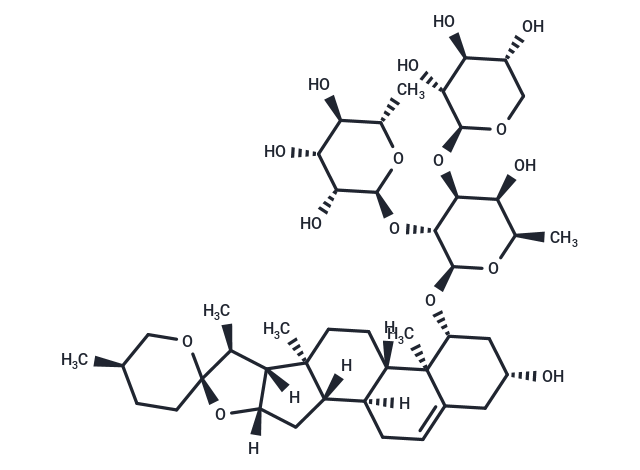
| Description | Ophiopogonin D is a natural product,and is a CYP2J3 inducer that significantly inhibits Ang II induced NF-κB nuclear translocation. Ophiopogonin-D significantly inhibited the in vitro and in vivo growth of prostate cells via RIPK1. Ophiopogonin-D may be developed as a potential anti-prostate cancer agent. |
| In vitro | Ophiopogonin D(OPD) was shown to exert potent anti-tumor activity against PC3 cells.?It induced apoptosis via a RIPK1-related pathway, increased the protein expression levels of RIPK1 and Bim, and decreased the levels of cleaved-RIPK1, caspase 8, cleaved-caspase 8, Bid, caspase 10, and cleaved-caspase 10.?OPD' also increased the mRNA expression of Bim.?The protein expression of Bim was decreased when cells were pre-treated with necrostatin-1[1].
OPHIOPOGONIN D(OP-D) significantly inhibited Ang II induced NF-κB nuclear translocation, IκBα down-regulation and activation of pro-inflammatory cytokines (TNF-α, IL-6 and VCAM-1) by increasing the expression of CYP2J2/EETs and PPARα in HUVECs.?Furthermore, treatment with exogenous 11,12-EET attenuated endothelial inflammation induced by Ang II as evidenced by inhibited NF-κB nuclear translocation, increased IκBα expression and decreased inflammation factor level.?Finally, the activation of NF-κB nuclear translocation induced by Ang II was also markedly suppressed by fenofibrate.?Co-incubation with 6-(2-proparglyloxyphenyl) hexanoic acid (PPOH) and PPARα inhibitor GW6471 before drug treatment abolished the endothelium protective effects of OP-D.?Suggest that OP-D has the endothelial protective effect through activation of CYP2J and increasing EETs, and PPARα involves in this process. |
| In vivo | Ophiopogonin D(OPD)′ treatment led to significant tumor growth inhibition at a dose of 5.0 mg/kg bodyweight, beginning on Day 6 of treatment (p = 0.034).?At the end of the study (Day 24), the tumor tissues were excised, photographed, and weighed.?Treatment with 5.0 mg/kg bodyweight OPD′ resulted in significant (p = 0.000) tumor growth inhibition by approximately 79.8% on Day 24 compared to the vehicle treatment.?The 5.0 mg/kg dose led to significantly stronger tumor growth inhibition than the 2.5 mg/kg dose (p = 0.000).?There was not a significant loss of body weight in any of the groups[1]. |
| Cell Research | The CCK-8 assay was used to assess the viability of prostate cancer cells.?The cell morphology was examined by an ultrastructural analysis via transmission electron microscopy.?Cells in apoptosis (early and late stages) were detected using an Annexin V-FITC/propidium iodide kit with a FACSCaliber flow cytometer.?JC-1, a cationic lipophilic probe, was employed to measure the mitochondrial membrane potential (MMP) of PC3 cells.?Changes in the protein expression of RIPK1, C-RIPK1, caspase 8, cleaved-caspase 8, Bim, Bid, caspase 10, and cleaved-caspase 10 were evaluated by Western blotting.?The mRNA expression of Bim was examined by quantitative real-time reverse transcription polymerase chain reaction.?Z-VAD-FMK (a caspase inhibitor) and necrostatin-1 (a specific inhibitor of RIPK1) were utilized to determine whether the cell death was mediated by RIPK1 or caspases[1]. |
| Animal Research | One week after tumor cell inoculation, mice bearing palpable tumors were randomly divided into control and treatment groups (8 mice/group).?OPD′ was dissolved in the vehicle, PEG400:Saline:Ethanol (400:300:200, v/v/v), and administered (via i.p. injection) at doses of 2.5 or 5.0 mg/kg bodyweight 5 days a week for 24 days.?The control group received vehicle only.?The mice were sacrificed by cervical dislocation on Day 24, and the tumor tissues were removed and weighed[1]. |
| Molecular Weight | 855.02 |
| Formula | C44H70O16 |
| Cas No. | 945619-74-9 |
| Smiles | C[C@@]12[C@@]3([C@](C[C@]1([C@]4([C@](CC2)([C@@]5(C)[C@H](O[C@H]6[C@H](O[C@H]7[C@H](O)[C@H](O)[C@@H](O)[C@H](C)O7)[C@@H](O[C@H]8[C@H](O)[C@@H](O)[C@H](O)CO8)[C@@H](O)[C@@H](C)O6)C[C@H](O)CC5=CC4)[H])[H])[H])(O[C@@]9([C@H]3C)CC[C@@H](C)CO9)[H])[H] |
| Relative Density. | 1.4 |
| Storage | Keep away from direct sunlight,Keep away from moisture Powder: -20°C for 3 years | In solvent: -80°C for 1 year Shipping with blue ice/Shipping at ambient temperature. | |||||||||||||||||||||||||||||||||||
| Solubility Information | DMSO: 140 mg/mL (163.74 mM), Sonication is recommended.  | |||||||||||||||||||||||||||||||||||
| In Vivo Formulation | 10% DMSO+90% Saline: 10 mg/mL (11.7 mM), Suspension. 10% DMSO+90% Corn Oil: 2 mg/mL (2.34 mM) Please add the solvents sequentially, clarifying the solution as much as possible before adding the next one. Dissolve by heating and/or sonication if necessary. Working solution is recommended to be prepared and used immediately. The formulation provided above is for reference purposes only. In vivo formulations may vary and should be modified based on specific experimental conditions. | |||||||||||||||||||||||||||||||||||
Solution Preparation Table | ||||||||||||||||||||||||||||||||||||
DMSO
Note : The dilution table applies only to solid products. For liquid products, please calculate the stock solution based on the stated concentration and/or density. | ||||||||||||||||||||||||||||||||||||
 For example, if the intended dosage is 10 mg/kg for animals weighing 20 g , with a dosing volume of 100 μL per animal, and a total of 10 animals are to be administered, using a formulation of
  10% DMSO+ 40% PEG300+ 5% Tween 80+ 45% Saline/PBS/ddH2O , the resulting working solution concentration would be 2 mg/mL.
Dissolve 2 mg of the compound in 100 μL DMSO to obtain a stock solution at a concentration of 20 mg/mL . If the required concentration exceeds the compound's known solubility, please contact us for technical support before proceeding.
1) Add 100 μL of the DMSO stock solution to 400 µL PEG300 and mix thoroughly until the solution becomes clear.
2) Add 50 µL Tween 80 and mix well until fully clarified.
3) Add 450 µL Saline,PBS or ddH2O and mix thoroughly until a homogeneous solution is obtained.
| Size | Quantity | Unit Price | Amount | Operation |
|---|
 Feedback
 Hello! How can I help you today?
Copyright © 2015-2026 TargetMol Chemicals Inc. All Rights Reserved.
