


Shopping Cart
Remove All Your shopping cart is currently empty

Synonyms: (±)-p-Octopamine hydrochlorid, (+,-)-Octopamine HCl
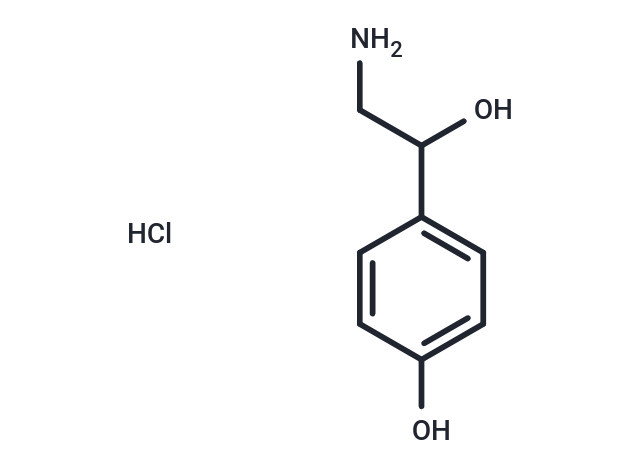
| Pack Size | Price | USA Stock | Global Stock | Quantity |
|---|---|---|---|---|
| 500 mg | $45 | In Stock | In Stock | |
| 1 g | $53 | - | In Stock |
| Description | Octopamine hydrochloride ((±)-p-Octopamine hydrochlorid) is a biogenic monoamine structurally associated with noradrenaline. It can serve as a neurohormone, a neurotransmitter, and a neuromodulator in invertebrates. |
| In vitro | Octopamine is present in relatively high concentrations in neuronal as well as in non-neuronal tissues of most invertebrate species studied, and modulates almost every physiological process. Octopamine acts as neurohormone including desensitization of sensory inputs, influence on learning and memory, or regulation of the mood of the animal in the central nervous system. Octopamine is the only neuroactive non-peptide transmitter whose physiological role is restricted to invertebrates, and all octopamine receptors belong to the family of G-protein coupled receptors. [1] |
| In vivo | Octopamine (10 mg/mL) is necessary for the acquisition of sugar memory in Drosophila. [2] Octopamine treatment increases responsiveness to brood pheromone and decreased responsiveness to social inhibition. Octopamine acts as an important source of variation in response thresholds and as a modulator of pheromonal communication in insect societies. [3] Octopamine (10 μM) injected into the mushroom body (MB) calyces or the antennal lobe but not the lateral protocerebral lobe produces a lasting, pairing-specific enhancement of extension of the proboscis. Octopamine (10 μM) injected into the MB calyces results in an additional pairing-specific effect, because it does not lead to an acquisition but a consolidation after conditioning. [4] Octopamine treatment significantly elevates levels of octopamine in the brain and caused a significant dose-dependent increase in the number of new foragers. Octopamine treatment is effective only when given to bees old enough to forage, i.e., older than 4 days of age. Octopamine influences division of labor in honey bee colonies. [5] |
| Synonyms | (±)-p-Octopamine hydrochlorid, (+,-)-Octopamine HCl |
| Molecular Weight | 189.64 |
| Formula | C8H12ClNO2 |
| Cas No. | 770-05-8 |
| Smiles | Cl.NCC(O)c1ccc(O)cc1 |
| Relative Density. | 1.39 g/cm3 at 20℃ |
| Storage | Powder: -20°C for 3 years | In solvent: -80°C for 1 year Shipping with blue ice/Shipping at ambient temperature. | ||||||||||||||||||||||||||||||||||||||||
| Solubility Information | DMSO: 6.2 mg/mL (32.69 mM), Sonication is recommended.  H2O: 200.4 mM, Sonication is recommended. | ||||||||||||||||||||||||||||||||||||||||
| In Vivo Formulation | 10% DMSO+90% Saline: 0.62 mg/mL (3.27 mM), Solution. Please add the solvents sequentially, clarifying the solution as much as possible before adding the next one. Dissolve by heating and/or sonication if necessary. Working solution is recommended to be prepared and used immediately. The formulation provided above is for reference purposes only. In vivo formulations may vary and should be modified based on specific experimental conditions. | ||||||||||||||||||||||||||||||||||||||||
Solution Preparation Table | |||||||||||||||||||||||||||||||||||||||||
DMSO/H2O
H2O
Note : The dilution table applies only to solid products. For liquid products, please calculate the stock solution based on the stated concentration and/or density. | |||||||||||||||||||||||||||||||||||||||||
 For example, if the intended dosage is 10 mg/kg for animals weighing 20 g , with a dosing volume of 100 μL per animal, and a total of 10 animals are to be administered, using a formulation of
  10% DMSO+ 40% PEG300+ 5% Tween 80+ 45% Saline/PBS/ddH2O , the resulting working solution concentration would be 2 mg/mL.
Dissolve 2 mg of the compound in 100 μL DMSO to obtain a stock solution at a concentration of 20 mg/mL . If the required concentration exceeds the compound's known solubility, please contact us for technical support before proceeding.
1) Add 100 μL of the DMSO stock solution to 400 µL PEG300 and mix thoroughly until the solution becomes clear.
2) Add 50 µL Tween 80 and mix well until fully clarified.
3) Add 450 µL Saline,PBS or ddH2O and mix thoroughly until a homogeneous solution is obtained.
| Size | Quantity | Unit Price | Amount | Operation |
|---|
 Feedback
 Hello! How can I help you today?
Copyright © 2015-2026 TargetMol Chemicals Inc. All Rights Reserved.
