


Shopping Cart
Remove All Your shopping cart is currently empty

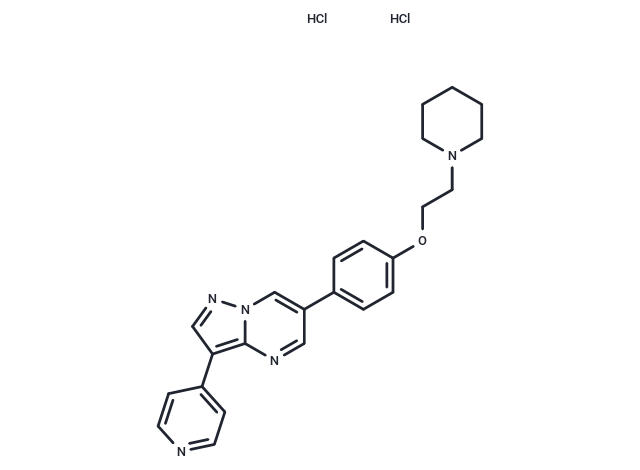
Synonyms: Dorsomorphin (Compound C) 2HCl, Compound C dihydrochloride, Compound C 2HCl, BML-275 dihydrochloride, BML-275 2HCl
| Pack Size | Price | USA Stock | Global Stock | Quantity |
|---|---|---|---|---|
| 2 mg | $30 | In Stock | In Stock | |
| 5 mg | $47 | In Stock | In Stock | |
| 10 mg | $64 | In Stock | In Stock | |
| 25 mg | $137 | In Stock | In Stock | |
| 50 mg | $247 | In Stock | In Stock | |
| 100 mg | $446 | In Stock | In Stock | |
| 500 mg | $987 | - | In Stock | |
| 1 mL x 10 mM (in DMSO) | $52 | In Stock | In Stock |
| Description | Dorsomorphin dihydrochloride (BML-275 2HCl) is a potent, selective and ATP-competitive AMPK inhibitor (Ki: 109 nM) and does not exhibit significant activity on structurally related kinases. |
| Targets & IC50 | HeLa cells:10.71 μM, 92-1 cells:6.526 µM, AMPK:109 nM (Ki), HCT116 cells:11.34 μM, Mel 270 cells:8.39 µM, A2780 cells:0.9 μM (EC50), OMM2.5 cells:31.45 µM, MP46 cells:10.13 µM, MCF-7 cells:4.9 μM (EC50) |
| In vitro | Dorsomorphin (compound C) is a potent reversible inhibitor that is competitive with ATP, with Ki = 109 ± 16 nM in the absence of AMP. Incubation of cultured hepatocytes with compound C inhibited ACC inactivation by either AICAR or metformin [1]. Compound C suppressed 2-deoxy-D-glucose (2DG)-induced GRP78 promoter activity in a dose-dependent manner but had little effect on tunicamycin-induced GRP78 promoter activity. Compound C also suppressed GRP78 promoter activity induced by glucose withdrawal [2]. |
| In vivo | 6 h after dorsomorphin was administered intravenously, hepatic hepcidin mRNA levels were reduced to one-third of that of vehicle-injected mice. Alterations in hepcidin levels affect serum iron concentrations within 24 h via the altered mobilization of intracellular iron by ferroportin33. Administration of dorsomorphin over 24 h led to a 60% increase in total serum iron concentrations [3]. |
| Synonyms | Dorsomorphin (Compound C) 2HCl, Compound C dihydrochloride, Compound C 2HCl, BML-275 dihydrochloride, BML-275 2HCl |
| Kinase Assay | Liver AMPK was partially purified from male SD rats to the blue-Sepharose step. The 100-μl reaction mixture contained 100 μM AMP, 100 μM ATP (0.5 μCi 33P-ATP per reaction), and 50 μM SAMS in a buffer (40 mM HEPES, pH 7.0, 80 mM NaCl, 0.8 mM EDTA, 5 mM MgCl2, 0.025% BSA, and 0.8 mM DTT). The reaction was initiated with the addition of the enzyme. After a 30-minute incubation at 30°C, the reaction was stopped by addition of 80 μl 1% H3PO4. Aliquots (100 μl) were transferred to 96-well MultiScreen plates. The plate was washed three times with 1% H3PO4 followed by detection in a Top-count. The in vitro AMPK inhibition data obtained with compound C — (6-[4-(2-Piperidin-1-yl-ethoxy)-phenyl)]-3-pyridin-4-yl-pyyrazolo[1,5-a] pyrimidine — were fit to the following equation for competitive inhibition by nonlinear regression using a least-squares Marquardt algorithm in a computer program written by N. Thornberry of Merck Research Laboratories: Vi/Vo = (Km + S)/[S + Km × (1 + I/Ki)], where Vi is the inhibited velocity, Vo is the initial velocity, S is the substrate (ATP) concentration, Km is the Michaelis constant for ATP, I is the inhibitor (compound C) concentration, and Ki is the dissociation constant for compound C [1]. |
| Cell Research | C2C12 cells were seeded into 96-well plates at 2,000 cells per well in DMEM supplemented with 2% FBS. Wells were treated in quadruplicate with BMP ligands and dorsomorphin or vehicle. Cells were harvested after 5 d in culture with 50 μl Tris-buffered saline, 1% Triton X-100. Lysates were added to p-nitro-phenylphosphate reagent in 96-well plates for 1 h, and alkaline phosphatase activity expressed as absorbance at 405 nM. Cell viability and quantity were measured by Cell-titer Glo and binding of nuclear dye CyQuant, respectively, using replicate wells treated identically to those used for alkaline phosphatase measurements [3]. |
| Animal Research | 12-week-old C57BL/6 mice raised on a standard diet were injected via the tail vein with 0.2 g kg?1 of dextran (average MW = 5,000) or 0.2 g kg?1 of iron-dextran USP. Dextran was injected with vehicle only, whereas iron-dextran was injected with either vehicle or dorsomorphin (10 mg/kg). 1 h after injection, mice were killed and liver segments were collected in 500 μl of SDS-lysis buffer and mechanically homogenized. 20 μl of liver extracts were resolved by SDS-PAGE and immunoblotted. Total RNA was harvested using Trizol from mechanically homogenized mouse livers (6 h after injection with a single intraperitoneal dose of dorsomorphin (10 mg/kg) or DMSO) [3]. |
| Molecular Weight | 472.41 |
| Formula | C24H25N5O·2HCl |
| Cas No. | 1219168-18-9 |
| Smiles | Cl.Cl.C(CN1CCCCC1)Oc1ccc(cc1)-c1cnc2c(cnn2c1)-c1ccncc1 |
| Relative Density. | no data available |
| Storage | Store under nitrogen Powder: -20°C for 3 years | In solvent: -80°C for 1 year Shipping with blue ice/Shipping at ambient temperature. | |||||||||||||||||||||||||||||||||||
| Solubility Information | DMSO: 7.4 mg/mL (15.66 mM), Sonication is recommended.  H2O: 47.2 mg/mL (99.91 mM), Sonication is recommended. | |||||||||||||||||||||||||||||||||||
Solution Preparation Table | ||||||||||||||||||||||||||||||||||||
DMSO/H2O
H2O
Note : The dilution table applies only to solid products. For liquid products, please calculate the stock solution based on the stated concentration and/or density. | ||||||||||||||||||||||||||||||||||||
 For example, if the intended dosage is 10 mg/kg for animals weighing 20 g , with a dosing volume of 100 μL per animal, and a total of 10 animals are to be administered, using a formulation of
  10% DMSO+ 40% PEG300+ 5% Tween 80+ 45% Saline/PBS/ddH2O , the resulting working solution concentration would be 2 mg/mL.
Dissolve 2 mg of the compound in 100 μL DMSO to obtain a stock solution at a concentration of 20 mg/mL . If the required concentration exceeds the compound's known solubility, please contact us for technical support before proceeding.
1) Add 100 μL of the DMSO stock solution to 400 µL PEG300 and mix thoroughly until the solution becomes clear.
2) Add 50 µL Tween 80 and mix well until fully clarified.
3) Add 450 µL Saline,PBS or ddH2O and mix thoroughly until a homogeneous solution is obtained.
| Size | Quantity | Unit Price | Amount | Operation |
|---|
 Feedback
 Hello! How can I help you today?
Copyright © 2015-2026 TargetMol Chemicals Inc. All Rights Reserved.
