


Shopping Cart
Remove All Your shopping cart is currently empty


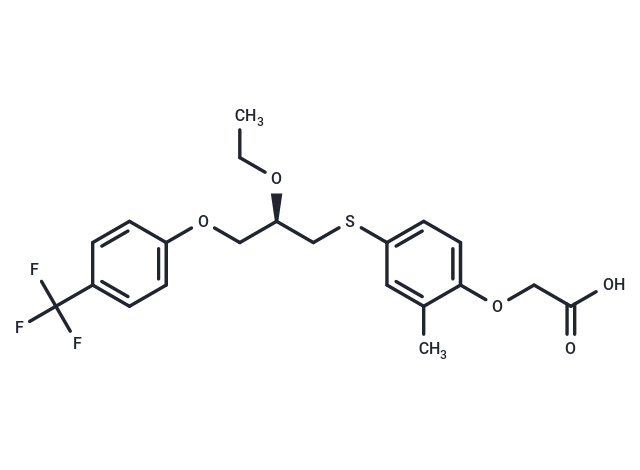
Synonyms: MBX 8025
| Pack Size | Price | USA Stock | Global Stock | Quantity |
|---|---|---|---|---|
| 5 mg | $43 | In Stock | In Stock | |
| 10 mg | $73 | In Stock | In Stock | |
| 25 mg | $137 | In Stock | In Stock | |
| 50 mg | $238 | In Stock | In Stock | |
| 100 mg | $356 | In Stock | In Stock | |
| 200 mg | $490 | In Stock | In Stock | |
| 1 mL x 10 mM (in DMSO) | $48 | In Stock | In Stock |
| Description | Seladelpar (MBX 8025) has been used in trials studying the treatment of Hyperlipidemia. |
| Targets & IC50 | PPARδ:2 nM (EC50), PPARα:1600 nM (EC50) |
| In vitro | Seladelpar (MBX-8025) is an orally administered, highly potent (2 nM), and selective PPAR-δ agonist with over 750-fold and 2500-fold specificity over PPAR-α and PPAR-γ receptors, respectively. As a lipid-modifying agent, it effectively improves insulin resistance, diabetes, and atherogenic dyslipidemia by targeting human PPAR-δ at a 50% effective concentration of 2 nM, compared to 1,600 nM for PPAR-α. |
| In vivo | Female Alms1 mutant (foz/foz) mice and their wild-type siblings were subjected to an atherogenic diet for 16 weeks post-weaning. Subsequently, groups (n=8-12) were randomized to receive either 10 mg/kg Seladelpar or a vehicle (1% methylcellulose) via gavage for 8 weeks. Seladelpar efficiently normalized hyperglycemia, hyperinsulinemia, and glucose disposal in foz/foz mice without significantly affecting body weight. It halved serum alanine aminotransferase levels, which ranged from 300-600 U/L in vehicle-treated foz/foz mice, and corrected serum lipid profiles as well as hepatic concentrations of free cholesterol and other lipotoxic lipids elevated in these mice compared to wild-type. These corrections led to the abolition of hepatocyte ballooning and apoptosis, marked reductions in steatosis and liver inflammation, and improved liver fibrosis. Vehicle-treated foz/foz mice had an average nonalcoholic fatty liver disease (NAFLD) activity score of 6.9, indicative of nonalcoholic steatohepatitis (NASH), which Seladelpar entirely reversed (NAFLD activity score reduced to 3.13). In wild-type mice fed an atherogenic diet, Seladelpar administration resulted in an approximate 18% reduction in body weight (P<0.05). However, it had a minimal impact on the body weight of atherogenic diet-fed foz/foz mice. These mice developed severe metabolic disruptions after 16 weeks, which Seladelpar significantly ameliorated (P<0.05). Following an intraperitoneal glucose challenge, blood glucose levels were significantly lower in Seladelpar-treated foz/foz mice compared to vehicle-treated ones (P<0.05), demonstrating Seladelpar's substantial improvement on glucose handling, an effect similarly observed in wild-type mice on an atherogenic diet (P<0.05). |
| Synonyms | MBX 8025 |
| Animal Research | From weaning (week 4), Alms1 mutant (foz/foz) NOD.B10 mice or Wt littermates (female mice in both groups) are fed an atherogenic diet (23% fat, 0.2% cholesterol and 45% simple carbohydrate; 4.78 kcal/g digestible energy) ad libitum for 16 weeks, after which groups are randomized (n=8-12 mice/group) to once-a-day oral administration (by gavage) for 8 weeks of Seladelpar (10 mg/kg in 1% methylcellulose) or vehicle (controls). Animals are housed under 12-hour light/dark cycle and constant temperature of 22°C and receive maximal humane care[2]. |
| Molecular Weight | 444.46 |
| Formula | C21H23F3O5S |
| Cas No. | 851528-79-5 |
| Smiles | CCO[C@H](COc1ccc(cc1)C(F)(F)F)CSc1ccc(OCC(O)=O)c(C)c1 |
| Relative Density. | no data available |
| Storage | Store at low temperature,Store under nitrogen Powder: -20°C for 3 years | In solvent: -80°C for 1 year Shipping with blue ice/Shipping at ambient temperature. | |||||||||||||||||||||||||||||||||||
| Solubility Information | DMSO: 255 mg/mL (573.73 mM), Sonication is recommended.  | |||||||||||||||||||||||||||||||||||
| In Vivo Formulation | 10% DMSO+40% PEG300+5% Tween 80+45% Saline: 1 mg/mL (2.25 mM), Sonication is recommended. Please add the solvents sequentially, clarifying the solution as much as possible before adding the next one. Dissolve by heating and/or sonication if necessary. Working solution is recommended to be prepared and used immediately. The formulation provided above is for reference purposes only. In vivo formulations may vary and should be modified based on specific experimental conditions. | |||||||||||||||||||||||||||||||||||
Solution Preparation Table | ||||||||||||||||||||||||||||||||||||
DMSO
Note : The dilution table applies only to solid products. For liquid products, please calculate the stock solution based on the stated concentration and/or density. | ||||||||||||||||||||||||||||||||||||
 For example, if the intended dosage is 10 mg/kg for animals weighing 20 g , with a dosing volume of 100 μL per animal, and a total of 10 animals are to be administered, using a formulation of
  10% DMSO+ 40% PEG300+ 5% Tween 80+ 45% Saline/PBS/ddH2O , the resulting working solution concentration would be 2 mg/mL.
Dissolve 2 mg of the compound in 100 μL DMSO to obtain a stock solution at a concentration of 20 mg/mL . If the required concentration exceeds the compound's known solubility, please contact us for technical support before proceeding.
1) Add 100 μL of the DMSO stock solution to 400 µL PEG300 and mix thoroughly until the solution becomes clear.
2) Add 50 µL Tween 80 and mix well until fully clarified.
3) Add 450 µL Saline,PBS or ddH2O and mix thoroughly until a homogeneous solution is obtained.
| Size | Quantity | Unit Price | Amount | Operation |
|---|
 Feedback
 Hello! How can I help you today?
Copyright © 2015-2026 TargetMol Chemicals Inc. All Rights Reserved.
