


Shopping Cart
Remove All Your shopping cart is currently empty

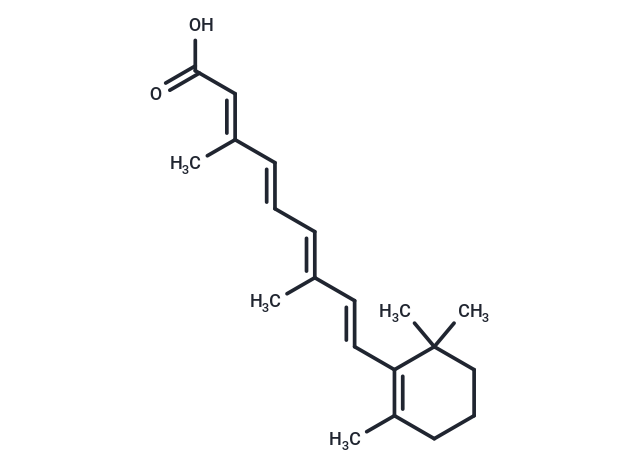
Synonyms: Vitamin A acid, Tretinoin, ATRA, all-trans-Retinoic acid
| Pack Size | Price | USA Stock | Global Stock | Quantity |
|---|---|---|---|---|
| 50 mg | $30 | In Stock | In Stock | |
| 100 mg | $42 | In Stock | In Stock | |
| 500 mg | $63 | In Stock | In Stock | |
| 1 g | $78 | In Stock | In Stock | |
| 5 g | $189 | - | In Stock | |
| 1 mL x 10 mM (in DMSO) | $44 | In Stock | In Stock |
| Description | Retinoic acid (Tretinoin), a metabolite of vitamin A, is a natural agonist of the retinoic acid receptor RAR and inhibits RARα/β/γ (IC50=14 nM). Retinoic acid induces cellular differentiation, reduces cellular proliferation, and inhibits tumorigenesis. |
| Targets & IC50 | RARα:14 nM, RARγ:14 nM, RARβ:14 nM, PPARβ/δ:17 nM (Kd), PPARα:103 nM (Kd), PPARγ:178 nM (Kd) |
| In vitro | Tretinoin prevents skin atrophy induced by corticosteroids in hairless mice. When co-administered with miquimod in guinea pigs, tretinoin induces tattoo fading and moderate pigment clearance histopathologically. Applications of tretinoin on incisions in the skin of 45 CD-1 mice increase fibroblast differentiation and reduce collagen production. In aged male Fischer 344 rats treated with tretinoin, renal cortex protein content is 30% lower compared to controls, potentially due to suppressed expression of tumor necrosis factor-β1 and osteopontin. |
| In vivo | In studies evaluating the impact on glutathione levels and catalase activity, Tretinoin increased both metrics in a time- and dose-dependent manner, offering protective and mitigating effects against H2O2 cytotoxicity in human renal mesangial cells. Treatment with Tretinoin resulted in elevated mRNA levels of catalase and γ-glutamylcysteine synthetase (the catalytic subunit responsible for the rate-limiting step in reduced glutathione synthesis) in cultured mesangial cells. Additionally, Tretinoin upregulated matrix metalloproteinase-8/13 in human keloid-derived fibroblasts. |
| Synonyms | Vitamin A acid, Tretinoin, ATRA, all-trans-Retinoic acid |
| Cell Research | Retinoic acid is dissolved in DMSO and stored, and then diluted with appropriate medium before use[3]. P19 cell are induced to undergo neuronal differentiation according to established procedures. Briefly, cells are cultured on 1% agarose-coated 10 cm dishes at 3×10 5 cells/mL in α-minimal essential medium supplemented with 10% FBS. Differentiation is induced by addition of Retinoic acid (1 μM) and medium containing Retinoic acid replaced 2 days later. On day 4, cell aggregates are collected by centrifugation, separated to single cells by trypsin/EDTA treatment, replated onto poly-L-lysine-coated plates, and cultured in α-minimal essential medium supplemented with 10% FBS. On day 6, medium is replaced with neurobasal medium containing B27 supplement and 2 mM GlutaMAX. Medium is replaced every 2 days for an additional week[3]. |
| Molecular Weight | 300.44 |
| Formula | C20H28O2 |
| Cas No. | 302-79-4 |
| Smiles | C(=C/C(=C/C=C/C(=C/C(O)=O)/C)/C)\C=1C(C)(C)CCCC1C |
| Relative Density. | 1.0597 g/cm3 (Estimated) |
| Storage | Keep away from direct sunlight,Store at low temperature Powder: -20°C for 3 years | In solvent: -80°C for 1 year Shipping with blue ice/Shipping at ambient temperature. | ||||||||||||||||||||||||||||||||||||||||
| Solubility Information | DMSO: 95 mg/mL (316.2 mM), Sonication is recommended.  Ethanol: 6 mg/mL (19.97 mM), Sonication is recommended. H2O: < 1 mg/mL (insoluble or slightly soluble) | ||||||||||||||||||||||||||||||||||||||||
| In Vivo Formulation | 10% DMSO+40% PEG300+5% Tween 80+45% Saline: 5.6 mg/mL (18.64 mM), Suspension. Please add the solvents sequentially, clarifying the solution as much as possible before adding the next one. Dissolve by heating and/or sonication if necessary. Working solution is recommended to be prepared and used immediately. The formulation provided above is for reference purposes only. In vivo formulations may vary and should be modified based on specific experimental conditions. | ||||||||||||||||||||||||||||||||||||||||
Solution Preparation Table | |||||||||||||||||||||||||||||||||||||||||
Ethanol/DMSO
DMSO
Note : The dilution table applies only to solid products. For liquid products, please calculate the stock solution based on the stated concentration and/or density. | |||||||||||||||||||||||||||||||||||||||||
 For example, if the intended dosage is 10 mg/kg for animals weighing 20 g , with a dosing volume of 100 μL per animal, and a total of 10 animals are to be administered, using a formulation of
  10% DMSO+ 40% PEG300+ 5% Tween 80+ 45% Saline/PBS/ddH2O , the resulting working solution concentration would be 2 mg/mL.
Dissolve 2 mg of the compound in 100 μL DMSO to obtain a stock solution at a concentration of 20 mg/mL . If the required concentration exceeds the compound's known solubility, please contact us for technical support before proceeding.
1) Add 100 μL of the DMSO stock solution to 400 µL PEG300 and mix thoroughly until the solution becomes clear.
2) Add 50 µL Tween 80 and mix well until fully clarified.
3) Add 450 µL Saline,PBS or ddH2O and mix thoroughly until a homogeneous solution is obtained.
| Size | Quantity | Unit Price | Amount | Operation |
|---|
 Feedback
 Hello! How can I help you today?
Copyright © 2015-2026 TargetMol Chemicals Inc. All Rights Reserved.
