


Shopping Cart
Remove All Your shopping cart is currently empty

Synonyms: NSC-287088

| Pack Size | Price | USA Stock | Global Stock | Quantity |
|---|---|---|---|---|
| 1 mg | $297 | - | In Stock | |
| 5 mg | $717 | - | In Stock | |
| 10 mg | $988 | - | In Stock | |
| 25 mg | $1,460 | - | In Stock | |
| 50 mg | $1,980 | - | In Stock | |
| 1 mL x 10 mM (in DMSO) | $857 | - | In Stock |
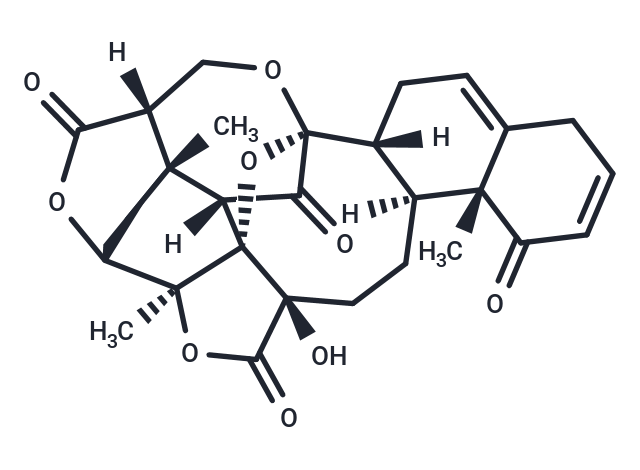
| Description | Physalin B is one of the major active compounds from the Solanaceae family of plants and has a wide range of biological activities for the treatment of inflammatory eczema and herpes, among other diseases.Physalin B ameliorates lipopolysaccharide-induced inflammatory response due to acute lung injury by inhibiting NF-κB and NLRP3 through activation of the PI3K/Akt pathway.Physalin B inhibits PDGF-BB-induced VSMC proliferation and migration and phenotypic transformation through activation of the Nrf2 pathway. Physalin B inhibits PDGF-BB-induced VSMC proliferation, migration and phenotypic transformation through activation of the Nrf2 pathway.Physalin B exerts antitumor activity by inhibiting LAP2α-HDAC1-mediated deacetylation of glioma-associated oncogene 1 and hepatic stellate cell activation. |
| In vitro | Physalin B inhibited the viability of HCT116 cells with an IC50 value of 1.35 μmol/L. Treatment of the cells with physalin B (2.5-10 μmol/L) induced apoptosis and the cleavage of PARP and caspase-3. Meanwhile, physalin B treatment induced autophagosome formation, and accumulation of LC3-II and p62, but decreased Beclin 1 protein level. Marked changes of microtubules and F-actin microfilaments were observed in physalin B-treated cells, which led to the blockage of co-localization of autophagosomes and lysosomes. Physalin B treatment dose-dependently increased the phosphorylation of p38, ERK, and JNK in the cells, whereas the p38 inhibitor SB202190, ERK inhibitor U0126, or JNK inhibitor SP600125 could partially reduce physalin B-induced PARP cleavage and p62 accumulation. Moreover, physalin B treatment dose-dependently increased mito-ROS production in the cells, whereas the ROS scavenger NAC could reverse physalin B-induced effects, including incomplete autophagic response, accumulation of ubiquitinated proteins, changes of microtubules and F-actin, activation of p38, ERK and JNK, as well as cell death and apoptosis. Physalin B induces mito-ROS, which not only inhibits the ubiquitin-proteasome pathway but also induces an incomplete autophagic response in HCT116 cells in vitro.[2] |
| Synonyms | NSC-287088 |
| Molecular Weight | 510.53 |
| Formula | C28H30O9 |
| Cas No. | 23133-56-4 |
| Smiles | [H][C@@]12C(=O)[C@]34O[C@]11[C@@](C)(OC(=O)[C@@]1(O)CC[C@@]1([H])[C@@]3([H])CC=C3CC=CC(=O)[C@]13C)[C@H]1C[C@]2(C)[C@@]([H])(CO4)C(=O)O1 |
| Relative Density. | 1.51 g/cm3 (Predicted) |
| Storage | Store at low temperature Powder: -20°C for 3 years | In solvent: -80°C for 1 year Shipping with blue ice/Shipping at ambient temperature. |
 For example, if the intended dosage is 10 mg/kg for animals weighing 20 g , with a dosing volume of 100 μL per animal, and a total of 10 animals are to be administered, using a formulation of
  10% DMSO+ 40% PEG300+ 5% Tween 80+ 45% Saline/PBS/ddH2O , the resulting working solution concentration would be 2 mg/mL.
Dissolve 2 mg of the compound in 100 μL DMSO to obtain a stock solution at a concentration of 20 mg/mL . If the required concentration exceeds the compound's known solubility, please contact us for technical support before proceeding.
1) Add 100 μL of the DMSO stock solution to 400 µL PEG300 and mix thoroughly until the solution becomes clear.
2) Add 50 µL Tween 80 and mix well until fully clarified.
3) Add 450 µL Saline,PBS or ddH2O and mix thoroughly until a homogeneous solution is obtained.
| Size | Quantity | Unit Price | Amount | Operation |
|---|
 Feedback
 Hello! How can I help you today?
Copyright © 2015-2026 TargetMol Chemicals Inc. All Rights Reserved.
