


Shopping Cart
Remove All Your shopping cart is currently empty

Synonyms: RJC 02792, NSC 407292, Dihydronaringenin
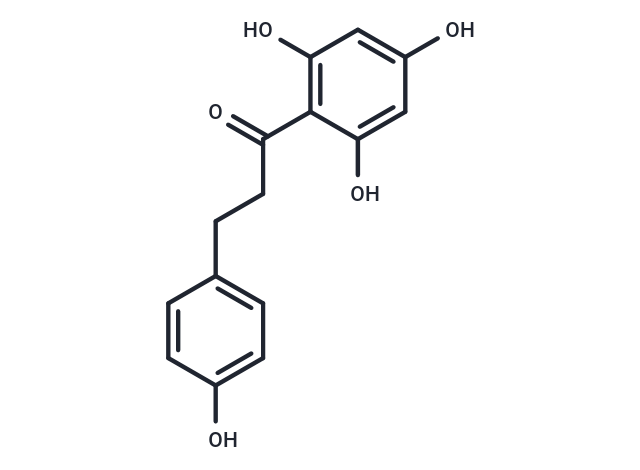
| Pack Size | Price | USA Stock | Global Stock | Quantity |
|---|---|---|---|---|
| 100 mg | $30 | In Stock | In Stock | |
| 500 mg | $57 | In Stock | In Stock | |
| 1 g | $76 | In Stock | In Stock | |
| 5 g | $139 | - | In Stock | |
| 10 g | $179 | - | In Stock | |
| 1 mL x 10 mM (in DMSO) | $48 | In Stock | In Stock |
| Description | Phloretin (NSC-407292) is a well-known inhibitor of eukaryotic urea transporters, blocks VacA-mediated urea and ion transport. Phloretin is a dihydrochalcone, a type of natural phenols. It can be found in apple tree leaves and the Manchurian apricot. It promotes potent antioxidative activities in peroxynitrite scavenging and the inhibition of lipid peroxidation. It has been found to inhibit the growth of several cancer cells and induce apoptosis of B16 melanoma and HL60 human leukemia cells. |
| In vitro | Phloretin is a dihydrochalcone found in the bark of pear (Pyrus communis), apple, cherry and other fruit trees. Phloretin inhibits the active transport of glucose into cells by SGLT1 and SGLT2, though the inhibition is weaker than by its glycoside phlorizin. [1] Orally consumed phlorizin is nearly entirely converted into phloretin by hydrolytic enzymes in the small intestine. An important effect of this is the inhibition of glucose absorption by the small intestine and the inhibition of renal glucose reabsorption. [2] [3] Phloretin also inhibits a variety of urea transporters. It induces urea loss and diuresis when coupled with high protein diets. [4] |
| Synonyms | RJC 02792, NSC 407292, Dihydronaringenin |
| Molecular Weight | 274.27 |
| Formula | C15H14O5 |
| Cas No. | 60-82-2 |
| Smiles | C(CCC1=CC=C(O)C=C1)(=O)C2=C(O)C=C(O)C=C2O |
| Relative Density. | 1.429 g/cm3 |
| Storage | Powder: -20°C for 3 years | In solvent: -80°C for 1 year Shipping with blue ice/Shipping at ambient temperature. | |||||||||||||||||||||||||||||||||||
| Solubility Information | Ethanol: 48 mg/mL (175.01 mM), Sonication is recommended. DMSO: 80 mg/mL (291.68 mM), Sonication is recommended.  H2O: < 1 mg/mL (insoluble or slightly soluble) | |||||||||||||||||||||||||||||||||||
| In Vivo Formulation | 10% DMSO+40% PEG300+5% Tween 80+45% Saline: 3.3 mg/mL (12.03 mM), Sonication is recommended. Please add the solvents sequentially, clarifying the solution as much as possible before adding the next one. Dissolve by heating and/or sonication if necessary. Working solution is recommended to be prepared and used immediately. The formulation provided above is for reference purposes only. In vivo formulations may vary and should be modified based on specific experimental conditions. | |||||||||||||||||||||||||||||||||||
Solution Preparation Table | ||||||||||||||||||||||||||||||||||||
Ethanol/DMSO
Note : The dilution table applies only to solid products. For liquid products, please calculate the stock solution based on the stated concentration and/or density. | ||||||||||||||||||||||||||||||||||||
 For example, if the intended dosage is 10 mg/kg for animals weighing 20 g , with a dosing volume of 100 μL per animal, and a total of 10 animals are to be administered, using a formulation of
  10% DMSO+ 40% PEG300+ 5% Tween 80+ 45% Saline/PBS/ddH2O , the resulting working solution concentration would be 2 mg/mL.
Dissolve 2 mg of the compound in 100 μL DMSO to obtain a stock solution at a concentration of 20 mg/mL . If the required concentration exceeds the compound's known solubility, please contact us for technical support before proceeding.
1) Add 100 μL of the DMSO stock solution to 400 µL PEG300 and mix thoroughly until the solution becomes clear.
2) Add 50 µL Tween 80 and mix well until fully clarified.
3) Add 450 µL Saline,PBS or ddH2O and mix thoroughly until a homogeneous solution is obtained.
| Size | Quantity | Unit Price | Amount | Operation |
|---|
 Feedback
 Hello! How can I help you today?
Copyright © 2015-2026 TargetMol Chemicals Inc. All Rights Reserved.
