


Shopping Cart
Remove All Your shopping cart is currently empty

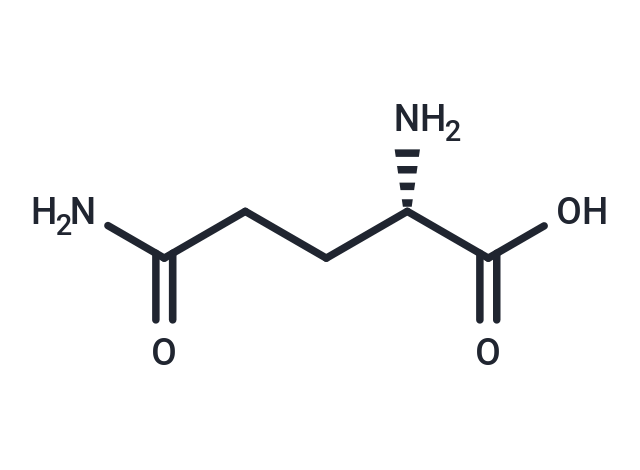
Synonyms: L-Glutamic acid 5-amide
| Pack Size | Price | USA Stock | Global Stock | Quantity |
|---|---|---|---|---|
| 5 g | $29 | - | In Stock | |
| 1 mL x 10 mM (in H2O) | $50 | In Stock | In Stock |
| Description | L-Glutamine (L-Glutamic acid 5-amide) is a non-essential amino acid abundantly present in the human body and involved in numerous metabolic processes. It serves multiple functions as a nitrogen source donor, energy substrate, and antioxidant precursor. It can be used in cell biology, immunology, and oncology research. |
| Targets & IC50 | mGluR7:19 μM |
| In vitro | Methods: L-glutamine (0.5, 1.0, 2.0, 10.0 mM) was added to male SD rat thoracic aortic vascular rings (with endothelium) (pre-contracted with 1 μM phenylephrine), and tension changes were recorded in real time. Results: 0.5 mM L-Glutamine increased relaxation velocity by 93%. De-endothelialization or L-NAME pretreatment attenuated the relaxation response by approximately 70–80%. L-Glutamine increased tissue cGMP levels by 77%. [1] Methods: Primary knee cartilage cells from 3-week-old SD rats were treated with L-glutamine (0, 5, 10, 20 mM). Some groups were pretreated with IL-1β (10 ng/mL) for 2 hours before L-glutamine treatment for 24 or 48 hours. Cell viability was assessed using the CCK-8 assay. Results: IL-1β reduced cell viability, while L-Glutamine concentration-dependently reversed this effect, with the most pronounced effect observed at 20 mM. [2] |
| In vivo | Methods: Female BALB/c mice received a single intraperitoneal injection of cantharidin (CTD) (2 mg/kg) or oral administration of L-glutamine (Gln) (1 or 2 g/kg). Four hours post-treatment, hearts were subjected to hematoxylin and eosin (HE) staining, and microscopic examination was performed to assess pathological changes such as inflammation and congestion. Results: The CTD group exhibited inflammatory cell infiltration and myocardial interstitial congestion in the heart; the L-Glutamine pretreatment group showed significantly reduced myocardial inflammation and pathological alterations. [3] Methods: Male C57BL/6J mice received intraperitoneal injections of L-glutamine (Gln) (50 mg/kg). Thirty minutes later, LPS (10 μg/kg) + D-Gal (700 mg/kg) was administered intraperitoneally to induce fulminant hepatitis. Animals were euthanized 6 hours after LPS/D-Gal injection.Plasma samples were collected to measure ALT and AST activity; liver tissue was examined histopathologically via HE staining. Results: L-Glutamine pretreatment significantly reduced LPS/D-Gal-induced elevations in plasma ALT and AST levels and mitigated histopathological liver damage (disorganized hepatic lobule architecture, hepatocyte necrosis, inflammatory cell infiltration).[4] |
| Synonyms | L-Glutamic acid 5-amide |
| Molecular Weight | 146.14 |
| Formula | C5H10N2O3 |
| Cas No. | 56-85-9 |
| Smiles | [C@H](CCC(N)=O)(C(O)=O)N |
| Relative Density. | 1.469 g/cm3. Temperature:20 °C.;1.469. Temperature:20 °C. |
| Storage | Store at low temperature Powder: -20°C for 3 years | In solvent: -80°C for 1 year Shipping with blue ice/Shipping at ambient temperature. | |||||||||||||||||||||||||||||||||||
| Solubility Information | DMSO: Insoluble H2O: 40.7 mg/mL (278.5 mM), Sonication and heating are recommended.  | |||||||||||||||||||||||||||||||||||
Solution Preparation Table | ||||||||||||||||||||||||||||||||||||
H2O
Note : The dilution table applies only to solid products. For liquid products, please calculate the stock solution based on the stated concentration and/or density. | ||||||||||||||||||||||||||||||||||||
 For example, if the intended dosage is 10 mg/kg for animals weighing 20 g , with a dosing volume of 100 μL per animal, and a total of 10 animals are to be administered, using a formulation of
  10% DMSO+ 40% PEG300+ 5% Tween 80+ 45% Saline/PBS/ddH2O , the resulting working solution concentration would be 2 mg/mL.
Dissolve 2 mg of the compound in 100 μL DMSO to obtain a stock solution at a concentration of 20 mg/mL . If the required concentration exceeds the compound's known solubility, please contact us for technical support before proceeding.
1) Add 100 μL of the DMSO stock solution to 400 µL PEG300 and mix thoroughly until the solution becomes clear.
2) Add 50 µL Tween 80 and mix well until fully clarified.
3) Add 450 µL Saline,PBS or ddH2O and mix thoroughly until a homogeneous solution is obtained.
| Size | Quantity | Unit Price | Amount | Operation |
|---|
 Feedback
 Hello! How can I help you today?
Copyright © 2015-2026 TargetMol Chemicals Inc. All Rights Reserved.
