


Shopping Cart
Remove All Your shopping cart is currently empty


Synonyms: Hydroxydaunorubicin, DOX, Adriamycin
| Pack Size | Price | USA Stock | Global Stock | Quantity |
|---|---|---|---|---|
| 25 mg | $39 | In Stock | In Stock | |
| 50 mg | $54 | In Stock | In Stock |
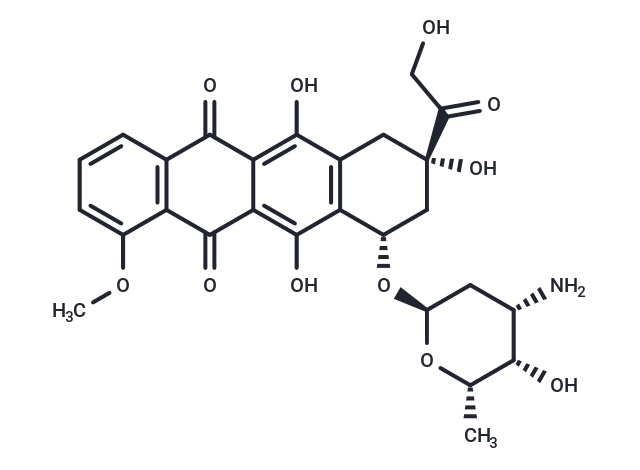
| Description | Doxorubicin (Adriamycin) is a fluorescent anthracycline antitumor antibiotic that inhibits Topoisomerase I/II, induces apoptosis and autophagy, downregulates the AMPK signaling pathway, and is commonly used in cancer chemotherapy as well as in models of nephritis and heart failure. |
| Targets & IC50 | Topo II:2.67 μM (IC50), Topo I:0.8 μM (IC50) |
| In vitro | The combination of Doxorubicin and Simvastatin at the highest tested concentrations (2 μM and 10 μM, respec-tively) kills 97% of the Hela cells[2]. |
| In vivo | In an experiment, mice with PC3 xenografts received injections of Doxorubicin at dosages of 2, 4, or 8 mg/kg, and tumor volume was monitored. The 2 mg/kg dose did not inhibit tumor growth, but doses of 4 mg/kg and 8 mg/kg initially delayed growth, significantly reducing c-FLIP levels in the tumors (p<0.05 on days 18 and 22)[3]. In a separate study with rats, treatments involved a single intraperitoneal injection of 10 mg/kg Doxorubicin, ten daily injections of 1 mg/kg, or five weekly injections of 2 mg/kg, resulting in an 80% mortality rate by day 28 for the first group, and on days 107 and 98 for the latter groups, respectively. Furthermore, fractional shortening—a measure of heart function—decreased by 30% in the first group at week 2, 55% in the second group at week 13, and 42% in the third group at week 13[4]. |
| Synonyms | Hydroxydaunorubicin, DOX, Adriamycin |
| Disease Modeling Protocol | Cardiomyopathy model
*Precautions: All rats were euthanized within 48 hours of DOX administration under deep isoflurane anesthesia. |
| Cell Research | Doxorubicin is dissolved in stock solutions (1 mM) and serially diluted with RPMI 1640 media (0.1, 1, and 2 μM)[2]. 160 μL of Hela cells suspension (3×10⁴ cell/mL) is dispensed into three 96-well U-bottom microplates and incubated for 24 h at 37°C in a fully humidified atmosphere of 5% CO2. In plate 1, serial dilutions of Doxorubicin (20 μL; final concentration, 0.1-2 μM) and Simvastatin (20 μL; final concentration, 0.25-2 μM) are added to a final volume of 200 μL and incubated for another 72 h. In plates 2 and 3 serial dilutions of each drug (Simvastatin or Doxorubicin, 40 μL) are added. After an incubation period of 24 h, the medium is aspirated and the cells are washed in PBS. Then, serial dilutions of other drug (40 μL) are added and supplemented with culture medium to a final volume of 200 μL, and incubated for 48 h. Doxorubicin and Simvastatin are used individually as positive controls (40 μL in each well), and the cells treated only with solvent are considered as negative controls. To evaluate cell survival, 20 μL of MTT solution (5 mg/mL in PBS) is added to each well and incubated for 3 h. Then the media is replaced with 150 μL of DMSO, and complete solubilization of formazan crystals is achieved by repeated pipetting of the solution. Absorbance is then determined at 540 nm by an ELISA plate reader. Each drug concentration is assayed in 4 or 8 wells and repeated 3 times. The cytotoxic/cytostatic effect of Doxorubicin is expressed as the relative viability (% control) and calculated. Percentage of cell survival in the negative control is assumed as 100. Relative viability=(experimental absorbance-background absorbance)/ (absorbance of untreated controls-background absorbance)×100 %[2]. |
| Molecular Weight | 543.52 |
| Formula | C27H29NO11 |
| Cas No. | 23214-92-8 |
| Smiles | COc1cccc2C(=O)c3c(O)c4C[C@](O)(C[C@H](O[C@H]5C[C@H](N)[C@H](O)[C@H](C)O5)c4c(O)c3C(=O)c12)C(=O)CO |
| Relative Density. | 1.61 g/cm3 |
| Storage | Keep away from direct sunlight,Keep away from moisture Powder: -20°C for 3 years | In solvent: -80°C for 1 year Shipping with blue ice/Shipping at ambient temperature. | ||||||||||||||||||||||||||||||
| Solubility Information | H2O: 50 mg/mL (91.99 mM), Sonication is recommended. DMSO: 49 mg/mL (90.15 mM), Sonication is recommended.  | ||||||||||||||||||||||||||||||
Solution Preparation Table | |||||||||||||||||||||||||||||||
DMSO/H2O
Note : The dilution table applies only to solid products. For liquid products, please calculate the stock solution based on the stated concentration and/or density. | |||||||||||||||||||||||||||||||
 For example, if the intended dosage is 10 mg/kg for animals weighing 20 g , with a dosing volume of 100 μL per animal, and a total of 10 animals are to be administered, using a formulation of
  10% DMSO+ 40% PEG300+ 5% Tween 80+ 45% Saline/PBS/ddH2O , the resulting working solution concentration would be 2 mg/mL.
Dissolve 2 mg of the compound in 100 μL DMSO to obtain a stock solution at a concentration of 20 mg/mL . If the required concentration exceeds the compound's known solubility, please contact us for technical support before proceeding.
1) Add 100 μL of the DMSO stock solution to 400 µL PEG300 and mix thoroughly until the solution becomes clear.
2) Add 50 µL Tween 80 and mix well until fully clarified.
3) Add 450 µL Saline,PBS or ddH2O and mix thoroughly until a homogeneous solution is obtained.
| Size | Quantity | Unit Price | Amount | Operation |
|---|
 Feedback
 Hello! How can I help you today?
Copyright © 2015-2026 TargetMol Chemicals Inc. All Rights Reserved.
