


Shopping Cart
Remove All Your shopping cart is currently empty


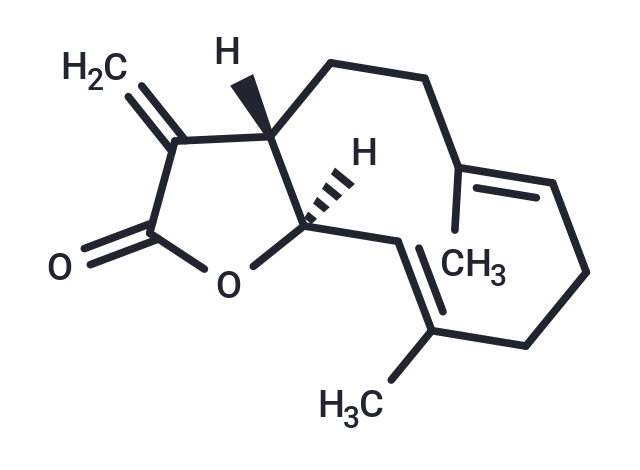
Synonyms: NSC 106404, Costus lactone, (+)-Costunolide
| Pack Size | Price | USA Stock | Global Stock | Quantity |
|---|---|---|---|---|
| 2 mg | $30 | In Stock | In Stock | |
| 5 mg | $45 | In Stock | In Stock | |
| 10 mg | $68 | In Stock | In Stock | |
| 25 mg | $122 | In Stock | In Stock | |
| 50 mg | $182 | In Stock | In Stock | |
| 100 mg | $263 | In Stock | In Stock | |
| 200 mg | $391 | In Stock | In Stock | |
| 1 mL x 10 mM (in DMSO) | $48 | In Stock | In Stock |
| Description | Costunolide (Costus lactone) has anti-inflammatory and anti-oxidant properties and mediates apoptosis. |
| Targets & IC50 | FPTase:20 μM, Telomerase (MDA-MB-231 cells):65 μM, Telomerase (MCF-7 cells):90 μM |
| In vitro | Costunolide reduces neovascularization induced by ethyl ester resin scale plaster in the corneal micropocket model of mice. It inhibits angiogenesis by blocking the vascular endothelial growth factor signaling pathway. |
| In vivo | Costunolide has been shown to inhibit cell proliferation in a dose-dependent manner over a 48-hour treatment in various human tumor cells, including A549, SK-OV-3, SK-MEL-2, XF498, and HCT-15. It induces apoptosis in HL-60 human leukemia cells through ROS-mediated mitochondrial permeability transition and cytochrome C release. Additionally, Costunolide exhibits significant antifungal activity against organisms such as Trichophyton rubrum, T. mentagrophytes, and Microsporum gypseum. The compound also suppresses telomerase activity and cell proliferation in MCF-7 and MDA-MB-231 cells in a concentration and time-dependent manner. Furthermore, Costunolide dose-dependently inhibits the farnesylation of lamin B by farnesyl protein transferase, demonstrating its diverse biochemical impacts. |
| Synonyms | NSC 106404, Costus lactone, (+)-Costunolide |
| Kinase Assay | Telomerase activity assay: The telomerase activity is measured by the TRAP assay using the TRAPez Telomerase Detection Kit, which includes primers of a 36-bp internal control (IC) for quantifying the amplification of telomerase activity within a linear range close to 2.5 logs. For RNase treatment, 10μL of extract are incubated with 1μg of RNase at 37 °C for 20 minutes. The products of the TRAP assay are resolved by electrophoresis in a nondenaturing12% PAGE in a buffer containing 0.5 × Tris–borate EDTA and detected by autoradiograph. For quantification of TRAP products, the dried gels are exposed to Fuji Imaging Plate at room temperature. Results are corrected for background, and a standard value of 100 is given to the untreated control cell signal. Signal intensities of Costunolide-treated cells are compared to the standard and are expressed as a fraction of the maximum value of 100. [1] |
| Cell Research | 1) Plate 500-10,000 cells in 200 μL media per well in a 96 well plate. Leave 8 wells empty for blank controls. 2) Incubate (37 °C, 5% CO2) overnight to allow the cells to attach to the wells. 3) Add 2 μL of Costunolide dissolved in DMSO to each well. Place on a shaking table, 150 rpm for 5 minutes, to thoroughly mix the samples into the media. 5) Incubate (37 °C, 5% CO2) for 48 hours to allow Costunolide to take effect. 6) Make 2 mL or more of MTT solution per 96 well plate at 5 mg/mL in PBS. Do not make a stock as MTT in solution is not stable long-term. 7) Add 20 μL MTT solution to each well. Place on a shaking table, 150 rpm for 5 minutes, to thoroughly mix the MTT into the media. 8) Incubate (37 °C, 5% CO2) for 1-5 hours to allow the MTT to be metabolized. 9) Dump off the media. (Dry plate on paper towels to remove residue if necessary. 10) Resuspend formazan (MTT metabolic product) in 200 μL DMSO. Place on a shaking table, 150 rpm for 5 minutes, to thoroughly mix the formazan into the solvent. 11) Read optical density at 560 nm and subtract background at 670 nm. Optical density should be directly correlated with cell quantity. (Only for Reference) |
| Molecular Weight | 232.32 |
| Formula | C15H20O2 |
| Cas No. | 553-21-9 |
| Smiles | [H][C@]12OC(=O)C(=C)[C@]1([H])CC\C(C)=C\CC\C(C)=C\2 |
| Relative Density. | 1.03 g/cm3 (Predicted) |
| Storage | Store at low temperature Powder: -20°C for 3 years | In solvent: -80°C for 1 year Shipping with blue ice/Shipping at ambient temperature. | ||||||||||||||||||||||||||||||||||||||||
| Solubility Information | DMSO: 240 mg/mL (1033.06 mM), Sonication is recommended.  Ethanol: 11.6 mg/mL (49.93 mM), Sonication is recommended. | ||||||||||||||||||||||||||||||||||||||||
| In Vivo Formulation | 10% DMSO+40% PEG300+5% Tween 80+45% Saline: 5 mg/mL (21.52 mM), Sonication is recommended. Please add the solvents sequentially, clarifying the solution as much as possible before adding the next one. Dissolve by heating and/or sonication if necessary. Working solution is recommended to be prepared and used immediately. The formulation provided above is for reference purposes only. In vivo formulations may vary and should be modified based on specific experimental conditions. | ||||||||||||||||||||||||||||||||||||||||
Solution Preparation Table | |||||||||||||||||||||||||||||||||||||||||
Ethanol/DMSO
DMSO
Note : The dilution table applies only to solid products. For liquid products, please calculate the stock solution based on the stated concentration and/or density. | |||||||||||||||||||||||||||||||||||||||||
 For example, if the intended dosage is 10 mg/kg for animals weighing 20 g , with a dosing volume of 100 μL per animal, and a total of 10 animals are to be administered, using a formulation of
  10% DMSO+ 40% PEG300+ 5% Tween 80+ 45% Saline/PBS/ddH2O , the resulting working solution concentration would be 2 mg/mL.
Dissolve 2 mg of the compound in 100 μL DMSO to obtain a stock solution at a concentration of 20 mg/mL . If the required concentration exceeds the compound's known solubility, please contact us for technical support before proceeding.
1) Add 100 μL of the DMSO stock solution to 400 µL PEG300 and mix thoroughly until the solution becomes clear.
2) Add 50 µL Tween 80 and mix well until fully clarified.
3) Add 450 µL Saline,PBS or ddH2O and mix thoroughly until a homogeneous solution is obtained.
| Size | Quantity | Unit Price | Amount | Operation |
|---|
 Feedback
 Hello! How can I help you today?
Copyright © 2015-2026 TargetMol Chemicals Inc. All Rights Reserved.
