


Shopping Cart
Remove All Your shopping cart is currently empty


Synonyms:
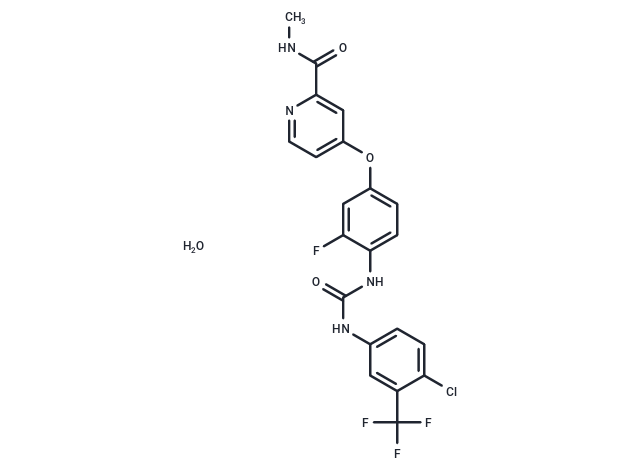
| Pack Size | Price | USA Stock | Global Stock | Quantity |
|---|---|---|---|---|
| 5 mg | $30 | In Stock | In Stock | |
| 10 mg | $41 | In Stock | In Stock | |
| 25 mg | $63 | In Stock | In Stock | |
| 50 mg | $90 | In Stock | In Stock | |
| 100 mg | $143 | In Stock | In Stock | |
| 200 mg | $218 | In Stock | In Stock | |
| 500 mg | $366 | In Stock | In Stock | |
| 1 mL x 10 mM (in DMSO) | $33 | In Stock | In Stock |
| Description | Regorafenib Monohydrate is a novel oral multikinase inhibitor with IC50 values of 13, 4.2, 46, 22, 7, 1.5, 2.5, 28, 19 nM for VEGFR1, murine VEGFR2, murine VEGFR3, PDGFR-β, KIT, RET, RAF-1, B-RAF and B-RAF(V600E) respectively. |
| Targets & IC50 | Tie2:311 ± 46 nM, B-Raf (V600E):19 nM, VEGFR3:46 nM, RET:1.5 nM, c-Kit:7 nM, VEGFR1:13 nM, Raf-1:2.5 nM, VEGFR2:4.2 nM, B-Raf:28 nM, PDGFRβ:22 nM |
| In vitro | Regorafenib potently inhibited a distinct set of kinases, including the angiogenic and stromal RTKs VEGFR1-3, TIE2, FGFR1 and PDGFR-b (IC50s: 4-311 nM), and the oncogenic RTKs KIT and RET, along with the intracellular signaling kinases c-RAF/RAF-1 and BRAF and its V600E mutant (IC50s: 1.5-28 nM). Regorafenib potently inhibited VEGFR2 autophosphorylation in NIH-3T3/VEGFR2 cells (IC50: 3 nM). In HAoSMCs, regorafenib inhibited PDGFR-b autophosphorylation after stimulation with PDGF-BB (IC50: 90 nM) [1]. Regorafenib caused a concentration-dependent decrease in Hep3B cell growth (IC50: 5 μM). PLC/PRF/5 cells were similar in their responses to Hep3B cells, but HepG2 cells were more sensitive (IC50: 1 μM) [2]. |
| In vivo | Treating tumor-bearing rats with a single oral dose of regorafenib at 10 mg/kg caused a significant decrease in tumor perfusion and extravasation of the contrast agent. A significant reduction of the normalized IAUC360 was observed by 10 hr after regorafenib treatment and persisted for up to 2 days when compared with vehicle. Regorafenib dosed qd orally inhibited tumor growth in a dose-dependent manner in multiple xenograft models, including models derived from CRC (Colo-205), BC (MDA-MB-231) and RCC (786-O) tumors. Regorafenib (10–100 mg/kg) effectively inhibited the growth of the Colo-205 xenografts, reaching a TGI of ~75% at day 14 at the 10 mg/kg dose [1]. In murine xenograft models, oral regorafenib, M-2, and M-5 significantly inhibited tumor growth versus controls. Total peak plasma drug concentrations and exposure to M-2 and M-5 in mice after repeated oral dosing with regorafenib 10 mg/kg/day were comparable to those in humans [3]. |
| Kinase Assay | In vitro assays using recombinant VEGFR2 (murine aa785–aa1367), VEGFR3 (murine aa818–aa1363), PDGFR-b (aa561–aa1106), RAF-1 (aa305–aa648) and BRAFV600E (aa409–aa765) kinase domains were performed as previously described. Initial in vitro kinase inhibition profiling was performed at a fixed 1 μM compound concentration under Millipore standard conditions [10 μM adenosine-50’- triphosphate (ATP) concentration]. Inhibitory concentration of 50% (IC50) values were determined from selected responding kinases, e.g., VEGFR1 and RET. TIE2 kinase inhibition was measured with a homogeneous time-resolved fluorescence (HTRF) assay using a recombinant fusion protein of glutathione-S-transferase, the intracellular domain of TIE2 and the peptide biotin-Ahx-EPKDDAYPLYSDFG as substrate. |
| Cell Research | Each cell line was seeded at 0.3×10^5 cells/2ml of DMEM containing 10% FBS in 35 mm tissue culture dishes. The cells were incubated for 24 h to allow attachment, and then the medium was replaced by fresh culture medium containing Regorafenib at increasing concentrations (1 μM, 2.5 μM, 5 μM, 7.5 μM and 10 μM). In these experimental conditions, the cells were allowed to grow for 72 or 96 h.Time-course experiments on Hep3B cells were performed with 7.5 μM of Regorafenib at short (15, 60, 180 min.), middle (24, 48, 72 and 96 h) or long times (up to seven days). When the cells were treated for long times the drug was replaced with a fresh one. Each experiment included a control with the equivalent concentration of DMSO (solvent control) as the one used for adding Regorafenib. Each experiment was performed in triplicate and repeated 3 times. Subsequent analyses were performed at specific Regorafenib concentrations and incubation times [2]. |
| Animal Research | Female athymic NCr nu/nu mice, kept in accordance with Federal guidelines, were subcutaneously inoculated with 5×10^6 Colo-205 or MDAMB-231 cells or implanted with 1 mm^3 786-O tumor fragments. When tumors reached a volume of ~100 mm^3, regorafenib or vehicle control was administered orally qd×21 in the 786-O model, and qd×9 in the Colo-205 and MDA-MB231 models, respectively, at doses of 100, 30, 10, and 3 mg/kg. Paclitaxel was administered intravenously at 10 mg/kg in ethanol/Cremophor ELV/saline (12.5%/12.5%/75%) every 2 days×5. Tumor size (volume) was estimated twice weekly (l×w^2)/2, and the percentage of tumor growth inhibition (TGI) was obtained from terminal tumor weights (1-T/C100). Mice were weighed every other day starting from the first day of treatment. The general health status of the mice was monitored daily [1]. |
| Molecular Weight | 500.83 |
| Formula | C21H17ClF4N4O4 |
| Cas No. | 1019206-88-2 |
| Smiles | O.CNC(=O)c1cc(Oc2ccc(NC(=O)Nc3ccc(Cl)c(c3)C(F)(F)F)c(F)c2)ccn1 |
| Relative Density. | no data available |
| Storage | Powder: -20°C for 3 years | In solvent: -80°C for 1 year Shipping with blue ice/Shipping at ambient temperature. | |||||||||||||||||||||||||||||||||||
| Solubility Information | DMSO: 250 mg/mL (499.17 mM), Sonication is recommended.  | |||||||||||||||||||||||||||||||||||
| In Vivo Formulation | 10% DMSO+40% PEG300+5% Tween 80+45% Saline: 10 mg/mL (19.97 mM), Suspension. 10% DMSO+90% Saline: < 10 mg/mL (19.97 mM), Lower concentrations may be soluble, but exact solubility limit is unknown. Please add the solvents sequentially, clarifying the solution as much as possible before adding the next one. Dissolve by heating and/or sonication if necessary. Working solution is recommended to be prepared and used immediately. The formulation provided above is for reference purposes only. In vivo formulations may vary and should be modified based on specific experimental conditions. | |||||||||||||||||||||||||||||||||||
Solution Preparation Table | ||||||||||||||||||||||||||||||||||||
DMSO
Note : The dilution table applies only to solid products. For liquid products, please calculate the stock solution based on the stated concentration and/or density. | ||||||||||||||||||||||||||||||||||||
 For example, if the intended dosage is 10 mg/kg for animals weighing 20 g , with a dosing volume of 100 μL per animal, and a total of 10 animals are to be administered, using a formulation of
  10% DMSO+ 40% PEG300+ 5% Tween 80+ 45% Saline/PBS/ddH2O , the resulting working solution concentration would be 2 mg/mL.
Dissolve 2 mg of the compound in 100 μL DMSO to obtain a stock solution at a concentration of 20 mg/mL . If the required concentration exceeds the compound's known solubility, please contact us for technical support before proceeding.
1) Add 100 μL of the DMSO stock solution to 400 µL PEG300 and mix thoroughly until the solution becomes clear.
2) Add 50 µL Tween 80 and mix well until fully clarified.
3) Add 450 µL Saline,PBS or ddH2O and mix thoroughly until a homogeneous solution is obtained.
| Size | Quantity | Unit Price | Amount | Operation |
|---|
 Feedback
 Hello! How can I help you today?
Copyright © 2015-2026 TargetMol Chemicals Inc. All Rights Reserved.
