


Shopping Cart
Remove All Your shopping cart is currently empty

Synonyms: R17934, Oncodazole
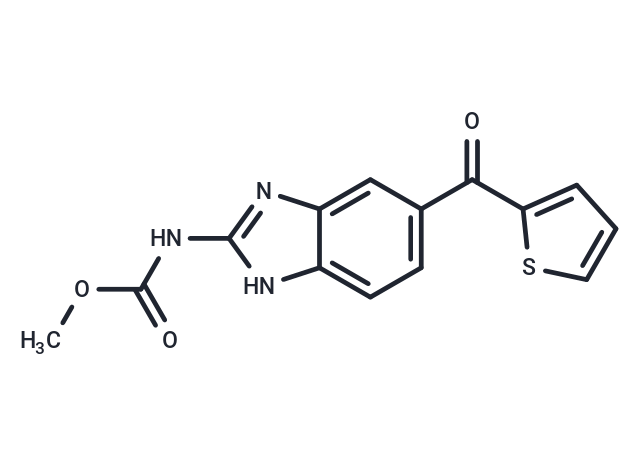

| Pack Size | Price | USA Stock | Global Stock | Quantity |
|---|---|---|---|---|
| 5 mg | $31 | In Stock | In Stock | |
| 10 mg | $50 | In Stock | In Stock | |
| 25 mg | $100 | In Stock | In Stock | |
| 50 mg | $177 | In Stock | In Stock | |
| 100 mg | $297 | In Stock | In Stock | |
| 200 mg | $443 | In Stock | In Stock | |
| 500 mg | $718 | - | In Stock | |
| 1 mL x 10 mM (in DMSO) | $34 | In Stock | In Stock |
| Description | Nocodazole (Oncodazole) is a reversible inhibitor of microtubule polymerization and an inhibitor of Bcr-Abl. Nocodazole has antitumor activity, blocks the cell cycle and induces apoptosis. |
| Targets & IC50 | Abl:0.21 μM, c-Kit:1.6 μM (Kd), Abl (E255K):0.53 μM, MET:1.7 μM (Kd), B-Raf:1.8 μM (Kd), PI3Kγ:1.5 μM (Kd), MEK2:1.6 μM (Kd), MEK1:1.7 μM (Kd), Abl (T315I):0.64 μM, B-Raf (V600E):1.1 μM (Kd) |
| In vitro | METHODS: Erythrocytes were treated with Nocodazole (15-60 µg/mL) for 48 h. Phosphatidylserine was detected using Annexin-V-FITC. RESULTS: Nocodazole treatment increased the percentage of phosphatidylserine exposed to erythrocytes, reaching statistical significance at 30 µg/mL. [1] METHODS: hESCs cells were treated with Nocodazole (100 ng/mL) for 16 h and cell cycle profiles were analyzed using Flow Cytometry. RESULTS: Nocodazole treatment synchronized the cell cycle (>90% of cells in G2/M), while cells remained synchronized after release and moved evenly through the cell cycle for 24 h. At 2 h after removal of Nocodazole, the cells entered the G1 phase, with 70% of the cells in the G1 phase after 4 h, and 80% in the S phase after 12 h. The cells were treated with Nocodazole (100 ng/mL) for 16 h, and the cell cycle was analyzed by Flow Cytometry. [2] |
| In vivo | METHODS: To detect anti-tumor activity in vivo, Nocodazole (12 mg/kg three times a week) and dexamethasone (2 mg/kg twice a week) were injected intraperitoneally for fifteen days into immunodeficient mice bearing myeloma H929. RESULTS: Nocodazole in combination with dexamethasone significantly inhibited myeloma tumor growth and prolonged survival. [3] METHODS: To study the effects on intestinal mucositis, Nocodazole (5 mg/kg) and ketoconazole (50 mg/kg) were administered intraperitoneally three times a week for six weeks to nude mice harboring the human colorectal cancer tumor COLO 205. RESULTS: The antitumor effect of Nocodazole was significantly enhanced after six weeks of ketoconazole treatment. [4] |
| Synonyms | R17934, Oncodazole |
| Cell Research | Nocodazole is dissolved in a final concentration of 0.05% DMSO. Proteins are loaded at 50 μg/lane and separated by 12% (w:v) sodium dodecyl sulfate-polyacrylamide gel electrophoresis, blotted, and probed with antibodies for cyclin E, p53, p21/CIP1, p27/KIP1, glyceraldehyde 3-phosphate dehydrogenase (GAPDH), cyclin A, cyclin D1, cyclin D3, cyclin B, CDK2, CDK4, and cytochrome C. Immunoreactive bands are visualized by incubating with the colorigenic substrates nitroblue tetrazolium and 5-bromo-4-chloro-3-indolyl-phosphate. The expression of GAPDH is used as the control for equal protein loading. |
| Molecular Weight | 301.32 |
| Formula | C14H11N3O3S |
| Cas No. | 31430-18-9 |
| Smiles | COC(=O)Nc1nc2cc(ccc2[nH]1)C(=O)c1cccs1 |
| Relative Density. | 1.49 g/cm3 |
| Storage | Store at low temperature Powder: -20°C for 3 years | In solvent: -80°C for 1 year Shipping with blue ice/Shipping at ambient temperature. | ||||||||||||||||||||||||||||||
| Solubility Information | DMSO: 20 mg/mL (66.37 mM), Sonication is recommended.  | ||||||||||||||||||||||||||||||
| In Vivo Formulation | 10% DMSO+40% PEG300+5% Tween 80+45% Saline: 2 mg/mL (6.64 mM), Sonication is recommended. Please add the solvents sequentially, clarifying the solution as much as possible before adding the next one. Dissolve by heating and/or sonication if necessary. Working solution is recommended to be prepared and used immediately. The formulation provided above is for reference purposes only. In vivo formulations may vary and should be modified based on specific experimental conditions. | ||||||||||||||||||||||||||||||
Solution Preparation Table | |||||||||||||||||||||||||||||||
DMSO
Note : The dilution table applies only to solid products. For liquid products, please calculate the stock solution based on the stated concentration and/or density. | |||||||||||||||||||||||||||||||
 For example, if the intended dosage is 10 mg/kg for animals weighing 20 g , with a dosing volume of 100 μL per animal, and a total of 10 animals are to be administered, using a formulation of
  10% DMSO+ 40% PEG300+ 5% Tween 80+ 45% Saline/PBS/ddH2O , the resulting working solution concentration would be 2 mg/mL.
Dissolve 2 mg of the compound in 100 μL DMSO to obtain a stock solution at a concentration of 20 mg/mL . If the required concentration exceeds the compound's known solubility, please contact us for technical support before proceeding.
1) Add 100 μL of the DMSO stock solution to 400 µL PEG300 and mix thoroughly until the solution becomes clear.
2) Add 50 µL Tween 80 and mix well until fully clarified.
3) Add 450 µL Saline,PBS or ddH2O and mix thoroughly until a homogeneous solution is obtained.
| Size | Quantity | Unit Price | Amount | Operation |
|---|
 Feedback
 Hello! How can I help you today?
Copyright © 2015-2026 TargetMol Chemicals Inc. All Rights Reserved.
